Audition Tips for Kids

Audition Tips for Kids – Interview with Meridee Stein.

Also Read Conrad’s Top Ten Audition Tips for KidsÂ

About Meridee Stein. For nearly two decades, Ms. Stein has produced and directed family entertainment including new works by Charles Strouse, Richard Peaslee, Elizabeth Swados and Stephen Schwartz. Her productions have been performed nationally at such venues as the NYSF/Public Theater, The Kennedy Center, Lincoln Center, The Annenberg Center and The O’Neill Theater Center, and internationally in China, Japan, India, Sri Lanka and the Middle East. Ms. Stein is a member of SSDC, the Dramatists Guild, League of Professional Theatre Women and is a 2004 graduate of the Commercial Theatre Institute.

About Auditions for Children

Carol de Giere: As a director, what would you advise kids who are auditioning, or what are some of the biggest mistakes?

Meridee Stein: One of the biggest mistakes I see a lot is singing out of your range. You need to present yourself in the best possible light. If you have a more limited range, find a song that highlights that range.

Also I would say, 12 year olds should not be singing sultry, very mature adult songs and lyrics, which sometimes they do. It’s very off-putting in a way, because it really doesn’t come from them.

CD: So would they pick songs from musicals where there was a child part?

MS: They could. For example, we had some little boys come in and sing from Oliver, “Where is Love” that shows off their beautiful boy’s soprano. We had a girl come in and sing “Popular” from Wicked. That was fine. She was great. She even had the little Kristin Chenoweth sound. Anything that they can really understand themselves and stays within their vocal range would be fine. Otherwise it’s a little off-putting and they don’t sound as good as they could.

CD: Do children come in with an up tempo and a ballad like adults would?

MS: Yes. In our case [for Captain Louie for the York Theatre production in the spring of 2005] we told them to bring a legitimate theatre tune and a pop tune. So some were ballads and some weren’t but they were two different modes. They get 16 bars but they should prepare the whole song because we will sometimes let kids sing all the way through.

CD: What else do you expect of them going into a show?

MS: …We expect them to be prepared, and when they are out there, that they behave like professionals. They are going to have to balance their school work and their performance schedule.

CD: Do you expect them to act a song when they are auditioning?

MS: I do. The more an actor or actress (kid or not) can get across a character in their song, the more I am interested. Songs in musicals aren’t sung without the context of the show they’re in. I’m looking for people who will do a good job in my show, not for cabaret performers. When I audition, during call backs I run scenes with them. I let them read the scene first and I give them directions to see who can follow. And sometimes I give line readings to see if they can get what it is that we want. The ability to take direction, to change what they are doing based on suggestion, is more important to me in the audition than whether they actually nail the specific character or part.

It’s hard to find kids who can act and sing and dance at the same time. We kind of put the dancing on hold, but you can tell whether kids are stiff or can move. And our choreography tends more to be movement than actual dance. In the end, I’ll take more of a chance on a kid who can sing and needs work on the acting side because you can help people with line readings but you can’t give them a good voice. It’s a matter of balance. And the nature of the particular role, as well.

CD: When they perform at an audition, do they look at the director?

MS: When they are up there, they have a reader and they are working with the reader….[So they are looking at the reader]…

CD: For your professional off-Broadway production, what’s the relation of the number who audition to who gets the part?

MS: I would say there were at least 200 people that auditioned and I think we picked six or seven. That’s a pretty tight ratio. It’s a tough business, and these are young starting out with great talent. Not a whole lot of experience, so I’m going to have to work a lot to get the performances. Some of them have great voices but it’s not just about learning the music, it’s about performing the song in context– about making the musical moment work within the show.

CD: So what does that mean to you – the difference between singing and performing.

MS: All songs are performed when they are on stage. Signing is learning the notes and what you have to sing. But for performing it, there are the lyrics, it’s what it says. It’s the context in which you are performing this number in the show itself. And what it’s supposed to be doing and what you want the audience to feel and what part of the story are you telling when you sing this song, and how does it move us forward from point A to point B, what does it serve, and why is it here? It’s the actor’s job to tell that story of the show through the song. So it’s just as big an acting job as it is when you’re talking to somebody in a scene.

Rocky Horror Show Etiquette

rocky_horror_h.gif

“Rocky Horror” Etiquette
The difference between a true RHPS fan and someone just out for a rowdy time can be seen in their manners and etiquette. Here are some guidelines that should be deemed necessary by anyone looking to perpetuate our experiences of absolute pleasure.

* Please note, this is an “interactive” show – the audience will throw “props” (see below for full description) in the theater as part of the audience participation. The throwing of rice, toilet paper, water, etc. is part of the fun. It is not meant to harm people or cause any damage to the theater.
* Never make fun of someone for “dressing up” – especially if their costume or make-up is not exact. The point is that their heart is in it and this might discourage them or others from ever returning in costume and that’s what this cult’s all about, isn’t it?
* If you portray a certain character, don’t get angry or jealous if someone else comes dressed as that character. Remember that the movie and its characters are not your exclusive property. When you think about it, any resentment is hypocritical to your own “dressing up.”
* Respect the wishes of the theater and its management. Vandalism and the breaking of rules might not only lead to your ejection, but to the closing of the film. This would only be spoiling it for everyone.
* When there are visitors from other theaters or areas, don’t try to “shout them down.” Respect the fact that they might yell different “lines.” Why, you might even find some new ones more preferable to your own.
* Calling Brad an “a**hole” and “neck lines” to the criminologist are funny in their proper place, but should not be yelled every time you see these characters’ faces. It does get boring and monotonous.

Basic List of Props and Instructions

1) Rice – At the beginning of the film is the wedding of Ralph Hapschatt and Betty Munroe. As the newlyweds exit the church, you should throw the rice along with the on-screen wedding guests.

2) Newspapers – When Brad and Janet are caught in the storm, Janet covers her head with a newspaper, “The Plain Dealer.” At this point, you should likewise cover your head.

3) Water pistols – These are used by members of the audience to simulate the rainstorm that Brad and Janet are caught in. (Now do you see why you should use the newspapers?)

4) Rubber gloves – During and after the creation speech, Frank snaps his rubber gloves three times. Later, Magenta pulls these gloves off his hands. You should snap your gloves in sync each time to create a fantastic sound effect.

5) Noisemakers – At the end of the creation speech, the Transylvanians respond with applause and noisemakers. You should do the same.

6) Confetti – At the end of the “Charles Atlas Song” reprise, the Transylvanians throw confetti as Rocky and Frank head toward the bedroom. You should do the same.

7) Toilet paper – When Dr. Scott enters the lab, Brad cries out “Great Scott!” At this point, you should hurl rolls of toilet paper into the air. (Preferably Scotts brand.)

8.) Toast – When Frank proposes a toast at dinner, members of the audience throw toast into the air. (Preferably unbuttered – things could get sticky.)

9) Party hat – At the diner table, when Frank puts on a party hat, you should do the same.

10) Bell – During the song “Planet Schmanet,” ring the bell when Frank sings “Did you hear a bell ring?”

11) Cards – During the song “I’m Going Home” Frank sings “Cards for sorrow, cards for pain.” At this point you should shower the theater with cards.

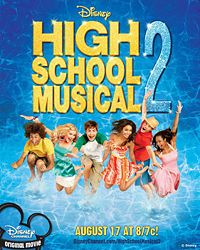
High School Musical Two – HSM 2

 hsm2poster.jpg

High School Musical 2 is the sequel to the Emmy Award winning Disney Channel Original Movie, High School Musical. High School Musical 2 is set to debut on Disney Channel on August 17, 2007. It is the first DCOM to have commercials on ABC.

PLOT

Over summer vacation, the East High Wildcats are ready to enjoy their vacation and earn some money at summer jobs. Troy Bolton (Zac Efron) lands a job at the country club, Lava Springs, not knowing that his job is a part of Sharpay Evans’s (Ashley Tisdale) plan to steal him from Gabriella Montez (Vanessa Hudgens). Accidentally foiling Sharpay’s plot, Troy not only helps Gabriella get a job as a lifeguard, but also lands jobs for Chad (Corbin Bleu), Taylor (Monique Coleman), Zeke (Chris Warren Jr), Martha (Kaycee Stroh), Kelsi (Olesya Rulin), Jason (Ryne Sanborn) and the rest of his Wildcat teammates.

Making it worse, Sharpay finds out Kelsi has written a duet for Troy and Gabriella that’s sure to outperform everyone at the club’s annual Midsummer Night’s Talent Show. Reminded of her humiliation in winter musical, Sharpay is determined not to suffer a repeat and forms her own campaign to make sure she’s not upstaged again. As they go head to head, Troy is enjoying the life of the privileged set, and begins to question his values. [1]

CAST

* Zac Efron as Troy Bolton
* Vanessa Hudgens as Gabriella Montez
* Ashley Tisdale as Sharpay Evans
* Lucas Grabeel as Ryan Evans
* Corbin Bleu as Chad Danforth
* Monique Coleman as Taylor McKessie
* Olesya Rulin as Kelsi Nielsen
* Chris Warren Jr. as Zeke Baylor
* Kaycee Stroh as Martha Cox
* Ryne Sanborn as Jason Cross
* Bart Johnson as Jack Bolton

Daddy’s Gonna Eat Your Fingers

Sent to me from my Canadian secret agent who is constantly on the look out for the official “Worst Joke In The World” – Actually, I think this one is pretty good:

As I was packing for my business trip, my 3-year old daughter was having a wonderful
time playing on the bed.

At one point, she said, “Daddy, look at this,” and stuck out two of her fingers.

Trying to keep her entertained, I reached out and stuck her tiny fingers in my mouth,
and said, “Daddy’s gonna eat your fingers!”, pretending to eat them before I rushed
out of the room again.

When I returned, my daughter was standing on the bed staring at her fingers with a
devastated look on her face.

I said, “What’s wrong, honey?”

She replied, “What happened to my booger?”

The Whys of Life

Why, Why, Why

Why do we press harder on a remote control when we know the batteries are getting weak?

Why do banks charge a fee on “insufficient funds” when they know there is not enough?

Why does someone believe you when you say there are four billion stars, but check when you say the paint is wet?

Why doesn’t glue stick to the bottle?

Why do they use sterilized needles for death by lethal injection?

Why doesn’t Tarzan have a beard?

Why does Superman stop bullets with his chest, but ducks when you throw a revolver at him?

Why do Kamikaze pilots wear helmets?

Whose idea was it to put an “S” in the word “lisp”?

If people evolved from apes, why are there still apes?

Why is it that no matter what color bubble bath you use the bubbles are always white?

Is there ever a day that mattresses are not on sale?

Why do people constantly return to the refrigerator with hopes that something new to eat will have materialized?

Why do people keep running over a string a dozen times with their vacuum cleaner, then reach down, pick it up, examine it, then put it down to give the vacuum one more chance?

Why is it that no plastic bag will open from the end on your first try?

How do those dead bugs get into those enclosed light fixtures?

When we are in the supermarket and someone rams our ankle with a shopping cart then apologizes for doing so, why do we say, “It’s all right?” Well, it isn’t all right, so why don’t we say, “That hurt, you stupid idiot?”

Why is it that whenever you attempt to catch something that’s falling off the table you always manage to knock something else over?

In winter why do we try to keep the house as warm as it was in summer when we complained about the heat?

How come you never hear father-in-law jokes?

And my FAVORITE……
The statistics on sanity are that one out of every four persons is suffering from some sort of mental illness. Think of your three best friends — if they’re okay, then it’s you.

Star Wars is on XP Systems

So you might already know this, but Star Wars Episode IV is implemented in Windows XP, and possibly other Operating Systems, but I haven’t tried on any other.

Anyway just go to Start> Run > and then write:
telnet towel.blinkenlights.nl

Watch Away!

🙂

FYI – No, it’s not a trick. No, it’s not going to shut your computer down. It will actually play Star Wars rendered entirely in text graphics.

Code to Call Forum List Includes

Copy and paste this code into notepad or text editor, then re-copy into code. If you just copy off this page it won’t work. phpbb forum list include.

*Update 01/08 – only use second line between question marks and accompanying arrow markers. Then if needed designate as code in post interface. Turn off rich text editor in use profile. Retype code from scratch if necessary. Works. Instead of sticky, set post as announcement.*

<phpcode><code><br />
<?php include(“http://www.websiteurl.com/forum_list_include.php”); ?></code></phpcode>

<phpcode><code><br />
<?php include(“http://www.websitename.com/forum_list_include.php”); ?></code></phpcode>

Baby Fae – The Unlearned Lesson of Evolution

Perspectives On Medical Research
Volume 2, 1990

Baby Fae: The Unlearned Lesson

Kenneth P. Stoller, MD.

On October 26, 1984, Dr. Leonard L Bailey placed the heart of a baboon into the chest of Baby Fae, an infant born with a severe heart defect known as left hypoplastic heart. Baby Fae seemed to do well for a few days; then her body mounted a massive immunological attack on the foreign tissue and rejected the graft. Baby Fae’s death came as no surprise to scientists and physicians familiar with the human immune system and with the scientific realities that preclude successful cross-species transplants.

Before the Baby Fae incident, Bailey, a surgeon at Loma Linda University Medical Center, spent almost a decade vainly pursuing research grants. His work in xenografts, largely unknown and unrcviewed by other professionals, had not appeared in journals and was funded by Bailey himself and his colleagues.1,2 During the seven years preceding the Baby Fae baboon transplant, he performed some 160 cross-species transplants, mostly on sheep and goats, none of whom survived more than 6 months. Although warned by a colleague at a medical conference that his research was too incomplete to risk using human subjects,3 Bailey went ahead.

Baby Fae was not the first human to receive a primate xenograft. In a review of xenografts,4 the Council of Scientific Affairs of the American Medical Association noted a rapid rejection of all baboon transplants to humans. Nevertheless, Bailey claimed that the problems of rejection could be overcome by the “immature” state of an infant’s immune system. After the operation, immunologists from around the world pointed out that the part of the immune system that rejects unmatched transplants is fully mature at birth, Furthermore, there is no way to match baboon hearts to human recipients, because baboons have no antigens in common with human tissue.5 Bailey has always maintained that Baby Fae’s death was unrelated to the species of the organ “donor.” An editorial in the Journal of the American Medical Association called Bailey’s claim “wishful thinking.”5

Bailey’s use of baboons was somewhat surprising, given their relatively distant evolutionary relationship to humans compared to other primates. The reason came to light when the Times of London published an interview between Bailey and an Australian radio crew. The reporters had been forbidden to ask direct questions about the operation, so they queried Bailey on the issue of why he had chosen a baboon in view of the baboon’s evolutionary distance from humans. Bailey replied, “Er, I find that difficult to answer. You see, I don’t believe in evolution.”6 It is shocking that Bailey ignored basic biological concepts in formulating a life-threatening human experiment.

Often, ambitious surgeons wish to perform new, perhaps dangerous, experimental operations. In an effort to safeguard patients, institutional review boards must first give permission for any human experiment. In an unconscionable lapse of ethics, the review board of Loma Linda Medical Center failed to live up to its obligations — they gave Bailey permission for five baboon-to-human transplant experiments, having no reports documenting that even heart allotransplantation in infancy is successful.5 Furthermore, highly experimental procedures on children, such as a xenograft, require special permission from the Secretary of Health and Human Services.7

In addition to these institutional and federal safeguards that should have protected Baby Fae, California’s Protection of Human Subjects in Medical Experimentation Act (PHSMEA) requires that if informed consent is given in behalf of another person, the experimental procedure must meet certain criteria. California’s Health and Safety Code ~24175, subsection (e) states, “Informed consent given by a person other than the human subject shall only be for medical experiments related to maintaining or improving the health of the human subject or related to obtaining information about a pathological condition of the human subject.”

Because Bailey did not look for a human heart donor and did not refer Baby Fae elsewhere for attempted surgical repair, the highly experimental transplant was both unethical and unlawful. Dr. William Norwood at the Children’s Hospital in Boston has been repairing left hypoplastic hearts since 1979. The survival rate of the Norwood procedure is now as high as 75 percent Nevertheless, Baby Fae’s consent form read, “Temporizing operation to extend the lives of babies like yours by a few months have generally been unsuccessful. We believe heart transplantation may offer hope of life for your baby. Laboratory research at Loma Linda University over the past seven years, including over 150 heart transplants in newborn animals, suggest that long term survival with appropriate growth and development may be possible following heart transplantation during the first week of life.”

Following considerable controversy over the Baby Fae transplant, the National Institutes of Health (NIH) appointed a special committee charged with reviewing the procedures used by the university to assure that Baby Fae’s relatives gave proper informed consent. The committee did not deal with the scientific basis for transplanting a baboon heart into a human. The committee found several weaknesses in the consent procedure. Specifically, the committee concluded that possibility of “long term survival” had been overstated and the protocol did not include searching for or transplanting a human heart. The committee’s report did not address why Loma Linda had not sought permission for this unprecedented experiment from the Secretary of Health and Human Services. Furthermore, it did not address the California law that should have prevented the experiment. (Perhaps the NIH committee was unaware of PHSMEA.)

Why hasn’t Bailey been prosecuted? The San Bernandino District Attorney’s office has officially stated that there are insufficient facts to support a felony prosecution. Unofficially, I was told that the highly technical nature of the case would likely overwhelm the court with conflicting medical opinions and therefore make a conviction unlikely. Furthermore, Bailey is considered a local hero. The office of the California State Attorney General, John K. Van de Kamp, has also maintained that Sufficient facts are available to establish that a crime occurred.

The facts, however, suggest that Baby Fae was sacrificed to Leonard Bailey’s career. Given the state of current medical knowledge, there was no doubt that Baby Fae would reject the baboon heart. Rules and laws designed to protect her were violated by those entrusted to uphold them. Professional ethics were considered to be of less importance than widespread publicity. The institutional review boards and law enforcement agencies responsible for protecting human subjects have virtually no accountability to the public, much less to the experimental subjects themselves.

References

1. Anon: Next please. PCRM Update, July-August, 1985.

2. Roe BR, Glaser RH: The lessons of the Baby Fae Case (letter). The Wall Street Journal Dec 24, 1984.

3. Mathews J: Colleague warned doctor before Baby Fae implant. Washington Post, 1984.

4. American Medical Association Council on Scientific Affairs: Xenografts: Review of the literature and curreut status. JAMA l985;254:3353-3357,

5. Jonasson O, Hardy MA: The case of Baby Fae (letter). JAMA 1985;254:3358-3359.

6. Gould SJ: The heart of erminology What has an abstruse debate over evolutionary logic got to do with Baby Fat? Natural History 1988;97:24.

7. Department of Health and Human Services: Final regulations amending basic HIHS policy for the protection of human research subject. Federal Register 1981;465:8366-8392.