The Music Technology of Dralion
by Lachlan Westfall
(from the Roland User’s Group magazine)
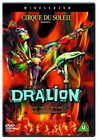 The icon is a Dragon-Lion: a physical representation of East-meets-West. Also present are the elements of air, water, fire and earth. As we approach the new century, Canada’s Cirque du Soleil has chosen these basic yet powerful themes for their latest show, Dralion. It is a show that breaks from tradition to form a new one—a show that should take them spectacularly into the new millennium.
If you’ve seen any of the now-numerous Cirque du Soleil shows, you’re well aware that these modern-day circuses offer an engaging display of color, lights, acrobatics and in no small part, music. It’s the music, in fact, that has always served to set the mood and theme of each Cirque show. For this reason, Roland began working with Cirque when their show Alegria was on its North American tour in 1994, helping Cirque’s musicians design a system of instruments that enables them to perform the intricate music behind each incredible show. In fact, the music, musicians and the gear they use to create the soundscape is usually a story in itself.
There are seven different Cirque du Soleil shows currently playing across the globe, and each production is dramatically different. Dralion—with a cast including a 35-member Chinese acrobatic troop, a menacing wall of spikes and chain-mail, and an enormous metal “sun” that ascends and descends from 30 feet above the stage—is no exception. As you might expect, Roland Users Group is always excited about meeting with Cirque’s newest crop of musicians to talk about the new and unique things they’ve come up with using Roland gear for the latest shows. Much like Cirque’s choreographers and costume designers, these musicians are continually pushing their artistic limits.
As Dralion was in residence under the familiar blue and yellow tent in Toronto—just weeks away from its U.S. debut in Santa Monica, Calif.—Roland Users Group dropped in to see the show and talk with the two men behind the music of Dralion, bandleader/keyboardist Richard Oberacker and keyboardist Stephen Poulin. This was Stephen’s third stint with Cirque du Soleil, but for Richard, Dralion was his first outing—a “Nouvelle Experience,” to borrow from the title of a previous Cirque show. Thankfully, Richard had already learned that performing and conducting a Cirque show is by far the most difficult thing he’d ever fall in love with.
“It’s pretty crazy actually,” says Richard. “It’s the hardest thing I’ve ever done… and I’ve done Broadway and national tours. That was my whole world: professional musical theater. So this was a huge change… huge!”
Richard, in a sense, inherited a system of instruments that had been refined by keyboardist/conductor/musical director Claude Chaput—the man behind the keys for the two previous touring shows, Alegria and Quidam (see Roland Users Group issues 12/2 and 16/1, respectively). Although the composer, musicians, instrumentation and style are all completely new for Dralion, the method of producing the music, which relies heavily on Roland’s XP-80 Music Workstation and its Realtime Phrase Sequencing (RPS), remains the same, having been perfected by Claude over many years. In fact, it has become virtually the only way to perform this intricate music, which is designed to coincide with performers’ exact movements on stage in front of the musicians.
“I can’t imagine a show like Dralion being performed on anything but this Roland gear,” explains Richard. “The way the music for this and other Cirque shows has evolved necessitates the use of equipment with this amount of power. Coming here and learning this system was an enormous challenge. But once I learned it, I realized it was incredibly easy to understand. The RPS feature is absolutely crucial for Dralion.”
Richard continues, “The only reason I know how to do this is because of Claude Chaput. I had never dealt with anything this complex before. Claude designed the system for us here and then together we programmed the RPS sequences… For me, in the beginning there was darkness and God said ‘Let there be Claude!’ [laughs] In the New York pits, where I came from, you’re just given everything, and you don’t need to know much about it. I came to Claude as a blank slate… He knows so much about this type of system that he should work for Roland.”
With Richard’s background in theater, you’d think that performing for Cirque would be a natural. And while there are obvious similarities, there are some distinct differences with respect to the type of gear used and the interaction between the musician and the equipment. Richard explains, “Playing with Cirque is very different. In New York, everything is very compartmentalized. You have career programmers; they don’t play pits, they don’t conduct, they don’t write—they program. They deal with companies like Roland and others and design systems so that we don’t have to think about them. In a Broadway pit, we get the gear and it’s always designed to do what we need it to do in the moment—nothing else. For the player, it’s designed to come as close as possible to playing a single piano. The hardest thing I had to deal with in Broadway pits was changing a Patch.” With Cirque, the easiest thing Richard has to deal with is changing a Patch.
For the uninitiated, suffice to say the most basic tenet of Cirque du Soleil is to break the mold. Their first show outside of Canada was in fact titled “We Reinvent the Circus.” For Cirque, everything is constantly evolving. This not only includes the acts, but the music and sounds as well. “This job demands a constant evolution,” remarks Richard. “You can never just sit back and ‘push paper’ so to speak. And that goes for any department. The Cirque is a constantly evolving thing.” Richard’s first exposure to this concept was when he sat down with Claude to begin work on the music for Dralion.
“Claude was such a great teacher for me,” continues Richard, “because he’d never just do something and move on. He’d make sure that I went through the process. That’s how he taught me the architecture of these keyboards, from top to bottom. At first it was quite daunting; there’s no getting around that the XP-80 is a sophisticated piece. But once you understand its concept and you can visualize it—almost like a building where you map out which elevator takes you to which floor—it becomes a breeze.”
Their first job together was to take composer Violaine Corradi’s dramatic and striking score, incorporate it into the system and determine just how it would work with the variety of acts. “Claude and I would sit in the studio and watch video tape of the acts as they were being developed. He’d look at me and ask ‘Okay, what goes where? They’re flipping here, what part of this music goes with that?’ So I’d say, ‘Well, I think these two bars would go great with that,’ and he’d say ‘Great.’”
Then Claude and Richard would take the sequences they’d programmed and modify them for the final performance. Richard continues, “We’d go into Track Edit on the XP-80’s sequencer, grab the two bars and make an RPS [Realtime Phrase Sequence] of them. If we felt we might need some extra time, we’d repeat it a couple of times. Next, we’d have to map everything across the keyboard, which took some artistry in and of itself. Claude was a genius in all those areas—not only in creating this system, but also in how he taught me to use it. He put me in a position of sink or swim and taught me how to make these instruments work exclusively for what we are doing. I’m very familiar with the Kurzweil® system, but I’ve never seen anything like what these XP-80’s can do.”
The System
As with most Cirque shows, there’s a sizable ensemble of musicians for Dralion. The group consists of Richard and Stephen on keys, Mario Venditti on V-drums, François Guay on violin/cello, Claire Tremblay on winds, Christian Sylvestre on guitar and JoAnn Blondin on percussion. The combination of the powerful Roland keyboard system and the variety of musicians gives this ensemble incredible flexibility for performing Corradi’s intricate music. The score for Dralion, in keeping with its theme, draws from many different styles of music from all over the world. There’s a decidedly Asian slant, but there’s also a purely African number, some very European orchestral pieces and a good amount of percussive world-beat styles. This obviously puts quite a demand on the players—each and every one of them.
As the second keyboard player, Stephen is now no less involved in developing the show than Richard. “I’m always trying to improve the sounds as we progress with the show,” says Stephen. “When we first started out, there was very little layering on the sounds. Now I’m constantly adding layers and modifying the sounds. And since I do a lot of the bass sounds, many of the sounds you hear are sounds I’ve developed or modified as we’ve been playing.”
With Stephen’s experience in a variety of Cirque shows, he’s quick to note the new challenges in performing the Dralion score. “In this band, and specifically for this show, we have to be extremely versatile. And that’s why Roland’s expansion cards are so helpful. We have Asia, World and Vocal [wave expansion boards] installed in all three of our XP-80’s.”
While Stephen is free to play the more “out” styles and work on new sounds, Richard is back at Keys 1 controlling all the RPS sequences and conducting the band.
“My top XP-80 is basically the brain of this system,” explains Richard. “It’s MIDI’d to the other gear, but we only use that for program changes. We don’t trigger sounds on one XP-80 from the other; we use it to change the sounds on the lower XP-80, the three S-760’s and my programmable mixer. It also sends the click [via MIDI sync] to the other instruments. Of course, it also holds the RPS sequences.
“The dynamics of the show necessitate that I sequence on one keyboard while I’m changing programs on the other. This way, I can load sequences for the next tune while I’m playing the current tune. Actually, aside from the XP-80, I never even play the keys except to trigger RPS sequences. In fact, the mapping on the upper keyboard is so complex with all the RPS sequences that it would be impossible for me to play on it.
“One thing I’ve noticed about using this type of system is that the way you map your RPS sequences is very important. I set up pictures and patterns that I can remember. With a show such as this, you have to be able to trigger an RPS phrase associated with a specific act at a moment’s notice. Actually, it’s even more specific. We’ll have RPS’s associated with specific parts of an act or even a specific jump. So I end up associating a [certain] jump with an F-sharp, for example.
“As far as content, most of the RPS’s are made up of loops, but we often have whole patterns associated with a specific event—all triggered by a single RPS key. An excellent example of how we use this is in the ‘Double Trapeze’ [a breathtaking performance by two pair of Chinese acrobats]. When the girl is flying near the end, we’re in a musical holding pattern where the band’s playing without a click. Then I’ll count ‘Two, Three, And…’ and I’ll trigger the RPS sequence on the downbeat when the acrobats are into their next move. I have three RPS’s for that part but last night, for example, they needed four to complete that part of the act. With this system, it’s easy to be that flexible—and remember, you’re being flexible with complete pieces of orchestral music. That’s what’s so amazing. Yeah, there’s a lot of keyboards that sequence, but being able to attach a key to it, a click to it and to be able to get in and out so fast, that’s what’s so unique about this Roland [RPS] system, and what makes it work so well for us.”
In fact, the power of this system has influenced the way the music has developed since the show debuted earlier this year. “A lot of what [composer] Violaine Corradi gave us when we received the first demos was very percussive, featuring koto and world beat percussion sounds,” reveals Richard. “It was acoustic in theory and design, but not very orchestral. When we were working on it, we realized that we were not taking full advantage of these glorious string sounds we had in the S-760’s, and we went back to her and suggested going after a very legitimate orchestral string sound. So now we’re in the process of re-writing the initial overture to the show. In doing so, we’re trying to move the show to an even more orchestral place by introducing French horn and other brass sounds.”
The electronic orchestral sounds, when combined with the live string and wind instruments, give the music of Dralion an incredible depth. “We have some beautiful oboe lines in the score,” offers Stephen. “By mixing them in with the sounds from the XP-80 and S-760’s, we can get some very convincing orchestral sounds.”
Of course, this meant beefing up their supply of S-760’s. “There’s a funny story about those,” offers Richard. “Years ago, I had actually bought an S-760 for a project of mine. At the time I was very rushed, so I walked into a music store and said, ‘I want the best sampler you have,’ and they said ‘Well, here,’ and handed me the S-760. I took it home, quickly learned how to load one sound at a time, did the recording and put it in my closet. I mean, I maybe learned 1-percent of what that instrument could do. Then I went off on another national tour and forgot about it. Fast forward to the present, and I’m sitting with Claude and he says, ‘We really need just one more S-760.’ So I phoned my sublet in New York and said, ‘Could you go in the closet, dig around and find a box, and tell me what the number is on it?’”
And as if this arsenal of Roland keyboards and samplers wasn’t enough, there’s also pair of VG-8 V-Guitar Systems at the feet of the guitarist. “What Christian does now is mainly guitar-sounding things,” continues Stephen. “For example, in Dralion we have a walking electric bass line—that’s being done by Christian with the VG-8. However, with a pair of VG-8’s, there’s a lot more he can do as the show develops. Remember, we’re doing this show for three years. Over that time, we’ll certainly incorporate more of what the VG-8 can do.”
The Performance
Of course, the complexity, intricacy and power of this very unique music system is an intriguing story—especially to readers of this magazine. But any instrument, no matter how complex, is ultimately at the control of the musician. Unlike a concert, Cirque’s musicians are not only interacting with each other, but with the performers on stage in front of them. So not only is Richard playing, triggering RPS sequences and conducting the band, but he also has a keen eye on each and every acrobat—whether they’re coming up through the stage in a cloud of smoke or descending on a giant spinning wheel.
And Richard’s not simply checking where they happen to be on stage at any one point. “I’m watching specific muscle movements and breathing,” he notes, laughing. “Claude and I made a conscious decision at the beginning of the process to adjust this music in any way we needed to get accents as close as possible to what the performers were doing—so that when someone passed through a hoop, or when someone left the ground, that was exactly when the music would happen. I’ve seen many Cirque shows in the past and they’ve all had some amazing musical moments. But in past music there have not been nearly as many hits and accents. Dralion is loaded with that stuff.”
Richard goes so far as to want to know precisely what the performer is thinking and planning before the jump or flip takes place. He explains, “When we go to set something up, or we change or add something, I want to know not only what is happening physically on stage, but what the artist is thinking. Of course, this is often through translators [Cirque attracts the top artists from around the globe], and it drives them up a wall because they’re not used to the musicians being this involved.
“For me, it’s a matter of thinking like they think,” Richard continues. “For example, if there’s three [performers standing] on a tier, I have to know how and when they’re going to jump down. I now know that it’s actually the girl in the middle of the tower who does the decision making. I know that she waits until the other girl is on the top of her shoulder. She feels it, counts three and then calls for the dismount. Now that’s a very different approach to timing a cue than simply waiting for someone to jump down. By then, it’s too late.”
Beyond that, the real power of this system and the talent of the musicians becomes apparent when the lights go down, the performers take the stage, the music starts and… something doesn’t go quite right.
“There’s one acrobat in the show who sometimes gives us nightmares,” laughs Richard, eliciting a knowing grin from Stephen. “The timing [of his act] had been one way for about a month and then he decided to change it without talking to us. And what I’m talking about is his breath—the way he breathes before the roll,” explains Richard. “I look at this, anticipate his move and begin the count for the rest of the band… ‘Roll, Two, Three, And…’ and then we begin a two-bar cue. I’m actually watching his breath. At that point, I know I have two bars to get into it—it’s that specific. So then he starts changing it! It took me about two shows to figure out what his new timing was—much longer, more dramatic. We had that for about a month and then on the last show I look up and he’s rolling without any prep at all. So I had to go right into the hit without any count. And the orchestra got it perfectly because they’re watching just like I am.”
Richard continues, “All the musicians in this band have to be just as familiar with the show as I am because if I call a cue, I can’t sit there and explain ‘Well guys, he just missed a jump and we have to go back, etc.’ I have to call a cue or a hold and we need to be on it immediately.”
The Road
Dralion will be Richard and Stephen’s full-time career until at least 2001, by which time they will have played to audiences in 17 cities across Canada and the United States. Both are looking forward to the adventure. “Running off and joining the Cirque is a very exciting thing for us,” confesses Richard, “especially for me coming from commercial theater. You see a show like Cats in New York, in L.A., in Germany—it’s exactly the same show. It’s the same show because it’s ‘product.’ Dralion, and other Cirque shows, are not. You see, there’s only one company of Dralion—we’re unique. I don’t have a replacement. Stephen does not have a replacement. Most of the artists don’t have replacements. If they’re down, they’re down.” Richard continues, “As I said, Dralion is a work-in-progress. We started in Montreal and then Toronto, but the show when it hits Los Angeles will be quite different, and it will continue to grow from there.”
Fortunately, Dralion is just beginning its nearly three-year journey across North America. This means RUG readers should have an excellent opportunity to see it. However, get your tickets sooner rather than later; for years, Cirque shows have recorded attendance levels in the high 90-percentile.
Of course, while Dralion is trekking across America, you should note that there are a number of other Cirque productions going on around the world. Quidam is currently touring Europe and Saltimbanco is playing to audiences across Asia. In addition to the touring shows, Cirque du Soleil has four shows now in permanent residence: Both O and Mystére are in Las Vegas, Nevada; La Nouba can be seen at the Walt Disney World Resort near Orlando, Florida; and the wonderful Alegria, the first Cirque show this writer had seen, has just recently settled down at the Beau Rivage in Biloxi, Mississippi. Hmmm… you don’t always get an opportunity to see a Cirque show a second time. I think a trip down to the Mississippi Delta may just be in order. Well, that’s after I see Dralion again when is comes to Santa Monica… and then there’s that trip to Vegas.
Lachlan Westfall is editor of Roland Users Group magazine. He lives in Woodland Hills, California with his wife and daughter.