If he brings you happiness
Then i wish you all the best
It’s your happiness that matters most of all
But if he ever breaks your heart
If the teardrops ever start
I’ll be there before the next teardrop falls
Si te quire de verdad
Y te da felicidad
Te deseo lo mas bueno pa’los dos
Pero si te hace llorar
A mime puedes hablar
Y estare contigo cuando treste estas
I’ll be there anytime
You need me by your side
To drive away every teardrop that you cried
And if he ever leaves you blue
Just remember, I love you
And I’ll be there before the next teardrop falls
And I’ll be there before the next teardrop falls
Cast members from Seussical (META Performing Arts) and AIDA (Theater Arts Guild) will be performing at this benefit.
. Rick Epting Info
Friends of the late Rick Epting have gathered to continue his legacy of supporting the Arts in Skagit County with this lively showcase of local talent and humor. The evening features a reunion concert by Rick’s former bandmates in the Future Pastures Band, along with special performances by META Performing Arts and the Theatre Arts Guild, and appearances by vocalist Lynette McKormick, storyteller Teresa Vaughn, Don Wick, and others.
All proceeds go to select Skagit County arts organizations in memory of Rick Epting, one of the founding members of the Lincoln Theatre Center Foundation and the Skagit Performing Arts Council (SPAC). Rick was instrumental in the restoration campaign for the Lincoln Theatre and the planning for the new McIntyre Hall.
Act One
Future Pastures Band
“No Shoes, No Shirt, No Service”
Elfa Gisla, MC
META PERFORMING ARTS
with Conrad Askland on piano
“Alone in the Universe”
“How to Raise a Child”
“Amazing Mayzie”
VOCALIST LYNETTE McCORMACK
“La Vie En Rose”
with Einar Tapo on accordion
“It’s Only a Paper Moon”
with Conrad Askland on piano
THEATER ARTS GUILD
Leisha Skinner/Brett Madden perform “Elaborate Lives” from AIDA
MARTHA McDADE
“Broadway Baby”
Don Wick – MC
VOCALIST MIA VERMILLION-HARRISON
“Embrace Me” and “Joy”
STORYTELLER TERESA VAUGHN
“Cinderella”
THE HOLMES SHEA BAND
“Red Rooster:
“Look My Way”
“The Karma Tune”
“Banging On The Door”
ACT TWO
BRIAN YOUNG
Saving Lincoln Theatre
LESLA EPTING and JOE JOHNSON
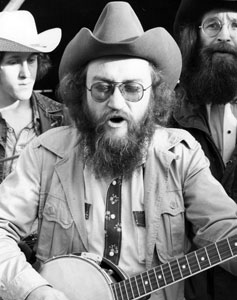
FUTURE PASTURES BAND and CHARLIE GEARHEART
PERFORMERS
Steve Stolpe – Mandolin/Guitar
Mark Gowan – Bass
Matt McClure – Drums
Mark Warren – Guitar
Charlie Gearheart – Guitar/Vocals
from Goose Creek Symphony
Jon Parry – Fiddle
Jim Davis – Guitar
Deanne Savage – Vocals
Don Mailloux – Vocals
HOLMES SHEA BAND
John Holmes – Guitar/Vocal
Jamie Shea – Keyboard/Vocal
Mark Gowan – Bass
Michael O’Neil – Drums/Vocal
Oscar De La Rosa – Percussion/Vocal
John Anderson – Sax/Flute
META PERFORMING ARTS
Bianca Campbell
Matt Olsen
Ashley Henning
Ireland Woods
Zoey Kypuros
Mary Witt
Lynette Cole
Corinn Holberg
Savanna Woods
Mckenzie Willis
LIGTHING
Bruce Vilders
Carole Lindberry
Shari Lindberry
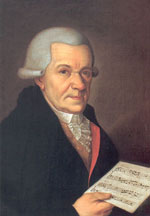
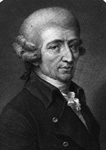
I’ve been working with our church choir on “Sing a New Song” by Michael Haydn. It was part of the church music library and threw me a little off guard. The name was Michael Haydn, but the sound was semi-baroque – but more contemporary sounding than JS Bach. It reminded me more of the sound of Bach’s sons like CPE Bach. To my ears a kind of “baroque light” sound.
This may seem like a small incident to you, but to me it was a big red flag. Have my ears deceived me, do I not understand Baroque music like I thought I did? It was a little too contemporary to be Baroque, and a little too Baroque to be contemporary. I had assumed Michael Haydn was a contemporary composer writing in Baroque style, but couldn’t get over how authentic some parts sounded.
So the hunt begins – Yes, the music WAS written in the 18th century, but who in the heck is Michael Haydn. Well, I’m showing a lapse in my music knowledge when I admit that I did not know Franz Joseph Haydn had a brother who was also a composer: Michael Haydn.
The happy ending to all this is I can rest easy my ears are still true. YES, it is music with a Baroque feel but not technically of the Baroque period (which ended in 1750), and YES it is authentic classical music – not a neo-classical re-creation. I don’t know more of his music to tell you if it’s representative of his style – but on this particular piece if I put down the composer as CPE Bach, I would be surprised if most would know the difference on hearing the piece for the first time.
So the next interesting question is – Like Salieri may have been the great remembered composer if Mozart had not lived; Would Michael have been the great remembered composer if Franz Joseph had not lived….or did Franz Joseph’s music help preserve the longevity of brother Michael’s compositions?
If you have the answer, I’d love for you to post it here.
And of course the interesting comment that history has on all this. Bach’s sons music was considered “modern” in the 18th century, and JS Bach’s music sounded old fashioned to ears at that time. They called JS the “old Bach”. But to our ears today, JS Bach’s music is the one that usually moves us most, is most “authentic” – and his sons music is….well….a little more like a jingle. His sons music lacks the depth of the old master. I would guess that Michael Haydn’s music was very successful in his day, like CPE Bach – but that time has eroded his music’s power just a wee bit. I’m guessing it stands as “good” baroque music, but not masterpieces. Please correct me, just my intuitive guesses.
Biography of Michael Haydn
Johann Michael Haydn September 14, 1737 August 10, 1806 was an Austriancomposer, the younger brother of (Franz) Joseph Haydn.
Michael Haydn was born in 1737 in the Austrian village of Rohrau near the Hungarian border. His father was Matthias Haydn, a wheelwright who also served as “Marktrichter”, an office akin to village mayor. Haydn’s mother, the former Maria Koller, had previously worked as a cook in the palace of Count Harrach, the presiding aristocrat of Rohrau. Neither parent could read music. However, Matthias was an enthusiastic folk musician, who during the journeyman period of his career had taught himself to play the harp.
Michael Haydn, like his brother Joseph, was a chorister at St Stephen’s in Vienna. Shortly after leaving the choir-school, he was appointed Kapellmeister at Großwardein and later, in 1762, at Salzburg. The latter office he held for forty-three years, during which time he wrote over 360 compositions for the church and much instrumental music. He was an intimate friend of Mozart, who had a high opinion of his work, and the teacher of Carl Maria von Weber.
Haydn’s sacred choral works are generally regarded as being his most important, including the Requiem pro defuncto Archiepiscopo Sigismundo (Requiem for the death of Archbishop Siegmund) in C minor, which has greatly influenced the Requiem by Mozart,Missa Hispanica (which he exchanged for his diploma at Stockholm), a Mass in D minor, a Lauda Sion, and a set of graduals, forty-two of which are reprinted in Anton Diabelli’s Ecciesiaslicon. He was also a prolific composer of secular music, including forty symphonies, a number of concerti and chamber music including a string quintet in C major which was once thought to have been by his brother Joseph.
Michael Haydn was the victim of another case of posthumous mistaken identity: for many years, the piece which is now known as Michael Haydn’s Symphony No. 26 was thought to be Mozart’s Symphony No. 37 and assigned K. 444. The confusion arose because an autograph was discovered which had the opening movement of the symphony in Mozart’s hand, and the rest in somebody else’s. It is now thought that Mozart had composed a new slow opening movement for reasons unknown, but the rest of the work is known to be by Michael Haydn. The piece, which had been quite widely performed as a Mozart symphony, has been performed considerably less often since this discovery in 1907.
Some of Haydn’s works are referred to by Perger numbers, from the thematic catalog of his works compiled by Lothar Perger in 1907.
1) Drums/Bass – you have the ok from the directors to wear red if you want to get the THING costumes.
2) Musicians please stay away from red accents as those are cat colors.
Here is the official list of color accents you can use along with black and white – these are “gem” colors:
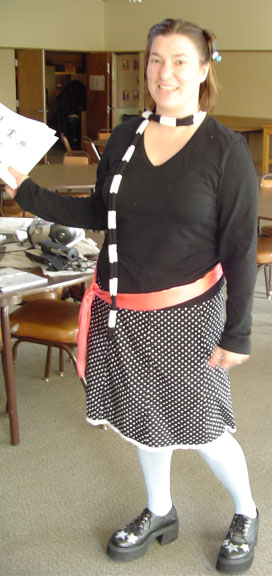
One of our directors modeling her Seuss style outfit….mmmm…..or is it Minnie Mouse?
3) The black and white scarf you see in Carrie’s photo is available at Wal-Mart for $3. Any and all musicians can use this as an accent.
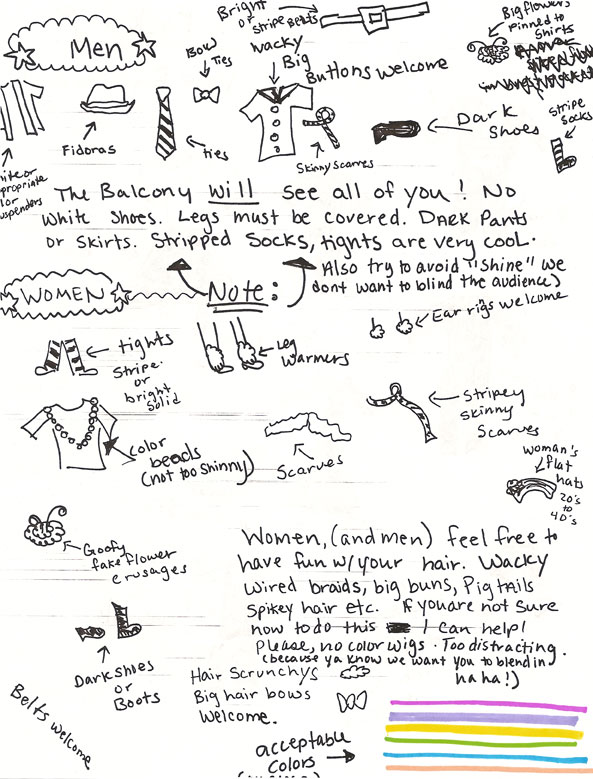
4) All musicians should wear dark shoes. The Balcony WILL see all of you! No white shoes, legs must be covered. Dark pants or skirts, striped socks, tights are very cool. Also avoid wearing “shine” – we don’t want to blind the audience.
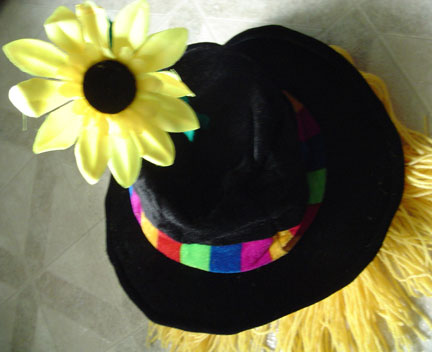
For example: Conductor will be wearing a tux with the tails pointing outward and up, a big Seuss style bow tie and on different nights an Einstein wig, a Shako (marching band hat) and/or this hat here:
IDEAS:
Men – Suspenders, Fidora Hats, Ties and Bow Ties (oversized are fun), big buttons, skinny scarfs, big flowers pinned to shirts, stripe socks. Fun colored wigs are ok!
Women – Tights (stripe or bright solid), leg warmers, earrings welcome, solid beads (not too shiny), scarves, stripey skinny scarfs, women’s flat hats (20’s to 30’s style), goofy fake flower corsages.
Women (and men) feel free to have fun with your hair. Wacky wired braids, big buns, pig tails, spikey hair, etc. If you’re not sure how to do this, Carrie James (director) will help you! Dark shoes or boots, belts welcome, hair scrunchies, big hair bows welcome. Fun colored wigs are OK!
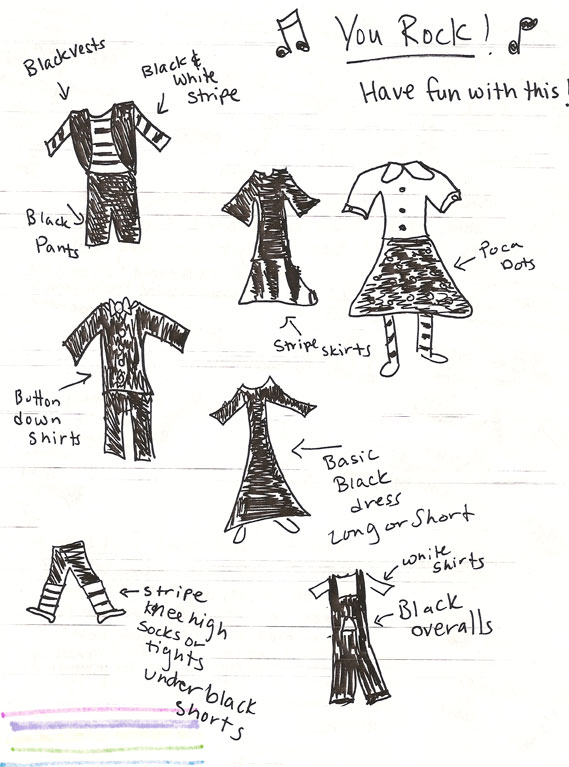
Here are some drawings Carrie James came up with for us. Please note: COLORED WIGS ARE OK! This was decided at our last orchestra rehearsal and ok’d by directors.
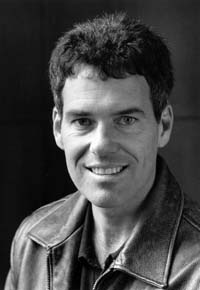
I want the whole world to know about Stephen Rumph. His voice is absolutely amazing. I wrote about it in my review of Skagit Opera’s Carmen. I went online to track him down and found out he’s not only an amazing vocalist, but active in music research (which I’ve listed below).
There are artists that are good, and artists that are talented, and artists that entertain us. But every once in a while you see an artist perform that touches the depth of your soul. That’s what Rumph’s performances do for me.
Stephen Rumph can take a note and morph it into so many different textures. It’s note a note anymore; it’s a living entity by itself. Well, read my review above, I don’t want to blather on and repeat myself. (Did I tell you he is AMAZING?)
I’m jealous he got an education at Oberlin. I had applied to Oberlin after high school and wasn’t accepted. I auditioned for voice, piano and composition. They turned me down for voice and piano, and said my compositions were illegible (and they still are! Thank God for computers!).
So as I continue to digress from my praises of Rumph I’m struck by a thought. Sometimes when I perform I have people come up to me and they are at a loss for words, and they look a bit silly during this interim. I’m not saying I’m so great, it’s just that if you perform a lot then their are a certain number of people you’re going to touch at a deep root level (that’s the way it SHOULD work, anyway). So here I am on the other side of the fence, at a total loss to describe to you the beauty of this man’s voice.
I guess it’s like when you laugh at your friends for being tongue twisted when they see a star they admire, then they laugh at you when it’s a star YOU admire. So right now, Stephen Rumph is my star. I hope he rocks the opera world big time.
His book: Beethoven After Napoleon – is available from Amazon.com
ABOUT THE BOOK
Beethoven After Napoleon Book Description In this provocative analysis of Beethoven’s late style, Stephen Rumph demonstrates how deeply political events shaped the composer’s music, from his early enthusiasm for the French Revolution to his later entrenchment during the Napoleonic era. Impressive in its breadth of research as well as for its devotion to interdisciplinary work in music history, Beethoven after Napoleon challenges accepted views by illustrating the influence of German Romantic political thought in the formation of the artist’s mature style. Beethoven’s political views, Rumph argues, were not quite as liberal as many have assumed. While scholars agree that the works of the Napoleonic era such as the Eroica Symphony or Fidelio embody enlightened, revolutionary ideals of progress, freedom, and humanism, Beethoven’s later works have attracted less political commentary. Rumph contends that the later works show clear affinities with a native German ideology that exalted history, religion, and the organic totality of state and society. He claims that as the Napoleonic Wars plunged Europe into political and economic turmoil, Beethoven’s growing antipathy to the French mirrored the experience of his Romantic contemporaries. Rumph maintains that Beethoven’s turn inward is no pessimistic retreat but a positive affirmation of new conservative ideals.
From the Inside Flap
“A brilliant and unfailingly provocative reading of Beethoven’s music. Rumph challenges and refines our views of the subject, reinterpreting overly familiar music in striking new ways. Wonderful critical and interpretive observations abound; the author writes with great imagination and flair.”–Scott Burnham, author of Beethoven Hero
“Rumph shows at last the extent to which Beethoven’s late period, the period of his most spiritual and ‘inward’ music, was a response to political change. In effect his book is an extended retort to E. T. A. Hoffmann’s two-centuries-old claim that Beethoven’s kingdom was not of this world–and it’s about time! Rumph’s argument will be resisted by Hoffmann’s many heirs; but it is most compelling, not least because it answers so many long-standing questions about ‘the music itself’ and clears up so many misconceptions about the nature of musical romanticism.”–Richard Taruskin, Class of 1955 Professor of Music, University of California, Berkeley
. Staff Bio from University of Washington Stephen Rumph joined the School of Music faculty in autumn 2002. He earned a B.M. degree in voice from the Oberlin Conservatory and his M.A. and Ph.D. in musicology from the University of California, Berkeley. Prior to coming to UW, Rumph lectured in music history at both Berkeley and the San Francisco Conservatory of Music.He has published articles in Nineteenth-Century Music and the Journal of Musicology. His book, Beethoven After Napoleon, a political study of the composer’s late works, was published in summer 2004 by University of California Press. Rumph is currently researching Mozart’s absorption of sacred music, in the context of Enlightenment aesthetics and language theory.
In addition to his scholarly work, Rumph has sung leading tenor roles, including Rodolfo, Hoffmann, Lenski, Tamino, and the Duke of Mantua, with West Bay Opera, Berkeley Opera, Pocket Opera, Livermore Valley Opera and other companies throughout the San Francisco Bay Area.
Carmen by Georges Bizet
Skagit Opera
McIntyre Hall October 6-15, 2006
I went with friends to the opening night of Skagit Opera’s CARMEN. I was blown away. This is the third opera I have seen by Skagit Opera – they have all been very good. But this time they really showed how they are continually working to raise the bar and improve every aspect of their productions.
The orchestra was absolutely fantastic. For a scaled down group they had a great command of dynamics under conductor Dean Williamson. To me, the key to great music for a show is not to notice it, it should seamlessly interweave with the action. And this orchestra did. It allowed me to become fully engaged in the action and singing. Espcially after the first act the orchestra was gelling very well. My normal complaint with scaled down groups is the wimpy string section sound – not in this production. Sharyn Peterson was concertmaster – she and Dean Williamson performed some magic and delivered a power very unusual for the size of group they had. The pathos of the lust in the music was all evident in their delivery. Bravo!
And to my friend who says it seems like I’ve done everything – yes I did perform in Carmen with Seattle Opera as a boy soprano back in…..mmmm……I think it was 1977 or 1978. But that was a lifetime ago.
One of the people I watched the opening night with is a well cultured European who commented: “I have seen many, many Carmens. But I have NEVER seen one as sexy as this one!” I agree. Sarah Heltzel was extremely sexy in the role. Her performance was…..how shall we say…..spicy and tantalizing. She made it very believable that men were falling in love with her left and right. From reading her bio (part of which is listed below), she is just starting to make her mark. She has the makings of a very strong and lengthy career ahead of her.
Don Jose performed by Stephen Rumph. (Read more about Stephen Rumph.) Stephen is my new favorite opera tenor. I saw him perform last year, I think it was in the Magic Flute. He has such command over his high falsetto and often makes use of switching between his chest voice, to head voice and back with apparent ease. It is reminiscent of an Irish tenor, the sweetness to the note – or the sound you might expect from Schubert Lieder – then just as swift he pounces with full power and reminds you fine enough that he is a tenor for the opera house. Of all the voices I have heard with Skagit Opera, his alone is the most moving and magical to me. You truly must hear it to believe it. In Magic Flute and the beginning of Carmen he plays very straight laced, kind of “prince charming” roles – it was surprising to see him at the end turn into the love crazed psychopath that Don Jose turns into before he kills Carmen. Great acting transition and entirely believable to me.
Ron Wohl is one of the founders of Skagit Opera. I think it’s fair enough to say he earned his role in this Carmen. He blended in with the full time pros evenly and steadily. Whatever he has been studying vocally has definately paid off and he is seeing ample returns. And of course he is always a commanding presence onstage, I think he’s like 15 feet tall. 🙂
The set was static and used for all four scenes – Plaza, Gypsy Tavern, Mountains and Bull Fighting ring. Awnings were changed for scenes and a drape across the top with special lighting was used for the Mountain scene. The set was construced for this particular run by Steven Craig who is revered locally for all his wizardy in theatre, including set design. I spoke with Steven Craig about the set design and he said it was very challenging to design one set for all four locations. He said Carmen is noted for it’s monstrous set changes, I thought his solution was very inventive – typical Craig style!
PRE SHOW LECTURE
The Sunday before opening night there was a free public lecture by conductor Dean Williamson. He noted that in Carmen the word “love” is sung so many, many times in the opera – but it is best substituted by the word “want”. The opera really has little to do with love. It is more about lust and wanting ownership over the affections of another individual. He also noted that in the final grand Toreador scene it is sometimes choreographed for a group of thirty or so chorus members to keep entering through the audience and quickly change costumes backstage to re-enter again for the bull fight arena scene. This can sometimes go on for quite a while, giving the impression that hundreds of people are entering the arena.
It was also noted that Bizet’s premiere of Carmen was not received well by the public. They did not like it. Bizet died a few months later, supposedly of depression and a broken heart. As my friend in attendance said, “It’s always like that you know, you have to die before people can like it.”
I look forward to Skagit Opera’s next production!
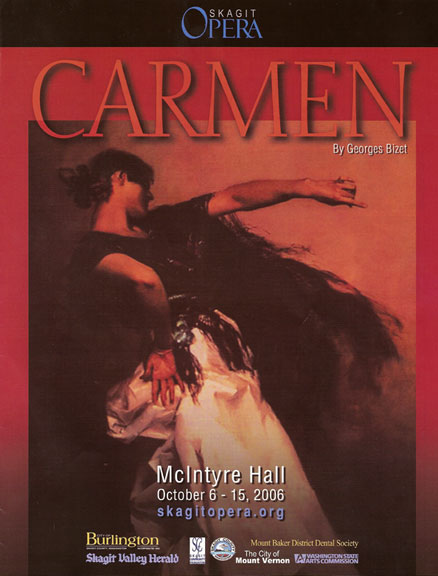
Skagit Opera Carmen Program Cover
Erich Parce – Stage Director Baritone Erich Parce has been a frequent guest of opera companies throughout North America and Europe, including the Metropolitan Opera, San Francisco Opera, San Diego Opera, Seattle Opera, Greater Miami Opera, L’Opera de Nice and L’Opera de Montreal.
Dean Williamson – Conductor Dean Williamson, one of the country’s foremost emergin opera conductors, has conducted all of the Seattle Opera Young Artists Program productions. He conducted Tales of Hoffman for Seattle Opera in 2005 and has conducted at Wolf Trap.
Sharyn Peterson – Concertmaster Sharyn Peterson, Skagit Opera Co-founder, Orchestra Coordinator and Concert Master, will again be the backbone of our wonderful Starry Night Orchestra and will conduct our production of Amahl and the Night Visitors. She holds a B.A. in Fine Arts and an M.A. in Violin Performance / Pedagogy from the University of Washington.
Julie Benzinger – Mercedes
Mezzo Soprano Mezzo Soprano Julia Benzinger has been a featured performer with the Sarasota Opera, Britten-Pears Young Artist Programme, Yorke Trust, Opera Pacifica, Bellevue Opera, Concert Opera of Seattle, Maud Powell Festival, Seattle Opera Guild, Rome Festival, Rainier Symphony, Seattle Symphony Chorale and Mancester Camerata.
Charles Crowley – Morales
Baritone Baritone Charles Crowley has received Bachelor’s and Master’s degrees in vocal performance from the University of Oregon and Western Washington University respectively. He has performed in many operatta, musical theater and opera productions in the Seattle area.
Sarah Heitzel – Carmen
Mezzo Soprano Lauded by the Seattle Weekly for her “perfectly polished and vivacious” singing, American Mezzo-Soprano Sarah Heitzel makes her role debut as Bizet’s Carmen with Skagit Opera. Heitzel made her Seattle Opera debut in 2005 as Siegrune in their acclaimed Der Ring des Nibelungen, also replacing an ill Rhinedaughter in Das Rheingold at the last minute.
Signe Mortensen – Micaela
Soprano Signe Mortensen has quickly made her vocal and theatrical mark in the Pacific Northwest region and beyond. She has worked with companies and symphonies including: Tri-Cities Opera, Skagit Opera, Bellevue Opera, Music of Rememrance, Off-Center Opera, Northwest Opera in Schools, Opera Pacifica, Seattle Gilbert and Sullivan Society, Northwest Savoyards, Hans Wolf Community Outreach, and the Rain City Symphony.
Timothy Proctor – Remendado
Tenor Originally from Santa Ana, California, Timothy Proctor makes his Pacific Northwest operatic debut as Remendado in Skagit Opera’s production of Carmen. Timothy received his Bachelor of Music in Vocal Performance in 2000 from CSU, Fullerton.
Richard Riddell – Dancairo
Baritone A graduate of Anacortes High School and Skagit Valley College, Mr. Riddell studied theater arts at Washington State University, the National Shakespeare Conservatory, and the Hartt School of Music at the University of Hartford. After graduation, Richard went on to a successful professional career singing roles with the Connecticut Opera, Chautauqua Opera, Opera Pacific, Michigan Opera Theatre, the Bronx Opera and Opernhaus Zurich.
Stephen Rumph – Don Jose
Tenor Stephen Rumph has established himself as a leading tenor in both opera and oratorio. Last season he sang Rudolfo in La Boheme with Tacoma Opera, and the tenor solo in Mozart’s Requiem with both Northwest Sinfonietta and the Walla Wall Symphony.
Morgan Smith – Escamillo
Baritone Originally from White Plains, NY, Morgan Smith received his training from Columbia College and the Mannes College of Music in New York City. The baritone made his professional operatic debut in 2001 , singing the role of Donald in Benjamin Britten’s Billy Budd with Seattle Opera.
Carl K. Turner – Lillas Pastia
Tenor Carl K. Turner comes originally from Tennessee and was a vetern performer at Opryland USA where he logged more than 300 performances as Captain Andy in Showboat. He studied acting under William Ball at the American Conservatory Theatre in San Francisco, and subsequently performed with San Francisco Shakespeare Festival, Eureka Theatre, San Mateo Civic Light Opera and various fringe theaters.
Cristina Villareale – Frasquita
Soprano Seattle native Cristian Villareale has performed all over the Northwest with organizations such as Seattle Opera, ACT Theatre, Skagit Opera and Village Theatre. Cristina began her career in musicals and plays. She was introduced to opera as a teenager, making her Seattle Opera debut as the young Gretel in Massenet’s Werther.
Ron Wohl – Zuniga
Bass-Baritone Ron Wohl sang Don Basilio in our Barber of Seville, the Major General in our Pirates of Penzance, Ko-Ko- in our Mikado and the Learned Judge in our Trial by Jury. He is a member of the Seattle Opera Supplementary Chorus and sang in their August 2003 production of Wagner’s Parsifal and in Gotterdammerung in 2005.
Skagit Opera presents Carmen
Music by Georges Bizet
Libretto by Henri Meilhac and Ludovic Halevy after the novella by Prosper Merimee
English Libretto and Dialogue by Mr. Sheldon Harnick
Premiere: March 3, 1875 at the Opera-Comique, Paris
This performance October 6 and 13 7:30pm – October 8 and 15 at 2:00pm
McIntyre Hall, Mount Vernon, WA
Conductor – Dean Williamson
Stage Director – Erich Parce
General Director – Ron Wohl
Set Designer – Steven Craig
Technical Director – Bruce Weech
Stage Manager – Rebecca Heilig
Concertmaster – Sharyn Peterson
Costumer – Charles Caine
Costumes – Malabar Limited, Toronto
Costume Coordinator – Lynne Rittenhouse
Choreography – Sara de Luis
Chorus Director – Scott Rittenhouse
Hair and Makeup Designer – Mary Bingham
Assistant Stage Manager – Breanne Desmarais
Accompanist – Glenda Williams
Rehearsal Assistant – Carl Turner
Properties – Carole Lindberry
Light Design – Steven Craig
Sound Engineer – Jerry Fortier
Light Operator – Don Willcuts
Stage Crew – Dave Mumford, Spencer Desmarais
Master Carpenter – Phil Brown
Publicity – Ron Wohl, Bill Arnett, Nancy Peterson, Ellie Slabodnik
Program – Ron Wohl, Scott McDade
Photography – Eric Hall, Gary Brown
Lobby Display – Robert Slabodnik
Cover and Season Graphics – Scott McDade
Special thanks to Talisman Productions
Ensemble Chorus
Lynne Rheinhardt, Chris Galbraith, Lydia Randall, Micke Rickert, Beth Wallace, Betsy Senff, Phil Trautman, Brian Myrick, Eric Hall, David Cross.
ORCHESTRA
Violin I
Sharyn Peterson
Danae Otterness
Tara Stewart
Andrea Talley
Violin II
Marcus Talley
Ann Glenn
Christine Wilkinson
Jessica Marshall
Pre-production work has started for the Theatre Arts Guild presentation of Disney’s High School Musical to be performed at McIntyre Hall in 2007. I’ll have information posted later on audition dates and info for musicians. Auditions will probably be in November. You can also visit the Theatre Arts Guild Website.
Here is the orchestration:
I don’t keep the Sabbath well. In fact, after church is done it’s just another day. It’s been bothering me for a while. Not just because it’s a commandment, just because…..well…in my gut it just makes sense to slow down and remind myself about what’s important.
At church today the sermon was on keeping the Sabbath day holy. It was a great sermon that touched on many of the original meanings of Sabbath and the traditions. As a Protestant we’re freed from the rigid ways of the orthodox religions – sticking to Saturday, no making fires, etc. But that’s not what really interests me right now. What interests me is my perfect Sabbath day today.
I took the minister’s words to heart, along with one of my favorite Martin Luther quotes: “How soon ‘not now’ becomes ‘never’.†So I decided to start today.
It kind of helped that the day started with the church choir singing beautifully, and I got to play a new Bach organ prelude that I really enjoy. But then I decided not to work. I went to a friends house for several hours and just talked with them. Then had dinner with my family, then watched the sunset with my mother.
I know it might not sound like much. But it was the perfect sabbath. I like the change.
On my theology and science forums I’m still amazed how many people have not researched the opposite viewpoint. With many people they just don’t know where to go, there’s so much information.
If the subject of Evolution and Creation interests you, and if you live in the United States it SHOULD interest you, then here are some starting resources for you. I have to say that whatever side you are on, if you are holding very strong pointed views and have not looked at what the opposite side has to say; I think you are cheating yourself.
Read for yourself and make your own decisions. It should not be a scary process, it should be exciting. That being said, to really get into this you really need to pace yourself over several weeks just to get a small bird’s eye view of the discussions. I think the reading will be well worth your time, and will keep you informed.
These are the two generally accepted resource points for Creation and Evolution from each perspective.
“Talk origins is a Usenet newsgroup devoted to the discussion and debate of biological and physical origins. Other topics of discussion include the origin of life, geology, biology, catastrophism, cosmology and theology.”
****************************
There you have it. I think those two websites together give a balanced view of what “each side” is saying. I say “each side” because their are a multitude of viewpoints to this subject.
If you are interested in this subject but refuse to read what the other side has to say, I would have to ask: Why?
If you have additional resources you are welcome to add those as comments to this post.