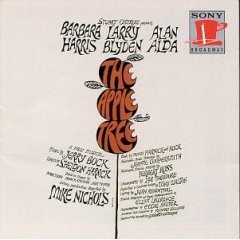
Mount Vernon, WA – Currently working on the first act of The Apple Tree which will run at Stanwood Auditorium (April 13, 2007), Philip Tarro Theater (April 14, 2007) and Mount Vernon Presbyterian Church (April 15, 2007).
The first act of the Apple Tree is based on “The Diaries of Adam and Eve” by Mark Twain. It is a comedy that conjuctures the humorous infighting of the first husband and wife, and their interaction with the snake in the Garden of Eden.
Music is by Jerry Bock with lyrics by Sheldon Harnick; the same writing team that created Fiddler on the Roof in 1964. The original run of The Apple Tree musical opened on October 18, 1966 at the Schubert Theater in New York City. It had a very successful first run with 463 performances. The original actors were Barbara Harris, Alan Alda and Larry Blyden.
A revival of The Apple Tree is currently running on Broadway in New York by the Roundabout Theatre Company. This musical revival opened in December 2006 and stars Kristin Chenoweth, Brian D’Arcy and Mark Kudisch.
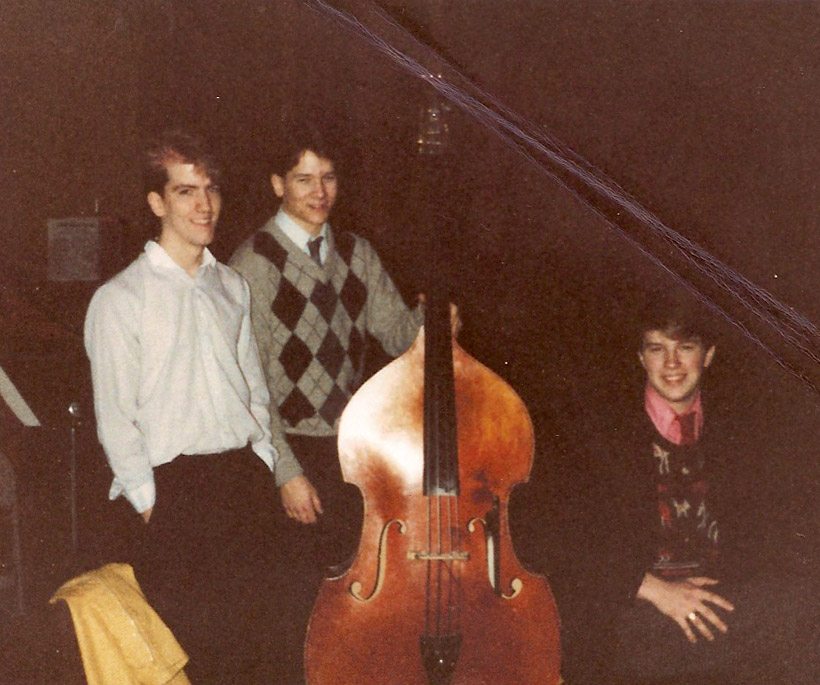
I was going through music selecting repertoire for a piano student and this picture fell out of a book. The picture is from 1983 (I was 17 years old). Pictured from left to right is Christopher Possanza (Synthesizer), Doug deBruyn (Upright Bass) and Conrad Askland (Harpsichord).
This photo was taken in the sanctuary of St. Andrew’s Lutheran Church in Bellevue, WA – 1983. We were preparing to play a Purcell Trumpet Voluntary as special music for a Sunday church service. Chris and Doug were two of my best friends in High School. I haven’t spoken with Doug since High School and only once with Chris in the last 20 years via email.
The three of us took music theory classes together at Interlake High School. Doug and I played together in the jazz band and marching bands. We also attended music composition seminars and did all the fun crazy things that should be done in high school, most of which are not appropriate to blog publicly about (which means it was very, very fun.)
Chris Possanza was lead singer for the Seattle band “This Busy Monster”, and is also one of the founders of Barsuk Records in Seattle, WA. His label is best known for producing the Seattle band “Death Cab for Cutie”. I’m sure both of them have had many more adventures the past twenty years, but those are the only ones I know of.
Of course this picture has a story to it. Originally we had a trumpet player to play the Purcell piece for that Sunday’s service. A couple days before Sunday, the trumpet player cancelled out on us. If I remember right he had never been in a church before and the thought of playing in a sanctuary really freaked him out.
Some things never change, of course the performance of this piece was the entire world to me and had to happen. So I called my friend Chris who owned a Prophet V Synthesizer to play the trumpet part. Back in 1983 synthesizers were pretty rare, especially the Prophet V. It was kind of like having the first tv set in the neighborhood. We spent many hours at Chris’ house experimenting with sounds and wishing we had done what Walter Carlos had accomplished with Switched on Bach (ok, I’m dating myself now.)
So Chris played the trumpet parts on his Prophet V synth along with a real upright bass, and a real harpsichord (which I got to tune, that was very fun.) The piece was played well and embellishments were executed properly for the Baroque style.
It was not intentional, but it may be one of the earliest uses of the Prophet V synthesizer in a liturgical setting. If memory serves me correctly there were a few people that did not feel a synthesizer was appropriate in church under any conditions. But overall it was received well.
You can make fun of my pink shirt. You can make fun of the animal prints on my sweater. But we give you fair warning not to question the reverence of our synthesizer patches. We are armed with MIDI. We will win.
“Remember that you are dust and to dust you shall return”
What is Lent and why do people “give things up for Lent”. Is it that they just want to be depressing? Hare are some answers to the tradition of Lent and it’s purpose in the church calendar.
Ash Wednesday is the first day of Lent. The early church determined that the Lenten period of fasting and renewal should correspond to Christ’s fasting (Matt. 4:2), and by counting forty days back from Easter (excluding Sundays, which remain “feast†days), arrived at the Wednesday seven weeks before Easter.
At one time Lent was primarily viewed as a period during which converts prepared for baptism on Easter Sunday, but later the season became a general time of penitence and renewal for all Christians. And Ash Wednesday became the day that marked the beginning of the Lenten renewal.
Ashes have a long history in biblical and church traditions. In Scripture ashes (dust) symbolize frailty or death (Gen. 18:27), sadness or mourning (Esther 4:3), judgment (Lam. 3:16) and repentance (Jon. 3:6). Some traditions also have considered ash a purifying or cleansing agent.
All these images are caught up in the church’s use of ashes as a symbol appropriate for Lent. In Christ’s passion we see God’s judgment on evil; in our penitence we express sorrow and repentance for our sins; in our rededication we show that we are purified and renewed.
The ash used in Ash Wednesday worship services is usually the ashes from the palm leaves of the previous year’s Palm Sunday celebration. Mixed with water or oil, the ash is carried in a small dish; as the minister goes from person to person, he dips his thumb in the ash and makes a cross on each forehead (“impositionâ€). And to each person he says, “Remember that you are dust and to dust you shall return,” or “Repent, and believe the gospel.”
The cleansing motif of ashes is reiterated in the psalm reading that follows: “Wash away all my iniquity and cleanse me from my sin†(Ps. 51:2). And the ultimate outcome for the penitent child of God is reflected in the closing prayer: “…that the rest of our life hereafter may be pure and holy, so that at the last we may come to his eternal joy…†(Book of Common Prayer).
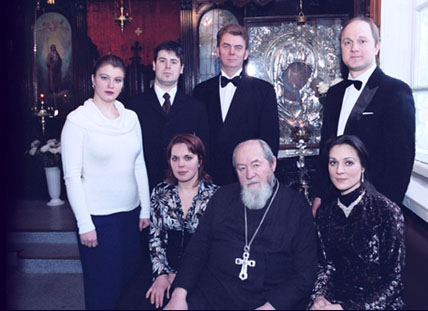
Con Anima, a vocal group from St. Petersburg Russia, will perform at Mount Vernon Presbyterian Church on Saturday March 3rd, 2007 at 7pm. The concert is free. Read more information about the Con Anima Russian choir.
I’ve been writing music for Charlie and the Chocoloate Factory, including a theme song for Augustus Gloop. I ran across this article today about a boy in London who is 8 years old and weighs 200 pounds. His mother says he will only eat junk food and she refuses to stop feeding him.
The English social services there actually reviewed whether he should be taken out of the home. They ruled today that he can stay, which is a good thing for him as it sounds like the food is pretty good.
Gosh darn it all, his mother tries to feed him fruits and vegatables but “he just spits them out.”
Hey, this is the REAL AUGUSTUS GLOOP! Read the Augustus Gloop CNN Article.
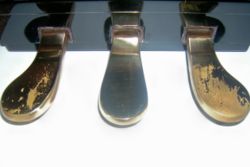
The nefarious middle piano pedal, the bane of piano teacher and student alike. Yes, it does have a function, but rarely used in contemporary music.
Piano pedals from left to right: una corda, sostenuto and damper.
THE THREE PIANO PEDALS
Left Pedal
The left piano pedal is called the “una corda” pedal, or in common usage called the “soft” pedal. When the pedal is pressed the piano becomes softer. In most upright pianos this is done by dropping a piece of felt between the hammers and the strings which softens the attack. In grand pianos the entire keyboard will shift so that the hammers only hit two strings instead of three. (Grand pianos have three strings per note, so only hitting two of those strings reduces the volume by roughly 1/3). The word “una corda” in Italian means “one strings”. So why is it called “one string” when it actually hits two? The inventor of the piano, Cristofori (1655-1731), made his pianos with two strings per note instead of three like we use today. He also included a “soft pedal” which would hit only one string instead of two, so it made sense to call it “una corda”. His soft pedal had a larger impact on the sound by decreasing volume by one half instead of one third.
Right Pedal
The right piano pedal is called the “damper” pedal (commonly the “sustaining” pedal). This is the most commonly used pedal on the piano and is often simply referred to as “the pedal” because it is used so much. When the pedal is pressed, the dampers lift off the strings so the sound continues to vibrate. This also allows strings that have not been struck to ring sympathetically with the overtones of ringing strings. This creates a fuller sound. This pedal is often overused to cover up poor technique. Of course, it doesn’t actually cover up the poor technique, but the player often thinks it does. In practicing it’s usually good advice to practice without the sustain pedal in order to focus on good finger technique and interpretation. Once technique is mastered, then add the pedal.
Middle Pedal
The middle piano pedal is called the “sostenuto” pedal on grand pianos or the “practice pedal” on uprights. The middle pedal has different functions depending whether it is on an upright piano or full grand piano. Many spinet pianos (smaller upright pianos, the kind most people have in their living room) do not have a middle pedal at all. On grand pianos, the middle pedal will sustain any notes which are currently pressed. On upright pianos, this pedal will sustain any notes in the lower octave.
It is not often you will come across the necessity for the middle piano pedal. But it does occur fairly often in piano transcriptions by Franz Liszt. A good example is the Liszt transcription of Prelude and Fugue in C Major by JS Bach (BSV 544 – S462/2). This piece uses Bach’s common ground or pedal tone sustaining in the low actives with fast sixteenth note runs over the top. And that is the reason for this entire post. I am currently working on that Liszt transcription and thought it would be a great opportunity to explain the piano pedals in detail.
The middle piano pedal is the red headed step child of the pedal family. You may very well find on your spinet piano at home that it does absolutely nothing at all, or is just a soft pedal. You would probably not want to play a Liszt piece on a small spinet anyway, so it all works out in the wash.
Conrad’s Practical Pedal Postulates
Some piano teachers may bristle at this, but short of preparing concert material, my practical approach to pedals is this: Right pedal sustain – Use to taste but reset often so the sound does not become muddy. Middle Pedal sostenuto – Don’t use it (very rare) Left Pedal Soft – Use to soften piano when accompanying vocalists or playing background music.
In a nationwide crackdown, the music industry is sending thousands more copyright complaints to universities this school year than last. In some cases, students are targeted for allegedly sharing a single mp3 file online. Read CNN Article.
Often I see forum members who are actively trolling and when confronted with this respond: “What is trolling? I’m not aware of what that is.” I think their response is genuine. So here is a fairly detailed definition of trolling. It usually applies to online communities. The act of trollling also consists of entering communities where the member is full aware their involvement is not appropriate.
Definition of Internet Troll and Online Trolling
In Internet terminology, a troll is a person who enters an established community such as an online discussion forum and intentionally tries to cause disruption, often in the form of posting messages that are inflammatory, insulting, incorrect, inaccurate, absurd, or off-topic, with the intent of provoking a reaction from others. Trolls can also be existing members of such a community that rarely post and often contribute no useful information to the thread, but instead make argumentative posts in an attempt to discredit another person, more often than not based on what they thought was said rather than what was actually said by the other person, concentrating almost exclusively on facts irrelevant to the point of the conversation, with the intent of provoking a reaction from others. The key element under attack by a troll is the forum or group’s hegemony. Hegemony refers to the recognized and agreed upon power structure of the said group or community. To this extent, a troll does not necessarily have to make malicious or incorrect comments. For example, a liberal-minded person who approaches a forum frequented by right-wing neo-nazis, may be considered a troll, even if no lies or attacks are made.
A person who retaliates (using whatever means) as a result of a misunderstanding (or as a way of rebelling against the overzealous application of rules) is not a troll. A troll is a person who approaches a board with the specific intention of destroying a forum’s hegemony, either with no particular motive or provocation in mind, other than to be purely destructive or if the motive or provocation is against the ethos of the board. For example, a neo-nazi approaching a Jewish forum with the intention of attacking the members, purely because the neo-nazi knows the forum to contain Jewish members, may be considered a troll. A Jewish member of the said forum, who becomes angry with the neo-nazi and breaks the rules in gaining revenge against the neo-nazi, and who is subsequently banned and who then begins to rebel, is not a troll.
The general element, that determines whether a malicious user is a troll or not, is the level of indignant emotions present in the person, coupled with the person’s history with the forum or group. An indignant user who has had a previous normal relationship with the group is not a troll, even if the user uses methods of attack that are characteristic of a troll attack.
The term Troll is often used as an insult in online communications, resulting in it being largely misapplied.
All singers in the group are graduates of Saint Petersburg Conservatory. Conservatory in Russia is a higher musical educational establishment. Term of training – 5 years. Conservatory diploma has the same rank as that of a university.
We build our repertoire of religious music, Russian chamber and opera music of the 19th and 20th century, including compositions by P.Tchaikovsky, S.Rakhmaninov, S.Taneev, N.Rimsky-Korsakov, P.Chesnokov and other.
We try to arrange our concert programmes to deliver to audience the depth and spiritual wealth of Russian orthodox culture. We consider our activities as a part of ecumenical links among Christian confessions, thus besides its concerts Con Anima takes part in divine service in various Christian churches.
CON ANIMA VOCALISTS
Anton Malakhovsky, baritone
Olga Dudchenko, mezzosoprano
Andrey Gavrin, tenor
Natalia Savchenko, soprano
Vladimir Feliauer, bass
Ekaterina Arhangelskaya, soprano
Meg Brockie – Jeanette d’Armand
Understudy – Laurie Miller
Charlie Dalrymple – James Scheider
Mr. Lundie – Bob Nydeger
Harry Beaton – Ryan Edwards
Jean MacLaren – Natalie Howell
Understudy – Elisa Fuller
Jane Ashton – Elisa Fuller
Archie Beaton – John Hepola
Mary Beaton – Laurie Miller
Andrew MacLaren – Clarence Holden
Anne MacLaren – Kathleen Kernohan
Bonnie MacGuffie – Kelly Pollino
Angus MacGuffie – Tom Mueller
Frank (the Bartender) – TBA
Kate – Ashley Rinas
Sandy Dean – Kristina Howell
Maggie – Stacy Lazanis
Fishmonger – TBA
Francis – Emma Asgharian
***PLEASE NOTE: Actors with understudy roles are double-cast in other roles. ALSO: Roles of men and women of the town may be switched around as we begin rehearsals and I am able to try out people in the various roles. Regardless of this, those people who are given speaking roles will have one of the men/women’s speaking roles.
Ensemble
Anna Jenny
Trina Jenny
Sarah Jenny
Luke Thompson
Erin Hemenway
Kalli Roberts
Elizabeth Sunderland
Kris Hemenway
Sarah Holcomb
Debbie Wolf
Kelli Bates
Jonathan Wolf
Katie Hudak
Christine Wolf
Jordan Rinas
Robin Carpenter
Ali Rinas
Juanita Kolbeck
Tess Gribin
Lauren Lippens
Abi Rinas
Sarah Howell
Kelli Niemeyer
Bianca Campbell
Kristina Niemeyer
Kelli Denike
Rebecca Wright
Calli Johnson
Francis Roane
Caitlin Edwards
Launi Kucera
Alex Hollingsworth