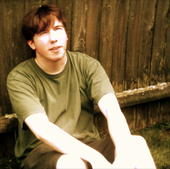
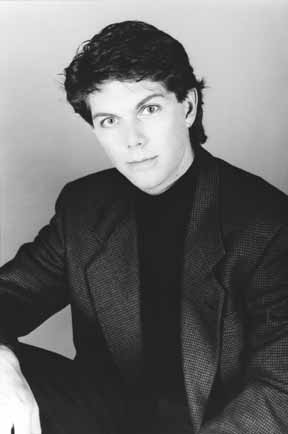
 (Douglas Besterman in 1985)
Doug Besterman is the King of Orchestrations.
WHO CARES ABOUT DOUG BESTERMAN?
I do. And I’ll tell you why. I will force you to care about this man and why he is so important. Well, no, not “important” – he is a magician of music.
My fascination with Doug Besterman started a couple weeks ago. I am working on a new musical. That may sound grand (and indeed it IS!), but there’s a whole hairy backend to doing this that requires a technical setup and workflow that’s efficient and doesn’t get in the way of the creative process.
Conductors get a lot of kudos and attention at showtime just because they are steering the ship during a show. But the REAL brains behind that is the orchestrator and arranger. You barely ever hear about them. Who orchestrates Andrew Lloyd Weber’s music? Yeah, see. Who cares? Well, the orchestrator is the one that brings the chicken scratches to life.
Orchestrations in the old classical composer days was more of a feat of skill, a time to showoff or improve on a great master. One composer would orchestrate a previous composers work for new instruments. But they would never have someone else orchestrate their OWN material. Who’s every heard of “Mozart Piano Concerto #1” , orchestrated by Beethoven. The first releases anyway, the composers did themselves.
Especially in musical theater it’s common for the “composer” (sometimes really just a songwriter) to pen out the melody and basic chords. The orchestrator can take this and turn it into a symphony. It’s a thankless job.
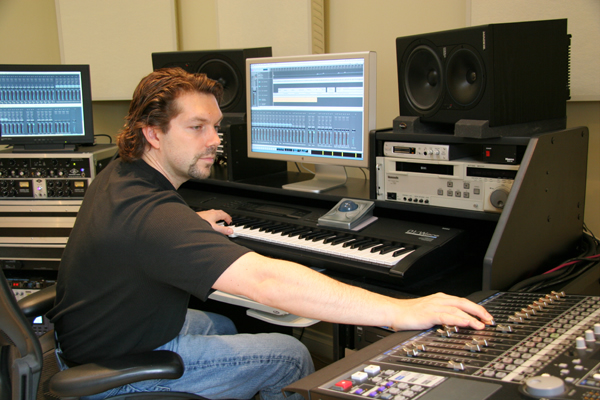
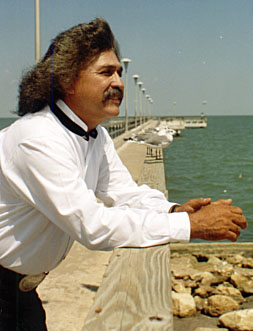
(Besterman working in his studio)
So for my musical – the end product I need to have created is finished scores for the musicians that coincides with the script. That’s obvious. But EEGADS that got complicated real quick when I started rearranging my studio specifically for this task.
As I’m searching online I come across references to the orchestrations of Besterman. One of the projects he orchestrated was Seussical the Musical. I conducted that show last year and a little light went off “Why yes, those orchestrations WERE FANTASTIC!” (The production of Seussical I conducted was with a full 20+ orchestra. It is VERY fun with a full ensemble – if you’re doing a production of Seussical please consider NOT pairing the orchestra down) I have a pretty good memory for music parts so I’ve been going over the orchestration in my head, recalling the parts that were particularly effective.
As I search on and on I have found many interviews with Douglas Besterman online that give a little insight to his training and where his influences come from. Of course nothing beats hearing it for yourself, so I’ve ordered several of his soundtracks to listen to.
Here’s more info on Besterman. At the end of this article is a link to his website. I’m glad you know who he is now – you’ll have to listen to his orchestrations for yourself to hear why he is a “magician of music”. He breathes life into new music, instead of that oldy moldy Broadway sound.
To my orchestration buddies (yes, I know you’re at there, all five of us) – check out a search of Besterman and orchestration terms online for interviews. There are many nuggets of wisdom and insight to be found.
BESTERMAN – On Orchestrating THE PRODUCERS
While the stars get encores and accolades-“Nathan Lane gives the performance of his career!” says WCBS-TV-and even the director gets notices- “Susan Stroman’s brilliant staging doesn’t miss a sight gag or a comic inflection!” says The Star-Ledger-most theater-goers might overlook the orchestrator’s credits.
We’re the designers of the sound of a piece,” Besterman says. “Outside of the theater world, a lot of people don’t really know about the job of an orchestrator. That’s partly because the kudos go to the composer when a score works, but it’s a job that’s pretty high on the food chain in theater.”
In a typical production, the composer develops the show’s melodies-the contextual skeleton-for each song, mainly on piano. The orchestrator then fleshes out each piece and develops them for a mini-orchestra-usually about 24 musicians for live theater.
Sometimes, a composer will pass on a fully developed piece. But often there’s little more than a hum of an indication of how a song is supposed to go. To complete that translation, the composer turns to the orchestrator.
“Composers carefully choose the right partner for a project,” Besterman says. “It’s very much a partnership.”
And Besterman has partnered with some of the best in the business in a career that has included bestselling Disney films and honored Broadway plays.
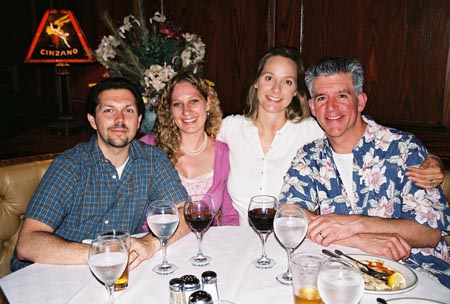
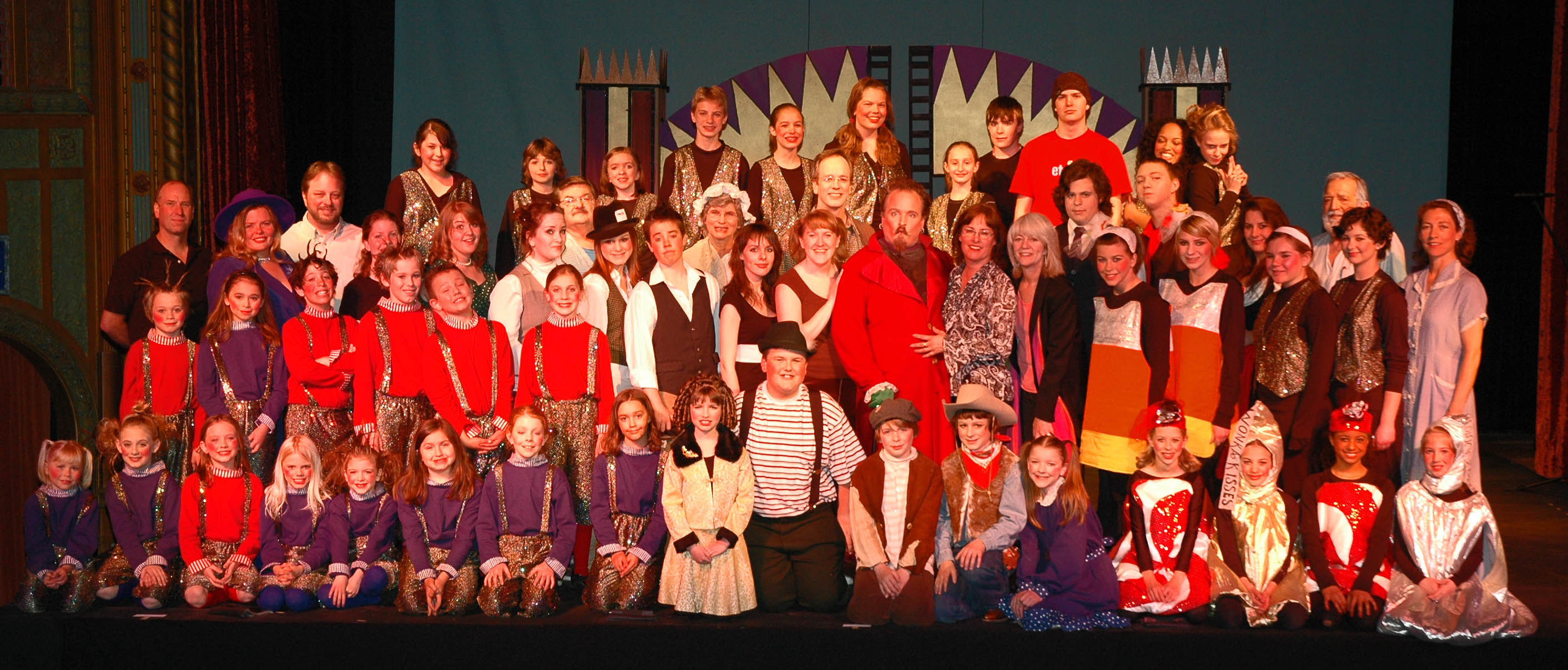
(left) Doug Besterman (Tony-award Winning Orchestrator, Fosse, The Producers, Thoroughly Modern Millie) wife Johanna, Julie and Gregory Jbara
BESTERMAN CREDITS TECHNIQUE TO MENTOR RAYBURN WRIGHT
s with many aspiring artists, Besterman dreamed of working on Broadway and in film while a college student. At Rochester, he studied both music history and theater, a program that allowed him to take classes at the College and at the Eastman School of Music.
Although he was always interested in composing and orchestrating, he says Rochester helped set the stage for his
career.
He studied with the late Rayburn Wright ’43E, then head of the Department of Jazz and Contemporary Media at Eastman, who had been a chief arranger at Radio City Music Hall in the ’50s. Besterman credits his former teacher with speeding his development.
“The things I learned from Ray shaved 10 years off my learning curve because it was incredibly practical information,” he says. “People used to say that I had no experience yet I was able to do so much, because that’s what Ray knew and taught us. It was an incredibly valuable four years.”
INTERVIEW WITH DOUG BESTERMAN
By Dan Goldwasser
What does an orchestrator do?
An orchestrator is responsible for taking a composer’s musical ideas – often written for piano or guitar – and expanding them to be played by a larger group of musicians – in the case of a Broadway show, anywhere from 6 to 24 musicians – and for a film, from 40 – 100.
What’s the difference between an arranger and an orchestrator?
Technically, an arranger will add his or her musical stamp on a piece of music – in the form of adding an intro or ending, coming up with counter-melodies, or re-conceiving the musical style of the piece – an orchestrator, technically speaking, won’t add anything.
In practice, orchestrators on Broadway – and to an extent in film as well – are also arrangers – we do often add counter-lines and re-conceive the musical style – but no distinction is made.
What are some of your more memorable experiences?
Well, it was fantastic being a part of the musical The Producers – a show like that only comes along every so often – the same goes for the movie Chicago. It was also great to work with singers like Barbra Streisand and Barry Manilow – and producers like Arif Mardin and Phil Ramone – recording industry legends.
Have you worked outside of musical theater and film?
Absolutely. I have done song arrangements for recording artists like Beyonce Knowles, Toni Braxton and Mandy Patinkin. I orchestrated two ballets for choreographer Susan Stroman, one for the Martha Graham Dance Company, and the other for the New York City Ballet. And I have written symphonic arrangements for the Hollywood Bowl, the Boston Pops, and the Los Angeles Philharmonic Orchestras.
I have also worked in the video game industry, creating and adapting music for Mulan (Disney Interactive), and Shadoan (Virtual Image Productions).
Through the course of your orchestration career, have you continued to write your own music?
Yes, I’ve continued to compose, and it the last couple of years, ever since moving out to Los Angeles, I’ve been more interested in songwriting and composing. In the last year or two, I’ve placed three songs in two shows (“Summerland” and “One Life to Live”) and one film, The Punisher. I enjoy writing – both songs and scores – and I would love to do more of that.
Do you have your own studio?
Yes – Mighty Music Productions, located in Los Angeles. I have a ProTools HD3 Accel system – I use Logic, Reason and Finale software – and I am set up to sync to video as well. I can create everything from orchestral synth mockups and demos to final tracks.
How did you get your start as an orchestrator?
It might sound strange, but I was aware that there were jobs called “orchestrator” and “arranger” from the time I was in my early teens. I grew up outside of New York City, and my family and I were big fans of musical theater – my parents loved Broadway shows, and would bring myself and my brothers to see shows as kids. At a certain point – I think it was probably the musical A Chorus Line – I noticed that there was music under the singing, and that it was interesting. My ears started to pick out that there were things happening under the singers, and they had a lot to do with the style and the tone of the show. So I really started to explore and investigate what that was, and how you did it.
By the time I was ready to go to college, I was pretty sure I was going to go into the music industry in some way – I was a pianist, and a French horn player, also. I ended up doing a dual program at the Eastman School of Music and the University of Rochester – so I was trained at a conservatory, and I was really fortunate at Eastman to study with a guy named Rayburn Wright. Ray had been the chief arranger at Radio City Music Hall in the 1950s, so we had a lot in common in terms of his experience, and my interest. Ray gave me a very clear understanding of how the music industry worked, what an arranger did, what an orchestrator did, and the mechanics of how you did that job in the industry. Somehow I walked away from Eastman feeling like I really understood how that all worked.
While I was in school, I studied Jazz Arranging, Film Scoring, Orchestration, as well as a conservatory curriculum in Music History and Theory. For a time, I toyed with being a professional horn player – being in conservatory, that’s a great place to really explore all those things. But by the time I left college, I knew that I was heading in a direction of musical theater. It was something I loved to do, I had worked semi-professionally as a rehearsal pianist and music director, and I felt like this was something I could do to earn a living, and be in the music industry, and see if I could move forward as a composer or as an arranger.
I got to New York in 1986, and started working as a rehearsal pianist and assistant music director, wrote arrangements for people, played auditions – then in the early 1990s I just had a lucky break – I met Danny Troob, who is a great orchestrator on Broadway, and had done a lot of film work with Alan Menken. Danny and I worked on a project together, and he asked me to help him with some orchestrations. Then an opportunity to do an off-Broadway show for Alan Menken came up, and Danny wasn’t available – so he recommended me. My phone rang at 9am one morning, and it was Alan. He said, “Danny says we should meet – grab a demo, and come up to my house.” That’s how my career as an orchestrator started.
You moved to Los Angeles in late 1990’s – how is it working on Broadway shows from LA?
I commute back and forth – I have a lot of frequent flier miles! It’s kind of ironic – I moved to Los Angeles, because I was getting busier doing basically what I do for Broadway, but for film. That was the end of the heyday period of the animated musical – I worked on Mulan and Anastasia long distance, from New York. So I moved out here to catch that wave – and because I was interested in being in LA and living in California – and a year after I came out there, I won my first Tony Award and got very busy in New York.
But in the last couple of years, there’s been a resurgence of interest in the Broadway musical on screen. Between Chicago and The Producers, for me it’s a very convenient calling card – in terms of doing more work in the film industry. I don’t think people in LA know that I’m in LA – they think of me as a New York guy!
A List of Some of the Composers that Doug Besterman has Collaborated With
Mel Brooks
Phil Collins
Randy Courts
Stephen Flaherty
Michael Gore
John Kander
Robert Lindsey-Nassif
Melissa Manchester
Howard Marren
Alan Menken
David Newman
Stephen Schwartz
David Shire
Alan Silvestri
Carly Simon
Kathy Sommer/Nina Ossoff
Stephen Sondheim
Charles Strouse
Jeanine Tesori
Danny Troob
Matthew Wilder
Frank Wildhorn
THEATER PROJECTS THAT DOUG BESTERMAN HAS ORCHESTRATED
*Note: This is just for theater. He has many more projects he has composed for television, film, and interactive game software.
BROADWAY/WEST END:
Tarzan (Richard Rogers Theater, NYC) – spring 2006
– Phil Collins, music
Guys and Dolls (Piccadilly Theater, London)
Dracula (Belasco Theater, NYC)
– Frank Wildhorn, music
Thoroughly Modern Millie (Marquis Theater, NYC)
– 2002 Tony Award &Drama Desk Award, Best Orchestrations
The Producers (St. James Theater, NYC)
– 2001 Tony Award & Drama Desk Award, Best Orchestrations
Seussical (Richard Rodgers Theater, NYC)
– Stephen Flaherty, music
Music Man (Neil Simon Theater, NYC)
– Drama Desk & Tony Award nominations
Fosse: A Celebration in Song and Dance (Broadhurst Theater, NYC)
– 1999 Tony Award, Best Orchestrations
King David (New Amsterdam Theater, NYC)
– Alan Menken, music
Big (Schubert Theater, NYC)
– David Shire, music
– Drama Desk Award nomination
Damn Yankees (Marquis Theater, NYC)
– Drama Desk Award nomination
Gentlemen Prefer Blondes (Lyceum Theater, NYC)
OFF-BROADWAY/OTHER NEW YORK THEATER:
A Christmas Carol (Theater at Madison Square Garden, NYC)
– Alan Menken, music
Weird Romance (WPA Theater, NYC)
– Alan Menken, music
Christmas Spectacular (Radio City Music Hall Productions, NYC)
Jack’s Holiday (Playwrights Horizons, NYC)
Johnny Pye and the Foolkiller (Lambs Theater, NYC)
REGIONAL:
I Sent A Letter To My Love (North Shore Music Theater, MA)
– Melissa Manchester, music
Captains Courageous (Ford’s Theater, Washington D.C.)
Paramour (Old Globe Theater, San Diego, CA)
Eliot Ness in Cleveland(Denver Center for Performing Arts, Denver, CO)
Jeanne La Pucelle (Place Des Arts, Montreal, Quebec)
Opal (George Street Playhouse, New Brunswick, NJ)
Visit the official Doug Besterman website at http://www.dougbesterman.com/