One of these two entries will win a $100 prize for the best remix of my Dracula Overture. Will post voting results in about a week.
Rock N Roll Hall of Fame Accepting Rap Artists
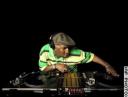 Grandmaster Flash is part of the first hip hop rap group inducted into the Rock N Roll Hall of Fame in Cleveland, Ohio. Officially “The Furious Five” is the first group inducted.
Many speculate this may be the end of inducting 70’s punk rock icons, and the ushering in of the hip hop era in rock music.
When Grandmaster Flash was asked about other artists he thought were deserving to be inducted, he said: “Afrika Bambaataa. Run-DMC. KRS-One,” he says, barely pausing for a breath. “Big Daddy Kane. LL Cool J. Eric B and Rakim. Tribe Called Quest. The list goes on and on.”
Flash left himself out, with good reason: The DJ and partners the Furious Five enter the Hall on Monday as its initial rap inductees. The Bronx hip-hop pioneers are part of an otherwise traditional class: R.E.M., Van Halen and a pair of fellow New York City performers, Patti Smith and the Ronettes.
*UPDATE 03/08/07 – Just received a comment that hip hop should NOT be allowed in the RRHOF – So I’ve opened up a discussion thread on that subject here: Rap Dogs RRHOF Discussion Thread.
1983 – Synthesizers in Church
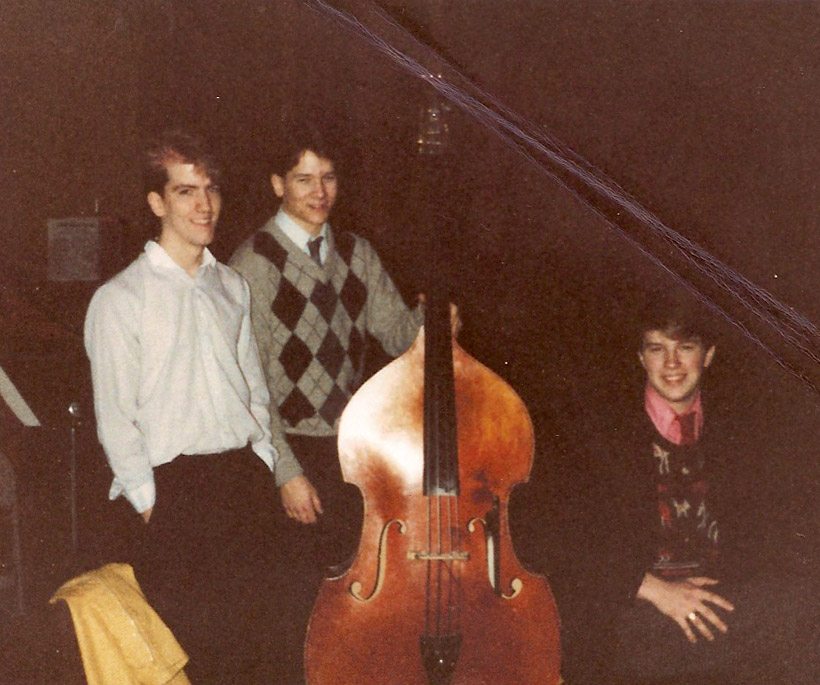 I was going through music selecting repertoire for a piano student and this picture fell out of a book. The picture is from 1983 (I was 17 years old). Pictured from left to right is Christopher Possanza (Synthesizer), Doug deBruyn (Upright Bass) and Conrad Askland (Harpsichord).
This photo was taken in the sanctuary of St. Andrew’s Lutheran Church in Bellevue, WA – 1983. We were preparing to play a Purcell Trumpet Voluntary as special music for a Sunday church service. Chris and Doug were two of my best friends in High School. I haven’t spoken with Doug since High School and only once with Chris in the last 20 years via email.
The three of us took music theory classes together at Interlake High School. Doug and I played together in the jazz band and marching bands. We also attended music composition seminars and did all the fun crazy things that should be done in high school, most of which are not appropriate to blog publicly about (which means it was very, very fun.)
Chris Possanza was lead singer for the Seattle band “This Busy Monster”, and is also one of the founders of Barsuk Records in Seattle, WA. His label is best known for producing the Seattle band “Death Cab for Cutie”. I’m sure both of them have had many more adventures the past twenty years, but those are the only ones I know of.
Of course this picture has a story to it. Originally we had a trumpet player to play the Purcell piece for that Sunday’s service. A couple days before Sunday, the trumpet player cancelled out on us. If I remember right he had never been in a church before and the thought of playing in a sanctuary really freaked him out.
Some things never change, of course the performance of this piece was the entire world to me and had to happen. So I called my friend Chris who owned a Prophet V Synthesizer to play the trumpet part. Back in 1983 synthesizers were pretty rare, especially the Prophet V. It was kind of like having the first tv set in the neighborhood. We spent many hours at Chris’ house experimenting with sounds and wishing we had done what Walter Carlos had accomplished with Switched on Bach (ok, I’m dating myself now.)
So Chris played the trumpet parts on his Prophet V synth along with a real upright bass, and a real harpsichord (which I got to tune, that was very fun.) The piece was played well and embellishments were executed properly for the Baroque style.
It was not intentional, but it may be one of the earliest uses of the Prophet V synthesizer in a liturgical setting. If memory serves me correctly there were a few people that did not feel a synthesizer was appropriate in church under any conditions. But overall it was received well.
You can make fun of my pink shirt. You can make fun of the animal prints on my sweater. But we give you fair warning not to question the reverence of our synthesizer patches. We are armed with MIDI. We will win.
Russian Choir in Mount Vernon WA
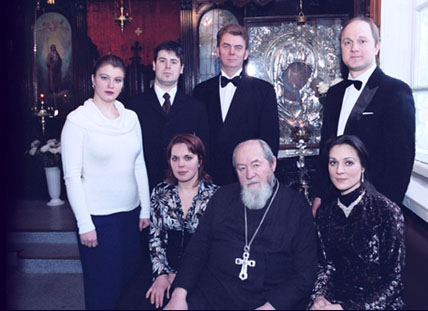 Con Anima, a vocal group from St. Petersburg Russia, will perform at Mount Vernon Presbyterian Church on Saturday March 3rd, 2007 at 7pm. The concert is free. Read more information about the Con Anima Russian choir.
The Mysterious Middle Piano Pedal
The nefarious middle piano pedal, the bane of piano teacher and student alike. Yes, it does have a function, but rarely used in contemporary music.
Piano pedals from left to right: una corda, sostenuto and damper.
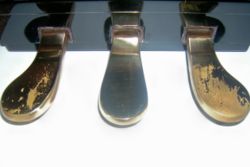
THE THREE PIANO PEDALS
Left Pedal
The left piano pedal is called the “una corda” pedal, or in common usage called the “soft” pedal. When the pedal is pressed the piano becomes softer. In most upright pianos this is done by dropping a piece of felt between the hammers and the strings which softens the attack. In grand pianos the entire keyboard will shift so that the hammers only hit two strings instead of three. (Grand pianos have three strings per note, so only hitting two of those strings reduces the volume by roughly 1/3). The word “una corda” in Italian means “one strings”. So why is it called “one string” when it actually hits two? The inventor of the piano, Cristofori (1655-1731), made his pianos with two strings per note instead of three like we use today. He also included a “soft pedal” which would hit only one string instead of two, so it made sense to call it “una corda”. His soft pedal had a larger impact on the sound by decreasing volume by one half instead of one third.
Right Pedal
The right piano pedal is called the “damper” pedal (commonly the “sustaining” pedal). This is the most commonly used pedal on the piano and is often simply referred to as “the pedal” because it is used so much. When the pedal is pressed, the dampers lift off the strings so the sound continues to vibrate. This also allows strings that have not been struck to ring sympathetically with the overtones of ringing strings. This creates a fuller sound. This pedal is often overused to cover up poor technique. Of course, it doesn’t actually cover up the poor technique, but the player often thinks it does. In practicing it’s usually good advice to practice without the sustain pedal in order to focus on good finger technique and interpretation. Once technique is mastered, then add the pedal.
Middle Pedal
The middle piano pedal is called the “sostenuto” pedal on grand pianos or the “practice pedal” on uprights. The middle pedal has different functions depending whether it is on an upright piano or full grand piano. Many spinet pianos (smaller upright pianos, the kind most people have in their living room) do not have a middle pedal at all. On grand pianos, the middle pedal will sustain any notes which are currently pressed. On upright pianos, this pedal will sustain any notes in the lower octave.
It is not often you will come across the necessity for the middle piano pedal. But it does occur fairly often in piano transcriptions by Franz Liszt. A good example is the Liszt transcription of Prelude and Fugue in C Major by JS Bach (BSV 544 – S462/2). This piece uses Bach’s common ground or pedal tone sustaining in the low actives with fast sixteenth note runs over the top. And that is the reason for this entire post. I am currently working on that Liszt transcription and thought it would be a great opportunity to explain the piano pedals in detail.
The middle piano pedal is the red headed step child of the pedal family. You may very well find on your spinet piano at home that it does absolutely nothing at all, or is just a soft pedal. You would probably not want to play a Liszt piece on a small spinet anyway, so it all works out in the wash.
Conrad’s Practical Pedal Postulates
Some piano teachers may bristle at this, but short of preparing concert material, my practical approach to pedals is this:
Right pedal sustain – Use to taste but reset often so the sound does not become muddy.
Middle Pedal sostenuto – Don’t use it (very rare)
Left Pedal Soft – Use to soften piano when accompanying vocalists or playing background music.
Music companies take crackdown to campuses
In a nationwide crackdown, the music industry is sending thousands more copyright complaints to universities this school year than last. In some cases, students are targeted for allegedly sharing a single mp3 file online. Read CNN Article.
Con Anima Russian Choir
St.Petersburg, Russia – Con Anima is a vocal ensemble of Saint Petersburg. Visit the Con Anima Russian Choir website.
Read a review of a Con Anima Church Concert.
All singers in the group are graduates of Saint Petersburg Conservatory. Conservatory in Russia is a higher musical educational establishment. Term of training – 5 years. Conservatory diploma has the same rank as that of a university.
We build our repertoire of religious music, Russian chamber and opera music of the 19th and 20th century, including compositions by P.Tchaikovsky, S.Rakhmaninov, S.Taneev, N.Rimsky-Korsakov, P.Chesnokov and other.
LISTEN TO AUDIO SAMPLE
Russian Choir Singing Psalm 103 – MP3
We try to arrange our concert programmes to deliver to audience the depth and spiritual wealth of Russian orthodox culture. We consider our activities as a part of ecumenical links among Christian confessions, thus besides its concerts Con Anima takes part in divine service in various Christian churches.
CON ANIMA VOCALISTS
Anton Malakhovsky, baritone
Olga Dudchenko, mezzosoprano
Andrey Gavrin, tenor
Natalia Savchenko, soprano
Vladimir Feliauer, bass
Ekaterina Arhangelskaya, soprano

Kenneth DeJong – Organist and Composer
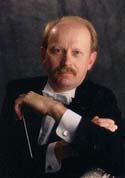 I have heard about Kenneth DeJong for many years and finally got to meet him at the Augsburg Fortress Music worskshop in Seattle, WA. An original wedding march he composed for organ was played by concert organist Douglas Cleveland (Music Director, Plymouth Congregational Church, Seattle, WA)
Mr. DeJong is music director for St. Andrew’s Lutheran Church in Bellevue, WA. This is the church I grew up in and was confirmed at. For many years as a young boy I sang and played at church services there, and they always let me practice in the sanctuary when I wanted. For a couple years that sanctuary felt like my second home. I never officially thanked St. Andrews for that – so here’s my official thank you.
I took advantage of access to their keyboard instruments and spent many hours playing the piano and organ in the sanctuary. For a while they even had a hand built harpsichord which I would tune by hand for Bach pieces. I also remember practicing jazz voicings on the church piano, and wondering if that was theologically sound. That was back in 1984 or so, church music has come a long way.
Kenneth is a composer, master organist, conductor and gifted vocalist One of his intriquing projects is singing with a male chorus consisting of all music conductors – it’s called Male Ensemble Northwest. I haven’t heard them yet, but he says it’s a great group – so it must be VERY good.
I have heard through the grapevine that Kenneth DeJong does very good work with congregational orchestras and ensembles. Hopefully I’ll meet up with him again to find out more info on that.
Kenneth DeJong – Organist and Music Director
St. Andrew’s Lutheran Church (Bellevue, WA)
Kenneth L. DeJong, Music Director and Principal Organist, has been at Saint Andrew’s since 1988. Following his undergraduate work and military service, he received a Master’s Degree in Conducting from the University of Washington. He taught for six years at Los Angeles Baptist College before returning to Seattle to pursue a doctorate degree. He has taught at Seattle Pacific University, Trinity Lutheran College, the University of Puget Sound, and the University of Washington.
He served as Music Director at Seattle’s First Presbyterian Church for six years, during which time he founded the Bellevue Chamber Chorus, which he conducted until 1998. He conducts the Lyric Arts Ensemble, sings in Male Ensemble Northwest, and is a frequent adjudicator and clinician. His Saint Andrew’s agenda includes worship hospitality and creativity, participation in vocal and instrumental ensembles by members of Saint Andrew’s, and creation of additional opportunities for growth and enjoyment of the arts in and around the Saint Andrew’s community. He is married to Kelley Mannon and they (with her son Brad) live in Issaquah.
Douglas Cleveland – Concert Organist
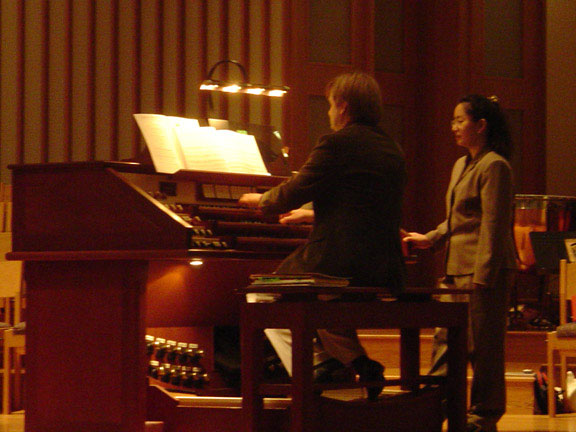
Douglas Cleveland is music director of Plymouth Congregational Church in Seattle, WA. He was our guide for the 2007 Augsburg Fortress music seminar. Mr. Cleveland is a master concert organist and played very difficult pipe organ music with ease. We picked up quite a bit of choral and pipe organ music and are currently integrating it into our worship services at Mt. Vernon Presbyterian Church.
Mr. Cleveland was an excellent host for this event and made our reading through the music an enjoyable experience. As an added bonus I got to hear original organ music by Kenneth DeJong, currently music director of the church I was confirmed at as a boy – St. Andrews Lutheran Church, Bellevue, WA.
Douglas Cleveland – Biography
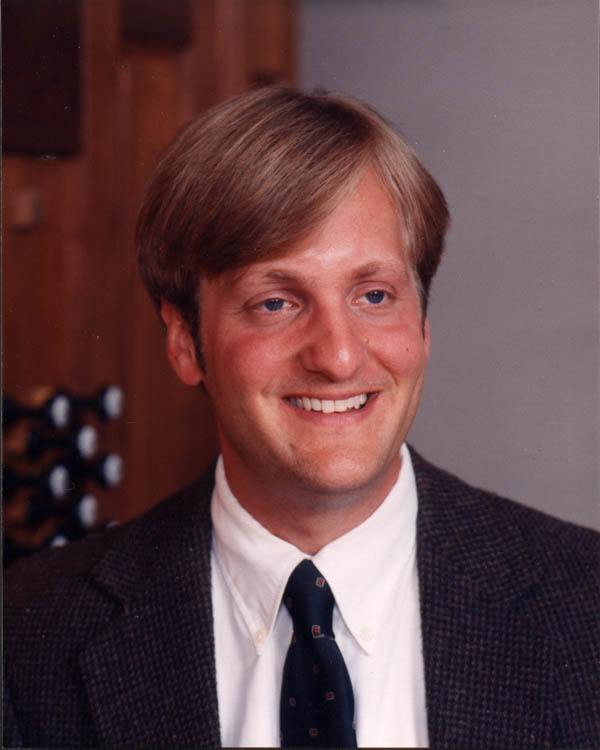 Douglas Cleveland began his tenure as Director of Music at Plymouth Congregational Church, Seattle in September of 2004. At Plymouth he directs three choirs and oversees a fine arts series.
A native of Washington State, Mr. Cleveland began his organ studies with Jane Edge in Olympia and continued his study in high school with Edward A. Hansen at the University of Puget Sound’s Community Music School. In 1986 he entered the Eastman School of Music of the University of Rochester where he earned the Bachelor of Music degree in 1990. While at Eastman, he served as Director of Music at the Lutheran Church of the Resurrection. As an undergraduate at Eastman, he won first prize in several organ competitions including The Westminster Choir College Graduate Competition, The Luther Place Memorial National Organ Competition in Washington, D.C., The Scarritt Undergraduate Competition in Nashville, Tennessee and the AGO Region VIII Competition in Seattle. He was also a finalist in the 1990 Grand Prix de Chartre, France and the Calgary International Organ Competition. Mr. Cleveland received the Master of Music degree in 1994 from Indiana University, Bloomington.
While at Indiana University, he served as assistant organist and choirmaster at Christ Church Episcopal Cathedral in Indianapolis, where he frequently directed the famed choir of men and boys and began the volunteer choir program. He also won first prize in the American Guild of Organists National Young Artists Competition in Dallas and the Ft. Wayne National Organ Competition.
Since winning these prizes, he has performed in 48 of the United States, as well as such venues as Westminster Abbey, Notre-Dame Cathedral, The Cathedral of Berlin, St. Patrick’s Cathedral in Melbourne, The Moscow Conservatory, and the Minato Mirai Concert Hall in Yokohama, Japan. He has performed with several symphony orchestras including the National Symphony at the National Cathedral in Washington, D.C. Mr. Cleveland served as Assistant Professor of Organ and Church Music at Northwestern University from 1999 to 2004. While on the faculty of Northwestern, he received the Searle Fellowship for teaching excellence. He served as a visiting faculty member at St. Olaf College in 1997. Mr. Cleveland has recorded three CD’s which have received critical acclaim in Fanfare, The American Record Guide, The Organists Review, The American Organist, The Diapason, the Association of Anglican Musicians and the Living Church Magazine.
Current as of September 2006
Pipe Organ at Plymouth Congregational Church
Seattle, WA
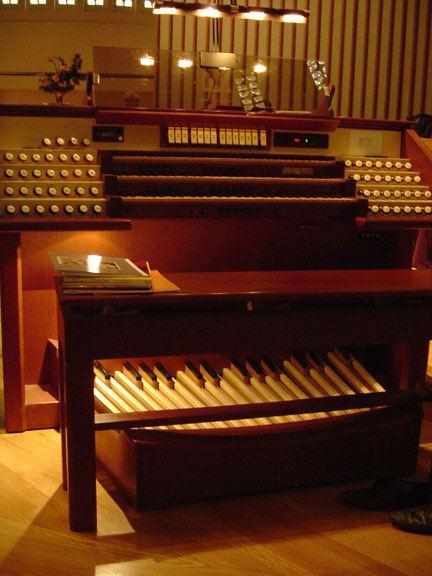
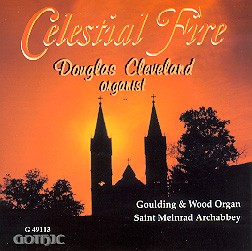
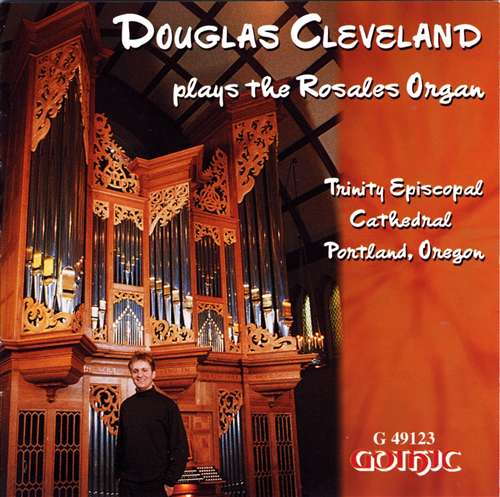
Douglas Cleveland CD Recording Covers
Bringing Vocals Forward
The challenging part of vocal coaching is getting singers to understand the feeling of vocal placement for their particular voice. It’s common at some point to show a vocalist an actual anatomy picture of the throat and muscles involved in vocal production. After that, it’s a mind game to have them understand the nuance of their own instrument.
One way to have singers bring the sound forward is to have them push out with their hands slowly while they are singing. It will look something like water aerobics – a bit silly looking and awkward. But I’ve heard this work well with individuals and especially in larger vocal ensembles. Just in bringing the hands forward I would estimate a 30% increase in overall volume without degradation of tone.
With a vocalist recently we tried this excercise but it wasn’t producing the desired effect. So I had them actually walk forward slowly while singing several phrases. For this particular vocalist it did the trick. The lightbulb went off in their head and they were very excited to feel the difference in bringing the sound forward.
Often I have heard a vocalist who is singing individual notes, but not driving through the end of a phrase. It’s as if they are sitting complacently on each note. The hand and walking excersises prove useful in getting a vocalist to visualize the forward motion of a phrase.
When a vocal phrase is “given up on” before it’s completion, it’s not very interesting to listen to. Why should the listener be engaged if the vocalist is not interested in the phrase? By singing through with intent to the very last note of a phrase, the listener is engaged in what is happening.
The walking forward is nothing I have ever read about – but came about because of a related idea I keep in mind. If you are instructing someone and they are not fully grasping the thought then you have two basic approaches: you can keep repeating the same information until they get it, or you can find a new way to explain the concept. I have found that finding a new analogy or explanation is infinitely more productive. I’ve slowly made it a habit. The reward is seeing the lightbulb shine in someone’s eyes; yes, they’ve got it!
And the thought that drives the creation of different examples is this: Know the final outcome you want. Chances are there are many varied roads to get there. Just pick one.