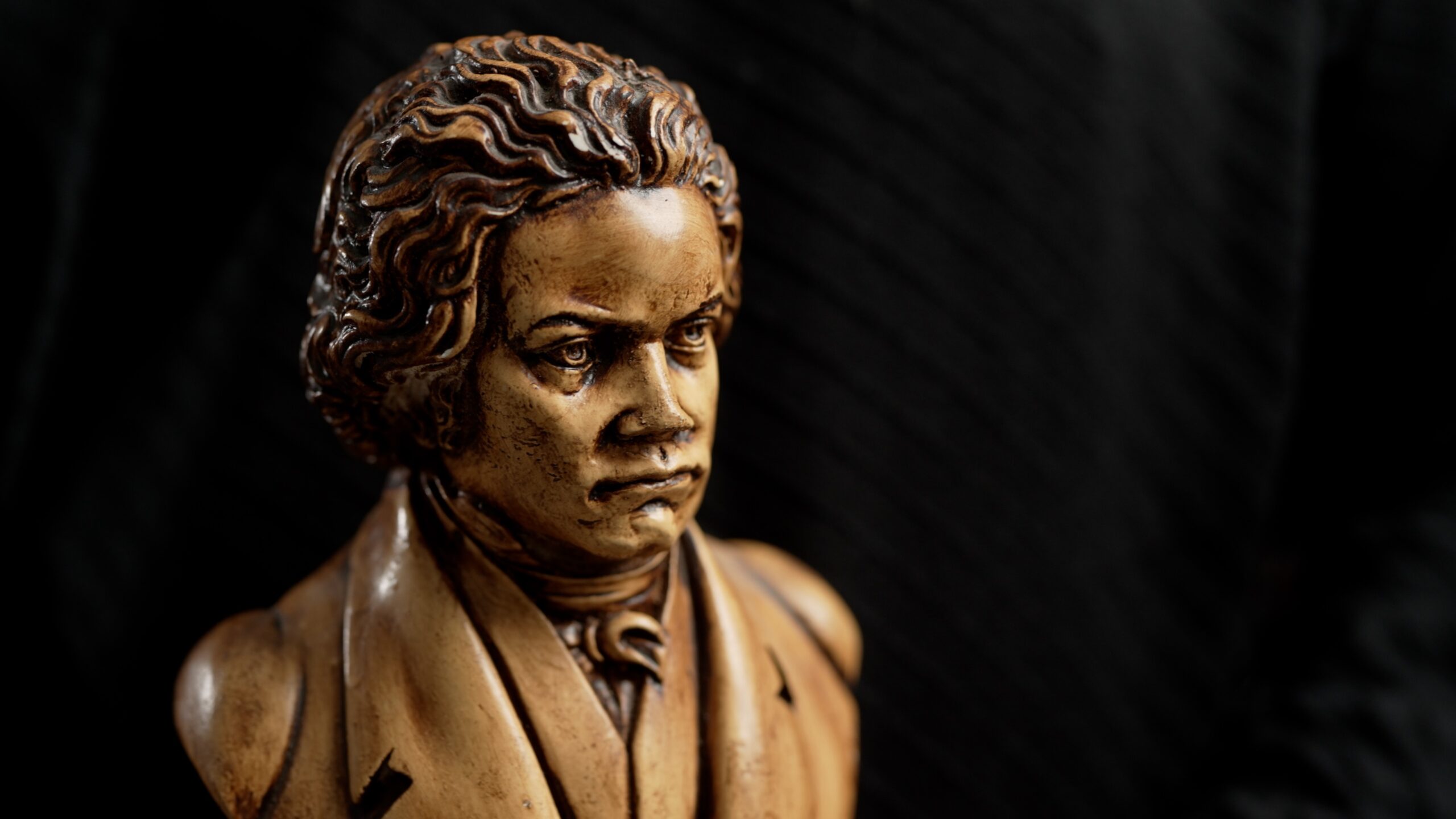
A bust of Beethoven, forty years later, and what it taught me about taste, commitment, and why some things define us.
The top people in the arts and in business all share one thing: a strong sense of aesthetics, and the discipline to commit to it.
So what is aesthetics, exactly, and how do you develop yours?
There is a bust of Beethoven that sits on my piano. I made it when I was twelve years old. My taste has changed in many things over the years, but my taste in this has not. I still love it. And in trying to figure out why, I think I have found something important about the difference between taste and aesthetics, about commitment, and about doing the work that makes a life feel distinctly yours.
A Twelve-Year-Old’s Side Hustle
When I was twelve, I made these busts and sold them to music stores and furniture stores around Seattle and Bellevue. They were popular. I sold a lot of them. It is kind of exciting to think that all over the world right now, there are still some of these busts sitting in people’s homes.
I had forgotten about them entirely until I ran across one in storage. What hit me immediately is that I love the look as much today as I did then. It has a classic patina. Something about it just works.
Rediscovering this thing, forty years later, got me thinking about what aesthetics actually is. It is not surface polish. It is not an architectural detail. It is something more fundamental than that.
Aesthetics is the bar you set for yourself and your team.
Time, Skills, Money: Pick Two
There are usually three constraints in play: time, skills, and money. It is rare you have all three at the same time. The one place I have seen all three line up was Cirque du Soleil, where I worked as a music director on tour. Cirque can hire people with the highest skill sets. They allot the time projects need. And they are well funded.
In most situations, you are going to have to choose. There is a saying common with techs backstage: “You can have it fast, you can have it cheap, or you can have it high quality. Pick two.”
So what happens when your aesthetic drive, your bar, is higher than your skill set?
Everyone has been there, especially when starting out. You have a vision of what you want to make, and what you are actually capable of making is not there yet.
The only way out is through. You have to iterate. You have to create. This is true in business and in the arts. You are going to look back in ten years at what you make today and think, “Wow, I could do so much better now.” That is the whole plan. You improve as you go.
You can plan all you want, but a business plan only takes you so far. At some point you start the business, and that is when you find out what needs to change. If you keep working on projects, iterate, and decompress on what went well and what did not, you are going to get better.
Years later, people will ask, “How did you know this?” You will smile and say, “I do not know.” But somewhere along the line you learned it on a project, not just by thinking about it.
The Hard Part: Mismatched Bars
Here is where it gets harder. There can be moments of creative frustration when your own aesthetics do not match your own skill set. More often, this frustration shows up in groups, where the team has a mismatch in skill sets and aesthetic bars.
The corporate culture of Cirque du Soleil is that everyone just knows they are striving for the highest bar possible. It never has to be said. It is understood.
That kind of commitment does not only show up at the top of the industry. It shows up in small ways too. And looking at this bust, I think I may have figured something out when I was twelve.
The Blank Bottom
When I rediscovered the bust, I flipped it over to see how I had signed it.
There was no signature. It was blank.
And then I realized: of course I did not sign it. Even at twelve, I knew I did not have the right to sign this bust unless I actually created it. I only painted it. I did not sculpt it.
That instinct to honor the work that other artists do is something I still take seriously today.
I noticed something else on the bottom: little protective felt patches, four of them, to protect the furniture the bust sat on. In this version, four small pieces. Kind of ugly. But in a later version I found, the bottom was covered with one large piece of green felt. It looked more beautiful and protected the furniture better.
A small step, but even at twelve I was iterating, both aesthetically and ergonomically. To my twelve-year-old self: well done.
Style Is What You Refused to Let Go Of
Here is what I have come to think aesthetics actually is.
It is not a preference you have. It is a commitment you keep.
The things that survive your changes of mind are the things that will define you. Style is the residue of the aesthetics you would not let go of.
If there is an artist whose style you love, that artist did not wake up one day and choose it. The style developed over many iterations of choosing commitments to aesthetics.
Over time you will have different influences and outside voices telling you to give up an aesthetic. “This is important.” “You could save money if you did not do this.” Each one is a decision for you to make.
Think of a large company you really admire. Now think back to their early years, to a moment when they stuck to an aesthetic commitment despite everyone telling them not to. I can think of five companies. Every one of them has an origin story where the founders held the line on a specific aesthetic and did not budge.
If everything was taken away from you, which aesthetic would still be true for you? Which would you still commit to? There is an answer in there about your life direction. It does not matter whether it is business or the arts. They come from the same core.
What’s Going to Survive Yours?
Look around your room. What things do you have that are still there from ten, twenty, thirty years ago? They are not there because you forgot to throw them out. That is worth paying attention to. It is not just nostalgia. It is a choice you have been making, over and over and over, about the aesthetics you want in your life. You may have been making those choices without being aware of it. Without naming it.
But once you can name it, you can build it.
This Beethoven bust has survived forty years of my changes of mind.
What is going to survive yours?