Copy and paste this code into notepad or text editor, then re-copy into code. If you just copy off this page it won’t work. phpbb forum list include.
*Update 01/08 – only use second line between question marks and accompanying arrow markers. Then if needed designate as code in post interface. Turn off rich text editor in use profile. Retype code from scratch if necessary. Works. Instead of sticky, set post as announcement.*
On October 26, 1984, Dr. Leonard L Bailey placed the heart of a baboon into the chest of Baby Fae, an infant born with a severe heart defect known as left hypoplastic heart. Baby Fae seemed to do well for a few days; then her body mounted a massive immunological attack on the foreign tissue and rejected the graft. Baby Fae’s death came as no surprise to scientists and physicians familiar with the human immune system and with the scientific realities that preclude successful cross-species transplants.
Before the Baby Fae incident, Bailey, a surgeon at Loma Linda University Medical Center, spent almost a decade vainly pursuing research grants. His work in xenografts, largely unknown and unrcviewed by other professionals, had not appeared in journals and was funded by Bailey himself and his colleagues.1,2 During the seven years preceding the Baby Fae baboon transplant, he performed some 160 cross-species transplants, mostly on sheep and goats, none of whom survived more than 6 months. Although warned by a colleague at a medical conference that his research was too incomplete to risk using human subjects,3 Bailey went ahead.
Baby Fae was not the first human to receive a primate xenograft. In a review of xenografts,4 the Council of Scientific Affairs of the American Medical Association noted a rapid rejection of all baboon transplants to humans. Nevertheless, Bailey claimed that the problems of rejection could be overcome by the “immature” state of an infant’s immune system. After the operation, immunologists from around the world pointed out that the part of the immune system that rejects unmatched transplants is fully mature at birth, Furthermore, there is no way to match baboon hearts to human recipients, because baboons have no antigens in common with human tissue.5 Bailey has always maintained that Baby Fae’s death was unrelated to the species of the organ “donor.” An editorial in the Journal of the American Medical Association called Bailey’s claim “wishful thinking.”5
Bailey’s use of baboons was somewhat surprising, given their relatively distant evolutionary relationship to humans compared to other primates. The reason came to light when the Times of London published an interview between Bailey and an Australian radio crew. The reporters had been forbidden to ask direct questions about the operation, so they queried Bailey on the issue of why he had chosen a baboon in view of the baboon’s evolutionary distance from humans. Bailey replied, “Er, I find that difficult to answer. You see, I don’t believe in evolution.”6 It is shocking that Bailey ignored basic biological concepts in formulating a life-threatening human experiment.
Often, ambitious surgeons wish to perform new, perhaps dangerous, experimental operations. In an effort to safeguard patients, institutional review boards must first give permission for any human experiment. In an unconscionable lapse of ethics, the review board of Loma Linda Medical Center failed to live up to its obligations — they gave Bailey permission for five baboon-to-human transplant experiments, having no reports documenting that even heart allotransplantation in infancy is successful.5 Furthermore, highly experimental procedures on children, such as a xenograft, require special permission from the Secretary of Health and Human Services.7
In addition to these institutional and federal safeguards that should have protected Baby Fae, California’s Protection of Human Subjects in Medical Experimentation Act (PHSMEA) requires that if informed consent is given in behalf of another person, the experimental procedure must meet certain criteria. California’s Health and Safety Code ~24175, subsection (e) states, “Informed consent given by a person other than the human subject shall only be for medical experiments related to maintaining or improving the health of the human subject or related to obtaining information about a pathological condition of the human subject.”
Because Bailey did not look for a human heart donor and did not refer Baby Fae elsewhere for attempted surgical repair, the highly experimental transplant was both unethical and unlawful. Dr. William Norwood at the Children’s Hospital in Boston has been repairing left hypoplastic hearts since 1979. The survival rate of the Norwood procedure is now as high as 75 percent Nevertheless, Baby Fae’s consent form read, “Temporizing operation to extend the lives of babies like yours by a few months have generally been unsuccessful. We believe heart transplantation may offer hope of life for your baby. Laboratory research at Loma Linda University over the past seven years, including over 150 heart transplants in newborn animals, suggest that long term survival with appropriate growth and development may be possible following heart transplantation during the first week of life.”
Following considerable controversy over the Baby Fae transplant, the National Institutes of Health (NIH) appointed a special committee charged with reviewing the procedures used by the university to assure that Baby Fae’s relatives gave proper informed consent. The committee did not deal with the scientific basis for transplanting a baboon heart into a human. The committee found several weaknesses in the consent procedure. Specifically, the committee concluded that possibility of “long term survival” had been overstated and the protocol did not include searching for or transplanting a human heart. The committee’s report did not address why Loma Linda had not sought permission for this unprecedented experiment from the Secretary of Health and Human Services. Furthermore, it did not address the California law that should have prevented the experiment. (Perhaps the NIH committee was unaware of PHSMEA.)
Why hasn’t Bailey been prosecuted? The San Bernandino District Attorney’s office has officially stated that there are insufficient facts to support a felony prosecution. Unofficially, I was told that the highly technical nature of the case would likely overwhelm the court with conflicting medical opinions and therefore make a conviction unlikely. Furthermore, Bailey is considered a local hero. The office of the California State Attorney General, John K. Van de Kamp, has also maintained that Sufficient facts are available to establish that a crime occurred.
The facts, however, suggest that Baby Fae was sacrificed to Leonard Bailey’s career. Given the state of current medical knowledge, there was no doubt that Baby Fae would reject the baboon heart. Rules and laws designed to protect her were violated by those entrusted to uphold them. Professional ethics were considered to be of less importance than widespread publicity. The institutional review boards and law enforcement agencies responsible for protecting human subjects have virtually no accountability to the public, much less to the experimental subjects themselves.
References
1. Anon: Next please. PCRM Update, July-August, 1985.
2. Roe BR, Glaser RH: The lessons of the Baby Fae Case (letter). The Wall Street Journal Dec 24, 1984.
3. Mathews J: Colleague warned doctor before Baby Fae implant. Washington Post, 1984.
4. American Medical Association Council on Scientific Affairs: Xenografts: Review of the literature and curreut status. JAMA l985;254:3353-3357,
5. Jonasson O, Hardy MA: The case of Baby Fae (letter). JAMA 1985;254:3358-3359.
6. Gould SJ: The heart of erminology What has an abstruse debate over evolutionary logic got to do with Baby Fat? Natural History 1988;97:24.
7. Department of Health and Human Services: Final regulations amending basic HIHS policy for the protection of human research subject. Federal Register 1981;465:8366-8392.
Mists of the Highlands Reach Skagit
by Bev Crichfield – Skagit Valley Herald www.GoSkagit.com
 Mount Vernon, WA – Welcome to the Scottish Highlands, where the mists of the moors hide a magical town called Brigadoon, and weary travelers can spend a day enjoying good music, friendship and even find the ever-elusive true love of their lives.
But be careful — it can only happen one day out of a century.
Everything about the Broadway musical “Brigadoon†is enough to make a woman swoon, said Brenda Mueller, director of the Lyric Light Opera’s production of the 1947 Lerner and Loewe classic set for three weekends in July at McIntyre Hall in Mount Vernon.
“You cannot find any more beautiful music from a musical than in ‘Brigadoon,’†Mueller said, while preparing to lead the chorus through a scene last week during rehearsals.
The romantic storyline continues to satisfy the imaginations of audiences years after it was written, Mueller said. “It’s magical. There’s the mists of the Highlands; you enter it and it just sweeps you away.â€
The production is the perfect fit for the Scottish-themed lineup of events throughout July in Skagit Valley, Mueller said. Lyric Light Opera is collaborating with the Skagit Valley Highland Games, set for July 14-15 at Edgewater Park in Mount Vernon.
Part of that collaboration has meant a few professional bagpipers who will compete in the games have offered to add the uniquely Highland sound of their instruments to the 23-member orchestra, which includes violins, woodwinds and a more classical style of music than most Broadway musicals.
Although it’s usually performed as a typical stage musical, Brigadoon has been considered borderline opera, and sometimes is performed by opera companies, Mueller said.
Standing in the hallway of the church where the 45-member cast was rehearsing last week, opera singer Megan Chenovick, who plays the female lead Fiona, said she was excited by the opportunity to do some “classical†singing for her part.
“There’s some great music and so many standards that people are going to recognize,†Chenovick said, including the romantic “Come To Me, Bend To Me,†and “The Love Of My Life.â€
Some of the tunes were so well-written that there isn’t much a singer has to do to make them new and fresh, said Tim Glynn, who plays the young, energetic Charlie.
“ ‘Come To Me, Bend To Me’ makes me feel so not needed,†Glynn said. The emotions that flow out of the lyrics and music are enough by themselves to sway an audience, he said.
Glynn is one of five professional performers hired by Lyric Light Opera for the $100,000 show. Those leads come from Seattle and have performed with such large theater companies as the 5th Avenue in Seattle and the Village Theatre in Everett and Issaquah.
Many cast members in the Stanwood-area based group are from Anacortes, Arlington, Bellevue, Camano Island, Marysville and Mount Vernon.
“Brigadoon†is the second big Lyric Light Opera production since the group was formed in 2006 out of the remnants of the Northwest Civic Light Opera. It’s a larger, more elaborate — and costly — endeavor than the group’s first show last July, “Annie Get Your Gun.â€
And despite the hiring of five professional performers, Mueller said she’s sticking firmly to the group’s aim to provide opportunities for local young theater hounds to learn the ins and outs of theater production.
The professional actors were hired on the condition that they serve as mentors to other, less-experienced members of the cast — an arrangement that’s already reaping benefits, Mueller said.
“We have a high level of excellence in our shows, and this is a part of that,†Mueller said.
She said she’s trying to stay as true as possible to the Scottish tradition.
Despite its Scottish backdrop, the real story of “Brigadoon†is based on a fairy tale from Germany, written by Friederich Gerstacker, about a mythical cursed village. In 1947, when the musical was written for Broadway, the United States had just come out of World War II and American audiences weren’t fond of Germany. So the location of the story and its character names were changed to reflect a Scottish theme.
Through the day they meet a list of colorful characters: The aggressively lovelorn Meg, who’s searched high and low for a husband; Harry Beaton, who is in love with the beautiful Jean; Angus McGuffie, who employs Meg and the gentle and good-hearted Fiona.
Oh, and did we mention that Fiona is beautiful? That goes without saying — this is, after all, a fairy tale at heart.
As the day goes on, Tommy finds himself falling in love with Fiona. The mystery of the village is revealed, too. Turns out, a parish priest 200 years prior to their arrival made a pact with God to make the village disappear only to become visible once every 100 years to protect it from the evils of the outside world. If someone leaves the village, it will disappear into the mist forever.
As the story continues, the future of the village is threatened, jealousy leads to tragedy, and Tommy and Fiona discover they’re a perfect match.
“The reason I like ‘Brigadoon’ so much is that there’s such a really broad emotional spectrum,†said Ryan Edwards of Arlington, who plays the jealous and self-absorbed Harry Beaton. “They explore a lot of difficult emotions that makes the play sentimental, a bit moody, tragic and a bit elated, in back-to-back scenes.â€
Aside from the rigorous dancing that incorporates hopping, twirling and some ballet — a totally new challenge for Edwards — the other big challenge for the cast has been adopting an authentic, but intelligible, Scottish brogue.
“I didn’t know anything about the Scottish accent (before the show),†said Jeannette d’Armand of Seattle, who plays the bubbly and flirtatious Meg.
“You don’t dress up, you dress oop,†she added, laughing.
Then there’s the constant rolling of the “Rs,†that keeps the actors constantly thinking about their words, she said.
“But it’s been fun for me — something new to learn,†she said.
Older Woman: I’d give it to you but I don’t have one.
Officer:Â Â Don’t have one?
Older Woman:Â Â Lost it, 4 years ago for drunk driving.
Officer:Â Â I see…Can I see your vehicle registration papers please.
Older Woman:Â Â I can’t do that.
Officer:Â Â Why not?
Older Woman:Â Â I stole this car.
Officer:Â Â Stole it?
Older Woman:Â Â Yes, and I killed and hacked up the owner.
Officer:Â Â You what?
Older Woman:Â Â His body parts are in plastic bags in the trunk if you want to see.
The Officer looks at the woman and slowly backs away to his car and calls for back up. Within minutes 5 police cars circle the car. A senior officer slowly approaches the car, clasping his half drawn gun.
Officer 2:Â Â Ma’am, could you step out of your vehicle please! The woman steps out of her vehicle.
Older woman:Â Â Is there a problem sir?
Officer 2:Â Â One of my officers told me that you have stolen this car and murdered the owner.
Older Woman:Â Â Murdered the owner?
Officer 2:Â Â Yes, could you please open the trunk of your car, please.
The woman opens the trunk, revealing nothing but an empty trunk.
Officer 2:Â Â Is this your car, ma’am?
Older Woman:Â Â Yes, here are the registration papers. The officer is quite stunned.
Officer 2:Â Â One of my officers claims that you do not have a driving license.
The woman digs into her handbag and pulls out a clutch purse and hands it to the officer.
The officer examines the license. He looks quite puzzled.
Officer 2:Â Â Thank you ma’am, one of my officers told me you didn’t have a license, that you stole this car, and that you murdered and hacked up the owner.
Older Woman:Â Â Bet the liar told you I was speeding, too.
GREAT TRUTHS THAT LITTLE CHILDREN HAVE LEARNED:
1) No matter how hard you try, you can’t baptize cats.
2) When your Mum is mad at your Dad , don’t let her brush your hair.
3) If your sister hits you, don’t hit her back. They always catch the second person.
4) Never ask your 3-year old brother to hold a tomato.
5) You can’t trust dogs to watch your food.
6) Don’t sneeze when someone is cutting your hair.
7) Never hold a Dust-Buster and a cat at the same time.
8.) You can’t hide a piece of broccoli in a glass of milk.
9) Don’t wear polka-dot underwear under white shorts.
10) The best place to be when you’re sad is Grandpa’s lap.
GREAT TRUTHS THAT ADULTS HAVE LEARNED:
1) Raising teenagers is like nailing jelly to a tree.
2) Wrinkles don’t hurt.
3) Families are like fudge…mostly sweet, with a few nuts.
4) Today’s mighty oak is just yesterday’s nut that held its ground.
5) Laughing is good exercise. It’s like jogging on the inside.
6) Middle age is when you choose your cereal for the fiber, not the toy.
GREAT TRUTHS ABOUT GROWING OLD:
1) Growing old is mandatory; growing up is optional.
2) Forget the health food. I need all the preservatives I can get.
3) When you fall down, you wonder what else you can do while you’re down there.
4) You’re getting old when you get the same sensation from a rocking chair that you
once got from a roller coaster.
5) It’s frustrating when you know all the answers but nobody bothers to ask you the questions.
6) Time may be a great healer, but it’s a lousy beautician.
7) Wisdom comes with age, but sometimes age comes alone.
THE FOUR STAGES OF LIFE:
1) You believe in Santa Claus.
2) You don’t believe in Santa Claus.
3) You are Santa Claus.
4) You look like Santa Claus.
SUCCESS:
At age 4 success is . . . not piddling in your pants.
At age 12 success is . . . having friends.
At age 17 success is . having a drivers license.
At age 35 success is . . having money.
At age 50 success is . . . having money.
At age 70 success is . …. . having a drivers license.
At age 75 success is . . . having friends.
At age 80 success is . . . not piddling in your pants.
i cdnuolt blveiee taht I cluod aulaclty uesdnatnrd waht I was rdanieg. The phaonmneal pweor of the hmuan mnid, aoccdrnig to a rscheearch at Cmabrigde Uinervtisy, it dseno’t mtaetr in waht oerdr the ltteres in a wrod are, the olny iproamtnt tihng is taht the frsit and lsat ltteer be in the rghit pclae. The rset can be a taotl mses and you can sitll raed it whotuit a pboerlm. Tihs is bcuseae the huamn mnid deos not raed ervey lteter by istlef, but the wrod as a wlohe. Azanmig huh? yaeh and I awlyas tghuhot slpeling was ipmorantt!
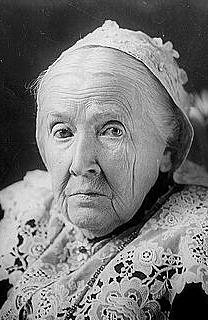
This hymn was born durÂing the AmerÂiÂcan ciÂvil war, when Howe visÂitÂed a UnÂion ArÂmy camp on the PoÂtoÂmac RivÂer near WashÂingÂton, D. C. She heard the solÂdiers singÂing the song “John Brown’s Body,†and was takÂen with the strong marchÂing beat. She wrote the words the next day:
I awoke in the grey of the mornÂing, and as I lay waitÂing for dawn, the long lines of the deÂsired poÂem beÂgan to enÂtwine themÂselves in my mind, and I said to myÂself, “I must get up and write these versÂes, lest I fall asleep and forÂget them!†So I sprang out of bed and in the dimÂness found an old stump of a pen, which I reÂmemÂbered usÂing the day beÂfore. I scrawled the versÂes alÂmost withÂout lookÂing at the pÂaper.
The hymn apÂpeared in the AtÂlantÂic MonthÂly in 1862. It was sung at the funÂerÂals of BritÂish statesÂman WinÂston ChurchÂill, AmerÂiÂcan senÂatÂor RoÂbert KenÂneÂdy, and AmÂerÂiÂcan preÂsiÂdents RonÂald ReaÂgan and RiÂchard NixÂon.
Music: John Brown’s BoÂdy, possÂiÂbly by John WillÂiam Steffe. John Brown was an AmerÂiÂcan aboÂliÂtionÂist who led a short lived inÂÂsurÂÂrectÂÂion to free the slaves.
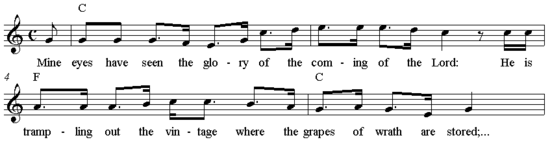
SAMPLE MUSIC – FIRST LINE
LYRICS FOR BATTLEÂ HYMN
Mine eyes have seen the glory of the coming of the Lord;
He is trampling out the vintage where the grapes of wrath are stored;
He hath loosed the fateful lightning of His terrible swift sword;
His truth is marching on.
Glory! Glory! Hallelujah! Glory! Glory! Hallelujah!
Glory! Glory! Hallelujah! His truth is marching on.
I have seen Him in the watch fires of a hundred circling camps
They have builded Him an altar in the evening dews and damps;
I can read His righteous sentence by the dim and flaring lamps;
His day is marching on.
Glory! Glory! Hallelujah! Glory! Glory! Hallelujah!
Glory! Glory! Hallelujah! His day is marching on.
I have read a fiery Gospel writ in burnished rows of steel;
“As ye deal with My contemners, so with you My grace shall dealâ€;
Let the Hero, born of woman, crush the serpent with His heel,
Since God is marching on.
Glory! Glory! Hallelujah! Glory! Glory! Hallelujah!
Glory! Glory! Hallelujah! Since God is marching on.
He has sounded forth the trumpet that shall never call retreat;
He is sifting out the hearts of men before His judgment seat;
Oh, be swift, my soul, to answer Him! be jubilant, my feet;
Our God is marching on.
Glory! Glory! Hallelujah! Glory! Glory! Hallelujah!
Glory! Glory! Hallelujah! Our God is marching on.
In the beauty of the lilies Christ was born across the sea,
With a glory in His bosom that transfigures you and me:
As He died to make men holy, let us live to make men free;
[originally …let us die to make men free]
While God is marching on.
Glory! Glory! Hallelujah! Glory! Glory! Hallelujah!
Glory! Glory! Hallelujah! While God is marching on.
He is coming like the glory of the morning on the wave,
He is wisdom to the mighty, He is honor to the brave;
So the world shall be His footstool, and the soul of wrong His slave,
Our God is marching on.
Glory! Glory! Hallelujah! Glory! Glory! Hallelujah!
Glory! Glory! Hallelujah! Our God is marching on.
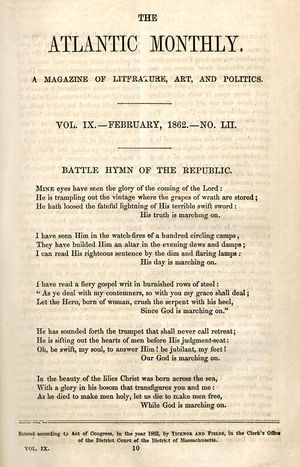
ORIGINAL PUBLICATION – BATTLE HYMN LYRICS
HISTORY OF BATTLE HYMN OF THE REPUBLIC
The tune was written, around 1855, by South Carolinian William Steffe. The lyrics at that time were alternately called “Canaan’s Happy Shore” or “Brothers, Will You Meet Me?” and the song was sung as a campfire spiritual. The tune spread across the United States, taking on many sets of new lyrics.
A man from Vermont named Thomas Bishop joined the Massachusetts Infantry before the outbreak of war and wrote a popular set of lyrics, circa 1860, titled “John Brown’s Body” which became one of his unit’s walking songs. According to writer Irwin Silber (who has written a book about Civil War folksongs), the song was not about John Brown, the famed abolitionist, but a Scotsman of the same name who was a member of the 12th Massachusetts Regiment. An article by writer Mark Steyn explains that the men of John Brown’s unit had made up a song poking fun at him, and sang it widely.
Bishop’s battalion was dispatched to Washington, D.C. early in the Civil War, and Julia Ward Howe heard this song during a public review of the troops in Washington. As with many others, she assumed it was about John Brown the abolitionist. Her companion at the review, the Reverend James Clarke, suggested to Howe that she write new words for the fighting men’s song, and the current version of “Battle Hymn of the Republic” was born.
Howe’s “The Battle Hymn of the Republic” was first published on the front page of The Atlantic Monthly of February 1862. The sixth verse written by Howe, which is less commonly sung, was not published at that time. The song was also published as a broadside in 1863 by the Supervisory Committee for Recruiting Colored Regiments in Philadelphia.
Julia Ward Howe was the wife of Samuel Gridley Howe, the famed scholar in education of the blind. Samuel and Julia were also active leaders in anti-slavery politics and strong supporters of the Union. Julia was visiting a Union camp when she heard the soldiers singing “John Brown’s Body” and was inspired to write the words to “The Battle Hymn of the Republic”.