June 10 – Final Choir Sunday – Summer Break
Ave Verum Corpus
Vivaldi Mass in C Major – Gloria and Close
Hymn Medley
June 3
Hymn Medley
May 27 – Pentecost Sunday
How My Soul Doth Savor – Handel
Every Time I Feel the Spirit
May 20
Children’s Service – Led by Youth
Children Sing Hosanna – Children/Glorify/Choir
May 13
Mother’s Day
Panis Angelicus
May 6
Guest Artist Stephanie Bethea
Bolling Suite for Jazz Piano and Flute
April 29
Youth Sunday
No Choir or Glorify today
April 22
There’s Room at the Cross for You – Chancel
Turn Your Eyes Upon Jesus – Chancel
Amazing Grace, Jesus Lover of My Soul – Glorify
Prelude – Organ Fugue in G minor – JS Bach
April 15
Guest Artist – Kathy Kahn
April 8
Crown Him With Many Crowns – Mass Choir
Holy, Holy, Holy
April 1
Untitled Hymn – Ferdinand Ortega
February 25
Now Is The Time To Worship
Better Is One Day
Come Be Here With Me
February 18
Guest Artist: Pachelbel Trio Sonata
Choir: Gloria from Vivaldi Mass
February 11
Guest Artist: Kalli Richards
Choir: Sons and Daughters of the King
Here I Am To Worship
Morning Has Broken
February 4
January 28
Lord, Guide My Feet – Chancel Choir
I Release and I Let Go – Chancel Choir with Ria Peth
Doxojazzology – Ria Peth
Come Thou Font of Every Blessing
Be Unto Your Name
In Christ Alone
January 21
Fugue in G Minor – JS Bach
Blest Are They – Chancel Choir
What a Friend We Have in Jesus – Choir SATB
Guests – Lyric Light Opera of the Northwest
O For a Thousand Tongues to Sing
January 14
Lift Every Voice and Sing
We Shall Overcome
Hear Your Praises
January 7
Pie Jesu – Andrew Lloyd Webber
Lord I Want to Be a Christian – Choir
Holy Holy Holy, Lord God Almighty
Thank You For This Day
Blessed Be Your Name
Thou Font of Every Blessing
Bach Organ Prelude and Fugue in Bb Major
Sunday Services 2006
December 31
Guest minister – Gretchen Cohan
PH28, PH59
Choir/Glorify: Lord Most High, Shout to the Lord
Hymn: PH357
December 24 – Evening Christmas Eve Service
Bach Organ Preludes and Fugues in C Major and F Major
The Birthday of a King
Gesu Bambino
December 24 – Morning Service
Where Shepherds Knelt Gently
December 17
The Jesus Gift
Children’s Service with Brass Quintet
December 10
Introit – Prepare Ye The Way of the Lord
Choir Anthem – Gesu Bambino
Come Emmanuel – PH9
Come, Now Is The Time To Worship
Better Is One Day
Shine On Us
Come, Thou Long Expected Jesus – PH2
December 3
Anthem – Come Emmanuel
Lift Up Your Heads, Ye Mighty Gates – PH 8
We Bring the Sacrifice of Praise – LH 59
God of Wonders
Emmanuel – LH 143
The Lord’s Prayer – sung after communion
Rejoice, Rejoice Believers – PH 15
November 26
Offertory – Sonata in C – WA Mozart
Chancel Choir: Simple Gifts
PH 151
Thank You For This Day
You Are My King
More Precious Than Silver
November 22 – Thanksgiving Eve Service
November 19
Prelude – El Shaddai – Amy Grant
Introit – Thank You For This Day
Anthem – Ave Verum Corpus – WA Mozart
Offertory – Be Thou My Vision – Louise Cheney – Violin
Postlude – Be Thou My Vision – Louise Cheney – Violin
Be Unto Your Name
We Gather Together
Come and Meet With Me
November 12
Anthem – Panis Angelicus – Cesar Franck
Organ Prelude and Fugue in G Major – JS Bach
May the Words of My Mouth
PH 485
Come and Fill Me Up
Blessed Be Your Name
November 5
Prelude – We Bow Down
Postlude – Eine Kleine Nachtmusik – WA Mozart
The Promise – Chancel Choir
The Old Rugged Cross
The River Is Here
Lord Most High
May The Words of My Mouth
October 29
Organ Postlude – Toccata and Fugue in D minor – JS Bach
What a Friend We Have In Jesus
Lord Reign In Me
We Want To See Jesus Lifted High
How Great Is Our God
October 22
The Holy City – Solo Iva Rauch
Prelude – The Old Hundredth
PH464 – Joyful, Joyful We Adore Thee
How Great Is Our God
Above All
Anthem – O Lord Hear My Prayer
Amazing Grace
.
October 15
Robes – Yes
Prelude – Nobilis Humilis – Christy Swartz – Harp
Offering – Con Te Partirò – Christy Swartz Harp
Choir Anthem – Sing a New Song – Michael Haydn (1737-1806)
All Hail the Power of Jesus’ Name (Glorify)
Come Thou Font of Every Blessing (Glorify)
We Want to See Jesus Lifted High (Glorify)
Here Our Praises (Glorify)
.
October 8
Robes – Yes
Choir Anthem – Leaning On the Everlasting Arms
Great is Thy Faithfulness
God of Wonders
Blessed Be Your Name
Prelude – Call to Worship (Organ)
Postlude – Improvisation on Great Is Thy Faithfulness (Organ)
.
October 1
Robes – No
Preludes – I’ll Walk With God, Prelude in G Major (JS Bach)
Postlude – Praise to the Lord, the Almighty If I Could Go Anywhere – Choirs and Ria Peth
Glorify Songs:
Praise to the Lord Almighty
Better Is One Day
Come, Now Is The Time to Worship
.
September 24
Robes – No
Prelude – I Allegro – Concerto In E Flat Major, K 447 – WA Mozart (Jim Gaudette – French Horn)
Hymns of Praise:
PH 151 – Crown Him With Many Crowns v 1, 2, 4
My Redeemer Lives
Songs of Adoration:
You Are My All In All
PH 306 – Fairest Lord Jesus – v1, 2
Preparation for Prayer – II Romance: Larghetto – Concerto In E Flat Major, K 447 WA Mozart (Jim Gaudette – French Horn)
Anthem – Spirit Most Holy – Chancel Choir
Offertory – God of Wonders (Glorify)
Postlude – III Allegro – Concerto In E Flat Major, K 447 – WA Mozart (Jim Gaudette – French Horn)
.
September 17
Prelude, Preparation for Prayer and Postlude:
Poulence Suite (Organ)
GLORIFY SONGS
PH467 – How Great Thou Art
LH 120 – Lamb of God – V1 and 3
Open the Eyes of My Heart – Paul Baloche
PH 391 – Take My Life – V1, 3, 5
Offertory – Choir – Praise the King
Ending Song: No Other Gods – Brian Doerksen
.
September 10
Preludes
I’m So Lonely I Could Cry – Hank Williams
Somebody Bigger Than You and I – Johnny Lange
Opening worship songs – Glorify:
Refiner’s Fire – Brian Doerksen
Meet With Me – Lamont Hiebert
Choir
1. It is America’s coffee capital, with more coffee bean roasters per capita than any other state.
2. “The Wave”, a popular fan cheer for the past 25 years, was started by Husky fans at the University of Washington.
3. Adam Morrison, a Washington State native and Gonzaga University basketball star, led the NCAA Division I in scoring last season.
4. The state is the nation’s largest exporter, representing $34 billion and 5 percent of all U.S. exports: forest products, aerospace products, apples, tulips, hops, mint, wheat and several other quality food products.
5. Leading innovators — Microsoft’s Bill Gates and Paul Allen, Starbucks’ Howard Schultz, wireless pioneers the McCaw family, and the Boeing family — live in Washington State.
6. Washington State is America’s gateway to the 2010 Winter Olympics in Vancouver, B.C.
7. Washington leads the country in technology industry employment.
8. Grand Coulee Dam, the largest concrete structure in North America, is in Washington State.
9. Washington’s residents are educated; it’s the state with most residents holding high school diplomas. (?) Seattle leads the country in residents with more college degrees per capita.
10. Father’s Day was founded here in 1910
11. The state is home to the world’s largest private car collection featuring over 3,000 vehicles.
12. Washington is home to the largest land mollusk in North America, a foraging banana slug that grows up to 9 inches long.
13. In Washington, a Seahawk is an athlete, not a bird. The closest thing to a Seahawk is an osprey hawk.
14. Washington’s entrepreneurial climate has made it the leading state for both startup and gazelles, or fast growing young companies.
15. Washington, the 42nd state in the union, is the only state named for a president
16. Seattle gets less rainfall annually than Atlanta, Boston, New York, Houston, Miami, New Orleans, Philadelphia, Washington D.C. and Miami, with 37 inches.
17. Seattle has the highest concentration of aerospace jobs in the world, led by Boeing’s 50,000 workers.
18. Our homegrown musicians include Jimi Hendrix, Nirvana, Kenny G, Conrad Askland, The Wailers, Pat Boone, Bing Crosby, Quincy Jones, among others. And now add Blake Lewis, 2007 American Idol final two. Oh, yeah, and Sanjaya.
19. Petrified wood is the state’s gem, and there’s a petrified forest here that’s considered the most unusual fossil forest in the world.
20. Washington State defines innovation. Some of the leading employers include Microsoft, Amazon.Com, Nordstrom, Boeing, Costco and Starbuck’s.
21. Washington has hosted the World’s Fair twice: 1962 in Seattle and 1974 in Spokane.
22. Washington produces 70 percent of the nation’s hops used to brew beer. Coincidentally, to overcome beer breath, the majority of the nation’s mint is also grown in the state.
23. The longest accessible beach in the U.S. is in Washington, the 28-mile-long stretch aptly named Long Beach.
24. Washington is a leader in health sciences research; it ranks tops in scientists and engineers as a percentage of workforce.
25. “Tales from the Far Side” cartoonist Gary Larson is a Washington native.
26. Washington has the largest ferry system in the nation — 26 million passengers travel by ferry each year.
27. The state’s nickname is the Evergreen State for its abundant Evergreen forests.
28. It is America’s raspberry capital, harvesting more than 57 million pounds of raspberries each year.
29. Washington is the country’s second largest producer of wine, with its more than 350 wineries gaining international attention.
30. More people in Seattle commute to work on bicycles than any other city nationwide.
31. Washington’s Hells Canyon is the deepest River Gorge in North America, deeper than the Grand Canyon at over 5,500 feet deep.
32. One in every six Washingtonians owns a boat in this state where recreational and the commercial boating industry leads the country.
33 Kennewick Man, a 9,000-year-old skeleton, the oldest ever discovered in the Americas, was found in Washington in 1996.
34. The first revolving restaurant in the continental U.S. was built in Seattle’s Space Needle for the 1962 World’s Fair.
35. The cleanest air in the nation is found in a Washington community, Bellingham, according to the EPA and American Lung Association.
36. Washington’s cows produce more milk pe r cow than any other state, totaling 1.3 billion pounds of milk each year.
37. Seattle’s world-famous glass artist Dale Chihuly has put Washington on the international map, second only to Venice in number and skill of glassblowing artists.
38. Mark Rypien, 1992 Super Bowl MVP, is a Washington native and resides in Washington State.
39. Washington is the nation’s top apple producing state, with 10-12 billion apples handpicked annually.
40. Seattle sells more sunglasses per capita than any other major city in the nation
Father’s Day, contrary to popular misconception, was not established as a holiday in order to help greeting card manufacturers sell more cards. In fact when a “father’s day” was first proposed there were no Father’s Day cards!
Mrs. John B. Dodd, of Washington, first proposed the idea of a “father’s day” in 1909. Mrs. Dodd wanted a special day to honor her father, William Smart. William Smart, a Civil War veteran, was widowed when his wife (Mrs. Dodd’s mother) died in childbirth with their sixth child. Mr. Smart was left to raise the newborn and his other five children by himself on a rural farm in eastern Washington state. It was after Mrs. Dodd became an adult that she realized the strength and selflessness her father had shown in raising his children as a single parent.
The first Father’s Day was observed on June 19, 1910 in Spokane Washington. At about the same time in various towns and cities across American other people were beginning to celebrate a “father’s day.” In 1924 President Calvin Coolidge supported the idea of a national Father’s Day. Finally in 1966 President Lyndon Johnson signed a presidential proclamation declaring the 3rd Sunday of June as Father’s Day.
Father’s Day has become a day to not only honor your father, but all men who act as a father figure. Stepfathers, uncles, grandfathers, and adult male friends are all honored on Father’s Day.
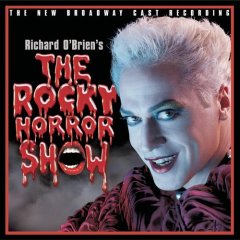
Gearing up for Rocky Horror Show auditions? Go to Amazon.com and search “Rocky Horror”. Most CD’s have audio samples you can listen to. There’s a new 2000 Broadway Revival Cast recording too that you might want to check out.
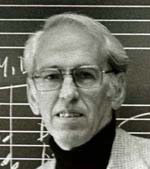
Ray Wright taught arrangers of all levels who attended the Arrangers’ Workshop started by him in the summer of 1959 at the Eastman School of Music. Head of Eastman’s Jazz Studies and Contemporary Media Program for many years, he also served as chief arranger and co-director of music at Radio City Music Hall in New York City. Ray also composed film scores for the prize-winning television documentary series “Saga of Western Man.”
His student writers at Eastman were frequent winners of arranging contests held by Down Beat magazine and the International Association of Jazz Educators (IAJE). Their writing has often been singled out as a leading factor in creating the distinctive quality for which Wright’s prize-winning Eastman Jazz Ensemble was known.
Tony Award winning orchestrator Douglas Besterman credits Rayburn Wright’s teaching for shaving ten years off his orchestration learning curve.
PUBLICATIONS BY RAYBURN WRIGHT
Inside The Score / Book & Cd – Wright
Series Composing/Arranging Book
Inside The Score/Cd*** – Wright
Series Compact Disc
I do. And I’ll tell you why. I will force you to care about this man and why he is so important. Well, no, not “important” – he is a magician of music.
My fascination with Doug Besterman started a couple weeks ago. I am working on a new musical. That may sound grand (and indeed it IS!), but there’s a whole hairy backend to doing this that requires a technical setup and workflow that’s efficient and doesn’t get in the way of the creative process.
Conductors get a lot of kudos and attention at showtime just because they are steering the ship during a show. But the REAL brains behind that is the orchestrator and arranger. You barely ever hear about them. Who orchestrates Andrew Lloyd Weber’s music? Yeah, see. Who cares? Well, the orchestrator is the one that brings the chicken scratches to life.
Orchestrations in the old classical composer days was more of a feat of skill, a time to showoff or improve on a great master. One composer would orchestrate a previous composers work for new instruments. But they would never have someone else orchestrate their OWN material. Who’s every heard of “Mozart Piano Concerto #1” , orchestrated by Beethoven. The first releases anyway, the composers did themselves.
Especially in musical theater it’s common for the “composer” (sometimes really just a songwriter) to pen out the melody and basic chords. The orchestrator can take this and turn it into a symphony. It’s a thankless job.
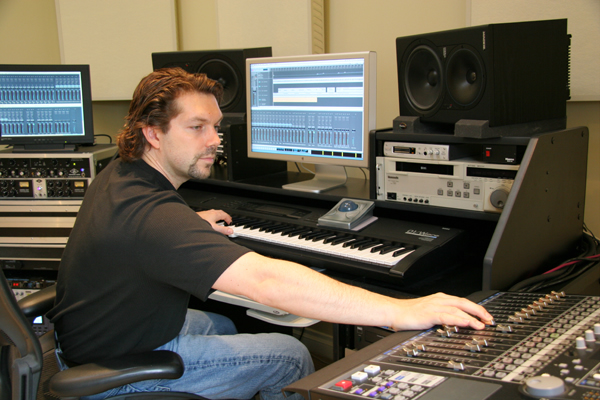
(Besterman working in his studio)
So for my musical – the end product I need to have created is finished scores for the musicians that coincides with the script. That’s obvious. But EEGADS that got complicated real quick when I started rearranging my studio specifically for this task.
As I’m searching online I come across references to the orchestrations of Besterman. One of the projects he orchestrated was Seussical the Musical. I conducted that show last year and a little light went off “Why yes, those orchestrations WERE FANTASTIC!” (The production of Seussical I conducted was with a full 20+ orchestra. It is VERY fun with a full ensemble – if you’re doing a production of Seussical please consider NOT pairing the orchestra down) I have a pretty good memory for music parts so I’ve been going over the orchestration in my head, recalling the parts that were particularly effective.
As I search on and on I have found many interviews with Douglas Besterman online that give a little insight to his training and where his influences come from. Of course nothing beats hearing it for yourself, so I’ve ordered several of his soundtracks to listen to.
Here’s more info on Besterman. At the end of this article is a link to his website. I’m glad you know who he is now – you’ll have to listen to his orchestrations for yourself to hear why he is a “magician of music”. He breathes life into new music, instead of that oldy moldy Broadway sound.
To my orchestration buddies (yes, I know you’re at there, all five of us) – check out a search of Besterman and orchestration terms online for interviews. There are many nuggets of wisdom and insight to be found.
BESTERMAN – On Orchestrating THE PRODUCERS
While the stars get encores and accolades-“Nathan Lane gives the performance of his career!” says WCBS-TV-and even the director gets notices- “Susan Stroman’s brilliant staging doesn’t miss a sight gag or a comic inflection!” says The Star-Ledger-most theater-goers might overlook the orchestrator’s credits.
We’re the designers of the sound of a piece,” Besterman says. “Outside of the theater world, a lot of people don’t really know about the job of an orchestrator. That’s partly because the kudos go to the composer when a score works, but it’s a job that’s pretty high on the food chain in theater.”
In a typical production, the composer develops the show’s melodies-the contextual skeleton-for each song, mainly on piano. The orchestrator then fleshes out each piece and develops them for a mini-orchestra-usually about 24 musicians for live theater.
Sometimes, a composer will pass on a fully developed piece. But often there’s little more than a hum of an indication of how a song is supposed to go. To complete that translation, the composer turns to the orchestrator.
“Composers carefully choose the right partner for a project,” Besterman says. “It’s very much a partnership.”
And Besterman has partnered with some of the best in the business in a career that has included bestselling Disney films and honored Broadway plays.
(left) Doug Besterman (Tony-award Winning Orchestrator, Fosse, The Producers, Thoroughly Modern Millie) wife Johanna, Julie and Gregory Jbara
BESTERMAN CREDITS TECHNIQUE TO MENTOR RAYBURN WRIGHT
s with many aspiring artists, Besterman dreamed of working on Broadway and in film while a college student. At Rochester, he studied both music history and theater, a program that allowed him to take classes at the College and at the Eastman School of Music.
Although he was always interested in composing and orchestrating, he says Rochester helped set the stage for his
career.
He studied with the late Rayburn Wright ’43E, then head of the Department of Jazz and Contemporary Media at Eastman, who had been a chief arranger at Radio City Music Hall in the ’50s. Besterman credits his former teacher with speeding his development.
“The things I learned from Ray shaved 10 years off my learning curve because it was incredibly practical information,” he says. “People used to say that I had no experience yet I was able to do so much, because that’s what Ray knew and taught us. It was an incredibly valuable four years.”
INTERVIEW WITH DOUG BESTERMAN
By Dan Goldwasser
What does an orchestrator do?
An orchestrator is responsible for taking a composer’s musical ideas – often written for piano or guitar – and expanding them to be played by a larger group of musicians – in the case of a Broadway show, anywhere from 6 to 24 musicians – and for a film, from 40 – 100.
What’s the difference between an arranger and an orchestrator?
Technically, an arranger will add his or her musical stamp on a piece of music – in the form of adding an intro or ending, coming up with counter-melodies, or re-conceiving the musical style of the piece – an orchestrator, technically speaking, won’t add anything.
In practice, orchestrators on Broadway – and to an extent in film as well – are also arrangers – we do often add counter-lines and re-conceive the musical style – but no distinction is made.
What are some of your more memorable experiences?
Well, it was fantastic being a part of the musical The Producers – a show like that only comes along every so often – the same goes for the movie Chicago. It was also great to work with singers like Barbra Streisand and Barry Manilow – and producers like Arif Mardin and Phil Ramone – recording industry legends.
Have you worked outside of musical theater and film?
Absolutely. I have done song arrangements for recording artists like Beyonce Knowles, Toni Braxton and Mandy Patinkin. I orchestrated two ballets for choreographer Susan Stroman, one for the Martha Graham Dance Company, and the other for the New York City Ballet. And I have written symphonic arrangements for the Hollywood Bowl, the Boston Pops, and the Los Angeles Philharmonic Orchestras.
I have also worked in the video game industry, creating and adapting music for Mulan (Disney Interactive), and Shadoan (Virtual Image Productions).
Through the course of your orchestration career, have you continued to write your own music?
Yes, I’ve continued to compose, and it the last couple of years, ever since moving out to Los Angeles, I’ve been more interested in songwriting and composing. In the last year or two, I’ve placed three songs in two shows (“Summerland” and “One Life to Live”) and one film, The Punisher. I enjoy writing – both songs and scores – and I would love to do more of that.
Do you have your own studio?
Yes – Mighty Music Productions, located in Los Angeles. I have a ProTools HD3 Accel system – I use Logic, Reason and Finale software – and I am set up to sync to video as well. I can create everything from orchestral synth mockups and demos to final tracks.
How did you get your start as an orchestrator?
It might sound strange, but I was aware that there were jobs called “orchestrator” and “arranger” from the time I was in my early teens. I grew up outside of New York City, and my family and I were big fans of musical theater – my parents loved Broadway shows, and would bring myself and my brothers to see shows as kids. At a certain point – I think it was probably the musical A Chorus Line – I noticed that there was music under the singing, and that it was interesting. My ears started to pick out that there were things happening under the singers, and they had a lot to do with the style and the tone of the show. So I really started to explore and investigate what that was, and how you did it.
By the time I was ready to go to college, I was pretty sure I was going to go into the music industry in some way – I was a pianist, and a French horn player, also. I ended up doing a dual program at the Eastman School of Music and the University of Rochester – so I was trained at a conservatory, and I was really fortunate at Eastman to study with a guy named Rayburn Wright. Ray had been the chief arranger at Radio City Music Hall in the 1950s, so we had a lot in common in terms of his experience, and my interest. Ray gave me a very clear understanding of how the music industry worked, what an arranger did, what an orchestrator did, and the mechanics of how you did that job in the industry. Somehow I walked away from Eastman feeling like I really understood how that all worked.
While I was in school, I studied Jazz Arranging, Film Scoring, Orchestration, as well as a conservatory curriculum in Music History and Theory. For a time, I toyed with being a professional horn player – being in conservatory, that’s a great place to really explore all those things. But by the time I left college, I knew that I was heading in a direction of musical theater. It was something I loved to do, I had worked semi-professionally as a rehearsal pianist and music director, and I felt like this was something I could do to earn a living, and be in the music industry, and see if I could move forward as a composer or as an arranger.
I got to New York in 1986, and started working as a rehearsal pianist and assistant music director, wrote arrangements for people, played auditions – then in the early 1990s I just had a lucky break – I met Danny Troob, who is a great orchestrator on Broadway, and had done a lot of film work with Alan Menken. Danny and I worked on a project together, and he asked me to help him with some orchestrations. Then an opportunity to do an off-Broadway show for Alan Menken came up, and Danny wasn’t available – so he recommended me. My phone rang at 9am one morning, and it was Alan. He said, “Danny says we should meet – grab a demo, and come up to my house.” That’s how my career as an orchestrator started.
You moved to Los Angeles in late 1990’s – how is it working on Broadway shows from LA?
I commute back and forth – I have a lot of frequent flier miles! It’s kind of ironic – I moved to Los Angeles, because I was getting busier doing basically what I do for Broadway, but for film. That was the end of the heyday period of the animated musical – I worked on Mulan and Anastasia long distance, from New York. So I moved out here to catch that wave – and because I was interested in being in LA and living in California – and a year after I came out there, I won my first Tony Award and got very busy in New York.
But in the last couple of years, there’s been a resurgence of interest in the Broadway musical on screen. Between Chicago and The Producers, for me it’s a very convenient calling card – in terms of doing more work in the film industry. I don’t think people in LA know that I’m in LA – they think of me as a New York guy!
A List of Some of the Composers that Doug Besterman has Collaborated With
Mel Brooks
Phil Collins
Randy Courts
Stephen Flaherty
Michael Gore
John Kander
Robert Lindsey-Nassif
Melissa Manchester
Howard Marren
Alan Menken
David Newman
Stephen Schwartz
David Shire
Alan Silvestri
Carly Simon
Kathy Sommer/Nina Ossoff
Stephen Sondheim
Charles Strouse
Jeanine Tesori
Danny Troob
Matthew Wilder
Frank Wildhorn
THEATER PROJECTS THAT DOUG BESTERMAN HAS ORCHESTRATED
*Note: This is just for theater. He has many more projects he has composed for television, film, and interactive game software.
BROADWAY/WEST END: Tarzan (Richard Rogers Theater, NYC) – spring 2006
– Phil Collins, music
Guys and Dolls (Piccadilly Theater, London)
Dracula (Belasco Theater, NYC) – Frank Wildhorn, music
Thoroughly Modern Millie (Marquis Theater, NYC) – 2002 Tony Award &Drama Desk Award, Best Orchestrations
The Producers (St. James Theater, NYC) – 2001 Tony Award & Drama Desk Award, Best Orchestrations
Seussical (Richard Rodgers Theater, NYC) – Stephen Flaherty, music
Music Man (Neil Simon Theater, NYC) – Drama Desk & Tony Award nominations
Fosse: A Celebration in Song and Dance (Broadhurst Theater, NYC) – 1999 Tony Award, Best Orchestrations
King David (New Amsterdam Theater, NYC) – Alan Menken, music
Big (Schubert Theater, NYC) – David Shire, music – Drama Desk Award nomination
Damn Yankees (Marquis Theater, NYC) – Drama Desk Award nomination
Gentlemen Prefer Blondes (Lyceum Theater, NYC)
OFF-BROADWAY/OTHER NEW YORK THEATER: A Christmas Carol (Theater at Madison Square Garden, NYC) – Alan Menken, music
Weird Romance (WPA Theater, NYC) – Alan Menken, music
Christmas Spectacular (Radio City Music Hall Productions, NYC)
Jack’s Holiday (Playwrights Horizons, NYC)
Johnny Pye and the Foolkiller (Lambs Theater, NYC)
REGIONAL: I Sent A Letter To My Love (North Shore Music Theater, MA) – Melissa Manchester, music
Captains Courageous (Ford’s Theater, Washington D.C.)
Paramour (Old Globe Theater, San Diego, CA)
Eliot Ness in Cleveland(Denver Center for Performing Arts, Denver, CO)
Jeanne La Pucelle (Place Des Arts, Montreal, Quebec)
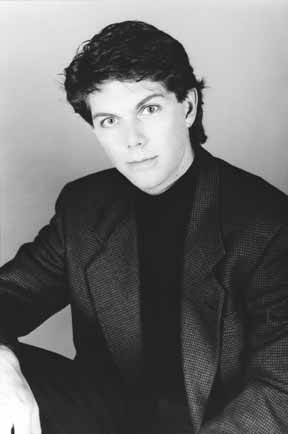
Alex Tirrell has acheved an incrdible amount of music and stage experience for his age. Keep your eye on him as an up and coming mover and shaker in the music world.
TIRRELL BACKGROUND INFO
(As of May 8, 2006)
Alex Tirrell is one of the original founders of the East Providence Community Theatre. He is currently serving as Technology Director, resident Music Director and on the Board of Trustees. Alex is a former member of the Rhode Island Music Educators Association and the Music Educators National Conference.
He is currently a Sophomore at Rhode Island College and is pursuing a Bachelor of Arts in Music with concentration in Voice and Piano. Alex is a Bass in the Rhode Island College Chorus and the Chamber Singers. Alex has also performed with the RIC Men’s Chorus and the Freshmen Men’s Quartet. He is the pianist for the Concert Jazz Band. He has also appeared as an ensemble singer with Opera Providence.
Alex is currently studying Voice with acclaimed tenor Dr. Fredrick Scheff, who has performed in national touring company productions of Andrew Lloyd Webber’s “Phantom of the Opera” and with many local opera companies. On the keyboard side, Alex currently studies classical piano with Lila Kane. He has previously studied Jazz Piano with composer/pianist Michael Kregler.
Alex has recently appeared on stage with the East Providence Community Theatre as Egeus in Shakespeare’s “A Midsummer Night’s Dream” (2005). Alex was previously the Music Director of the Holy Ghost Brotherhood Mariense Youth Group in East Providence. With HGBM he directed music and was pianist/conductor for Annie and The Wizard of Oz (RSC). He was also a pianist for The Wizard of Oz (RSC) at the now closed City Nights Dinner Theatre in Pawtucket.
Credits at East Providence High School include Keyboardist for Footloose – The Musical (2005); Bishop of Digne, Bambatois, Grantaire & Major Domo in Les Miserables (2004); Slim and Keyboard II in Oklahoma! (2003); Mr. Sheinkopf and Keyboard II in Fame – The Musical (2002); and The Messenger/Ensemble in The Wiz (2001).
Credits at Riverside Middle School include Crapshooter (Closing night cameo) in Guys & Dolls Jr. (2004), (School Board Member) in The Music Man Jr. (2003), Lighting Design & MIDI sequencing for The Wizard of Oz (2002), and Rooster Hannigan in Annie Jr. (2001)
Other Credits include Xander Harris and MIDI sequencing for ‘Once More, With Feeling – A Buffy Musical,’ a television-to-stage adaptation directed by Jon Brennan (2004).
Alex is also a keyboardist/vocalist for local rock band Shryne since 2004.
The Secret’s David Schirmer exposed
I had posted criticism of The Secret in the past and was told I was being negative. Maybe those people could take a couple minutes to watch this video.