My Second Grade Music Report

conrad-second-grade-report2.jpg

conrad-second-grade-report.jpg

In preparing for a big move I’m going through many old boxes. So if you notice odd posts lately, that’s why. Lots of old stuff I’m posting up….I don’t know….just because I can.

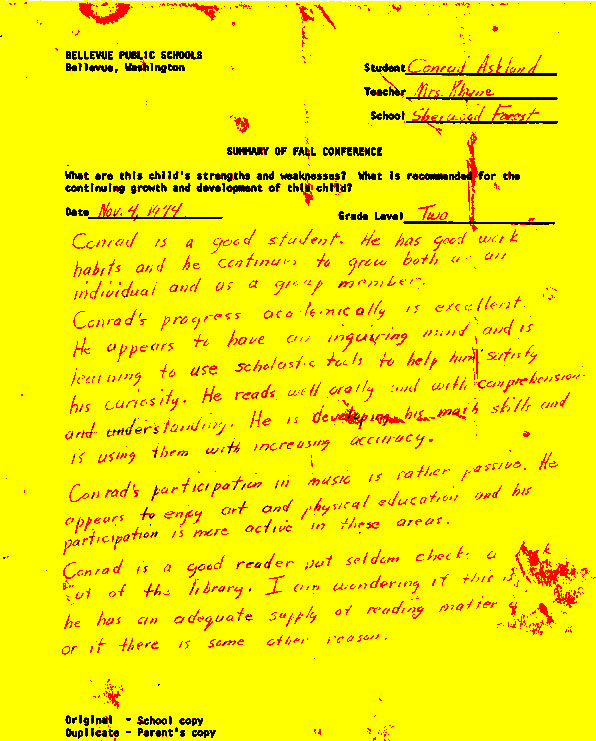
This is my second grade progress report. I attended Sherwood Forest Elementary in Bellevue, WA. My teacher, Ms. Rhyne, noted “Conrad’s participation in music is rather passive.” This seemed odd to me since I remember being intoxicated with music at my earliest memories around age 5.

So I asked my Mother about it and she started to giggle. She remembers that report card and at the time had asked me about it. She says my reponse was, “Oh, those kids sing so out of tune I can’t bear to listen to it. I refuse to sing with them.”

This should be funny to those that know me. I’m still very much the same today when it comes to intonation, but hopefully a hair more politically correct and gentle. As I go through all these papers from my grade school years I’m struck with the thought: “Do we really change as we grow older?”. All my early writings give every indication of who I am today – for better or for worse.

Phonics Made Easy

phonics-made-easy.jpg

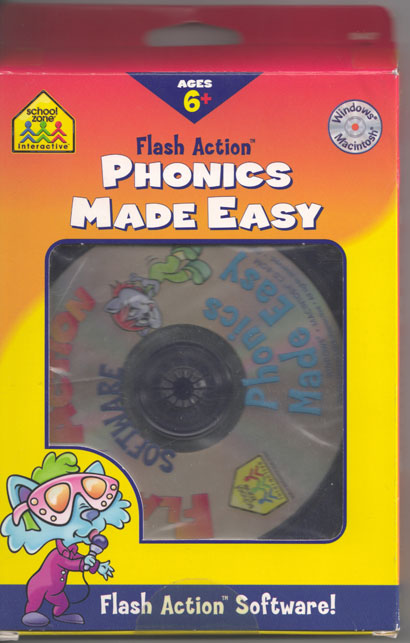
Phonics Made Easy by School Zone Interactive. Visit their website at schoolzone.com .

I love this company – let me tell you why. They bought one of my royalty free rap instrumentals and used it in their software (Yes, there’s more to it than just that). My hip hop library was intended for rappers to use for albums, but this company had business saavy and used it for their phonics software. Still falls under the “synchronization license” of my library. My hat is off to the person in this company that thought outside the box to come up with that. Most companies would look strictly at corporate buyout music from business entities, not at my hip hop outlets.

Let me tell you what else I love out this company. Very few people that use my soundtracks give me credit – and that’s really all I ask for many of my royalty free libraries. This company was courteous enough to not only give me credit, but they also sent me a finished copy of their software. It was released several years ago and I just now had the chance to actually load up the software and try it out. The software is made for age 6+ and I got a couple of the answers wrong! Mmmm…….

Thank you School Zone Interactive for being a creative company, and most of all for being upright and straight ahead in your business dealings. I salute you!

headbob01b.gifheadbob02b.gif

Learning beginning phonics has never been so much fun! Your child will explore beginning and ending letter sounds, long and short vowel sounds, rhyming families, letter blends, and more.

phonics-made-easy-conrad.jpg

Drive South Band

drive-south-band-web.jpg

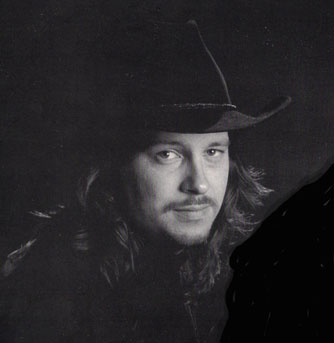
Drive South was a Southern California country band I played in during the early 90’s. It was a transition group between two other bands. Bob Gross – Bass Guitar. Peter Klimes – Electric Guitar. Jono Brown – Drums. Vocals – Jolene. Keyboards – Conrad Askland. I’m on the top left.

I kind of like this photo. Was taken back around 1993 or so.

conrad-1992-web.jpg

Photos from The Apple Tree musical comedy

apple-tree-3.jpg

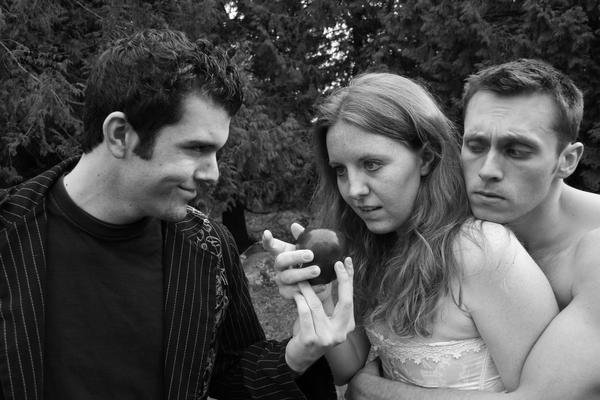
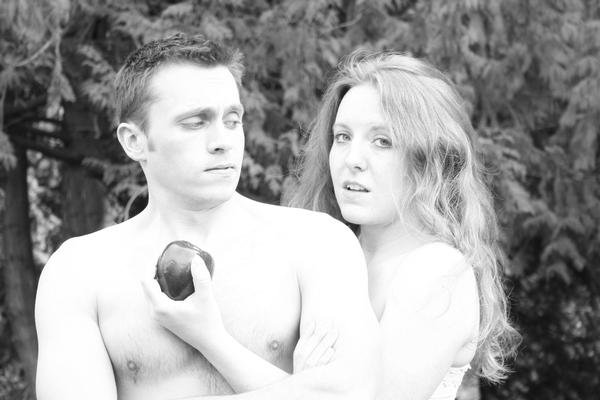
Some pictures from our production of “The Apple Tree”. Read more about it in my “Apple Tree” section of my website. It’s a musical comedy. The first act features Adam, Eve and the Snake in a humorous look at the differences between the sexes ala Mark Twain.

Updates on actors 09/07

  • James Padilla (left – Snake) had the lead role of Curly in Oklahoma and working on the role of Frank ‘N Furter in Rocky Horrow Show.
  • Erin Heminway (middle – Eve) has the lead role in the Bellingham production of Hair.
  • Kevin Pitman (right – Adam) currently studying under an acting apprenticeship program in….is it Chicago? He’s an incredibly detailed and thorough actor. VERY fun to watch him develop a character to it’s fullest.

apple-tree-2.jpg

Lyrics – How Great Thou Art

O Lord my God, When I in awesome wonder,
Consider all the worlds Thy Hands have made;
I see the stars, I hear the rolling thunder,
Thy power throughout the universe displayed.

Then sings my soul, My Saviour God, to Thee,
How great Thou art, How great Thou art.
Then sings my soul, My Saviour God, to Thee,
How great Thou art, How great Thou art!

When through the woods, and forest glades I wander,
And hear the birds sing sweetly in the trees.
When I look down, from lofty mountain grandeur
And see the brook, and feel the gentle breeze.

Then sings my soul, My Saviour God, to Thee,
How great Thou art, How great Thou art.
Then sings my soul, My Saviour God, to Thee,
How great Thou art, How great Thou art!

And when I think, that God, His Son not sparing;
Sent Him to die, I scarce can take it in;
That on the Cross, my burden gladly bearing,
He bled and died to take away my sin.

Then sings my soul, My Saviour God, to Thee,
How great Thou art, How great Thou art.
Then sings my soul, My Saviour God, to Thee,
How great Thou art, How great Thou art!

When Christ shall come, with shout of acclamation,
And take me home, what joy shall fill my heart.
Then I shall bow, in humble adoration,
And then proclaim: “My God, how great Thou art!”

Then sings my soul, My Saviour God, to Thee,
How great Thou art, How great Thou art.
Then sings my soul, My Saviour God, to Thee,
How great Thou art, How great Thou art!

words & music by Carl G. Boberg and R.J. Hughes

Joe Zawinul Dies at 75

zawinul_6.jpg

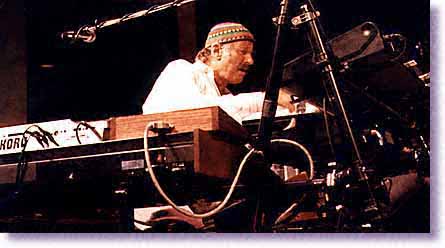
Jazz Legend Joe Zawinul Dies at 75

VIENNA, Austria — Jazz legend Joe Zawinul, who soared to fame as one of the creators of jazz fusion and performed and recorded with Miles Davis, died early Tuesday, a hospital official said. He was 75.

Zawinul had been hospitalized since last month. A spokeswoman for Vienna’s Wilhelmina Clinic confirmed his death without giving details.

Zawinul won widespread acclaim for his keyboard work on chart-topping Davis albums such as “In A Silent Way” and “*Biznich* Brew,” and was a leading force behind the so-called “Electric Jazz” movement.

In 1970, Zawinul founded the band Weather Report and produced a series of albums including “Heavy Weather,” “Black Market” and “I Sing the Body Electric.” After that band’s breakup, he founded the Zawinul Syndicate in 1987.

Zawinul is credited with bringing the electric piano and synthesizer into the jazz mainstream.

This past spring, he toured Europe to mark the 20th anniversary of the Zawinul Syndicate. He sought medical attention when the tour ended, the Viennese Hospital Association said in a statement last month.

Bye Bye Birdie 2007 Cast List

Cast list for META Performing Arts production of Bye Bye Birdie at McIntyre Hall, Skagit Valley College.

CONRAD BIRDIE Al Hollingsworth

ALBERT PETERSON DUSTIN MOORE

ROSE ALVAREZ SARAH SIMMONS

KIM MACAFEE DEMI FAIR

MRS. MACAFEE CALLY JOHNSON

MR. MACAFEE CLARENCE HOLDEN

RANDOLPH MICHAEL GILES

MRS. PETERSON KRIS HEMENWAY

URSULA ZOEY KYPUROS

HUGO MATTHEW THOMPSON

DEBORAH SUE To be determined

ALICE HAVALAH CALDERON

HARVEY NATHAN HAMER

SAD GIRL/DANCE CAPTAIN LAUREN RILEY

MAYOR ANDY GOLUB

MAYOR’S WIFE AMANDA CURTIS

MRS. MERKLE ROBIN LUIF

PHONE QUARTET (Nancy, Helen,Alice, Margie) PAIGE WOODS, SAVANNA WOODS, HAVALAH CALDERON, CORINN HOLBERG

TOWN’S FOLK GERMAINE KORNEGAY, CHRISTINA SOUTH, JAKE UPDEGRAFF, NICOLE TREPUS

TEEN CHORUS/ CHARACTER ROLES

JASMINE ZELL

CONNOR CROSBY

COURTNEY HOLBERG

SARA HOLDEN

MELISSA HOLDEN

EVE BERRINGTON

MADISON WAGONER

McKENZIE WILLIS

KELLI BATES

ALICIA CERNY

SAVANNAH DILLS

ALEXANDER PREDROZA

CATHERINE SOUTH

JESSICA PAULEY

FEATURED DANCERS AND TEEN CHORUS

ALISHA ANDERSON

KAYLAH GOLUB

ALEXA MCNEAL

NATE HAMER

PRETEEN CHORUS

KAYLA MALCOLM

DARA KING,

KATIE ARTHUR,

OLIVIA PEDROZA,

MAKAYLA HAIGH,

KADIN ZENONIAN,

ABIGAIL FERGUSON,

FALON SIERRA,

KARI TARABOCHIA

SHRINER RYAN MOWER

GLORIA RASPUTIN to be determined

MAUDE and quartet/shriners to be determined

Accidentals in French Music

A handwritten score by a French composer contains an orchestra part that changes from D# to Eb in the same measure. The key signature is 6 sharps. The question asked to me was whether the second note is actually an Eb, or if the flat simply cancels out the E# in the key signature, making it a natural E.

The player mentioned it might be a convention of French music to have the flat cancel out the sharp in the key signature. I believe the Eb is simply what it is, an Eb and I will explain why.

Flats and sharps are simply what they are, they are not added to or subtracted from the key signature or previous accidentals. In other words, a written Eb will always be just Eb – makes no difference about key signature or what is before.

Now there was a time in Early Music where the execution of accidentals had not been standardized. There was a time where accidentals would carry through a piece until they were changed again. In other words, if on page one the score show an F#, then the F’s would remain sharped until changed again – if that didn’t happen til page 5 it made no difference, the F’s remained sharp until let’s say on page F it was written as an F natural. Now imagine how confusing this was for a player to jump in on page 3 having no knowledge of the previous accidental! This is why it was later made standard that an accidental would only last for one measure.

In music theory the chords of the score each relate to each other. A Cm chord has a different quality and function depending how it fits into the score. For example: A Cm as the tonic in the key of Cm, or a Cm as the ii chord in Bb major, or the Cm as a vi chord in Eb major. As a composer writes, especially with chromatic music like Wagner, it’s common to temporarily change keys within a song – but in a very short phrase the key signature won’t be changed – it is done with accidentals. This is why when looking at a single part it may not make sense how the note is written, but it DOES make sense when seen with the score as a whole (if it is written and scored well).

The conundrum is that if you don’t see the underlying chord movement in your mind, the note seems written as a mistake. If you DO understand the underlying chords, and the writer notates the pitch so it’s easier to read but doesn’t support the actual theory of the chord – it’s VERY confusing to read. Most of the time I notice notes like this “dumbed down” in modern praise music, band charts, and usually when someone has written a score by hand without really understanding the chords.

An example of this: You are in the key of Bb major (two flats). In the middle of the piece the composer writes a ii-V-I to temporarily module to the key of E (chords would be F#m – B – E). On the “B” chord the third is D#. The player that is scored for that note sees they are in the key of Bb, but instead of an Eb written, they see D#. It looks like a mistake. But if they saw the whole score they would know it can ONLY be D# because it is the third of the B chord. If it were dumbed down to an Eb the chord would become the notes B-Eb-F# – if I were to sightread that I would miss it, thinking it were a jazz extension.

I hope this all makes sense. It’s much simpler to understand it than it is to explain it….like most things.