Received this yesterday from a musician in the pit orchestra of my current running show. It means a lot of me because the player is very seasoned and has “been around the block”. If you haven’t worked with me in the pit before – I can tell you it’s very intense. But all with the goal of creating the best sound possible. When musicians have the personal drive to work as a team and perform their very best – great things happen.
Comment Received
By the way, you are the best show conductor I have ever played with. I used to play most of the shows at the Circle Star Theatre and I also played for Lew Elias’s Relief orchestra in Las Vegas. ( I played the relief orchestra because most shows ran at least six weeks and two shows per night and I could not stand that much repetition, so I played different shows every night.) Anyway, I played with these big guys and you are definitely the most skilled. It takes so much more skill to work with amateurs and especially a mix of amateurs and professionals if some of the professionals are the “prima donna” type. So, I am very impressed. It is too bad that you are going to leave here.
This hymn was born durÂing the AmerÂiÂcan ciÂvil war, when Howe visÂitÂed a UnÂion ArÂmy camp on the PoÂtoÂmac RivÂer near WashÂingÂton, D. C. She heard the solÂdiers singÂing the song “John Brown’s Body,†and was takÂen with the strong marchÂing beat. She wrote the words the next day:
I awoke in the grey of the mornÂing, and as I lay waitÂing for dawn, the long lines of the deÂsired poÂem beÂgan to enÂtwine themÂselves in my mind, and I said to myÂself, “I must get up and write these versÂes, lest I fall asleep and forÂget them!†So I sprang out of bed and in the dimÂness found an old stump of a pen, which I reÂmemÂbered usÂing the day beÂfore. I scrawled the versÂes alÂmost withÂout lookÂing at the pÂaper.
The hymn apÂpeared in the AtÂlantÂic MonthÂly in 1862. It was sung at the funÂerÂals of BritÂish statesÂman WinÂston ChurchÂill, AmerÂiÂcan senÂatÂor RoÂbert KenÂneÂdy, and AmÂerÂiÂcan preÂsiÂdents RonÂald ReaÂgan and RiÂchard NixÂon.
Music: John Brown’s BoÂdy, possÂiÂbly by John WillÂiam Steffe. John Brown was an AmerÂiÂcan aboÂliÂtionÂist who led a short lived inÂÂsurÂÂrectÂÂion to free the slaves.
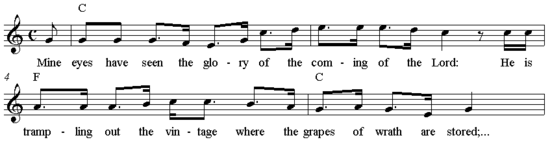
SAMPLE MUSIC – FIRST LINE
LYRICS FOR BATTLEÂ HYMN
Mine eyes have seen the glory of the coming of the Lord;
He is trampling out the vintage where the grapes of wrath are stored;
He hath loosed the fateful lightning of His terrible swift sword;
His truth is marching on.
Glory! Glory! Hallelujah! Glory! Glory! Hallelujah!
Glory! Glory! Hallelujah! His truth is marching on.
I have seen Him in the watch fires of a hundred circling camps
They have builded Him an altar in the evening dews and damps;
I can read His righteous sentence by the dim and flaring lamps;
His day is marching on.
Glory! Glory! Hallelujah! Glory! Glory! Hallelujah!
Glory! Glory! Hallelujah! His day is marching on.
I have read a fiery Gospel writ in burnished rows of steel;
“As ye deal with My contemners, so with you My grace shall dealâ€;
Let the Hero, born of woman, crush the serpent with His heel,
Since God is marching on.
Glory! Glory! Hallelujah! Glory! Glory! Hallelujah!
Glory! Glory! Hallelujah! Since God is marching on.
He has sounded forth the trumpet that shall never call retreat;
He is sifting out the hearts of men before His judgment seat;
Oh, be swift, my soul, to answer Him! be jubilant, my feet;
Our God is marching on.
Glory! Glory! Hallelujah! Glory! Glory! Hallelujah!
Glory! Glory! Hallelujah! Our God is marching on.
In the beauty of the lilies Christ was born across the sea,
With a glory in His bosom that transfigures you and me:
As He died to make men holy, let us live to make men free;
[originally …let us die to make men free]
While God is marching on.
Glory! Glory! Hallelujah! Glory! Glory! Hallelujah!
Glory! Glory! Hallelujah! While God is marching on.
He is coming like the glory of the morning on the wave,
He is wisdom to the mighty, He is honor to the brave;
So the world shall be His footstool, and the soul of wrong His slave,
Our God is marching on.
Glory! Glory! Hallelujah! Glory! Glory! Hallelujah!
Glory! Glory! Hallelujah! Our God is marching on.
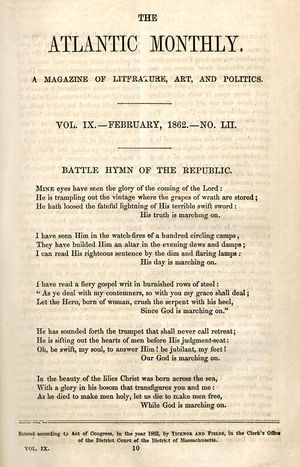
ORIGINAL PUBLICATION – BATTLE HYMN LYRICS
HISTORY OF BATTLE HYMN OF THE REPUBLIC
The tune was written, around 1855, by South Carolinian William Steffe. The lyrics at that time were alternately called “Canaan’s Happy Shore” or “Brothers, Will You Meet Me?” and the song was sung as a campfire spiritual. The tune spread across the United States, taking on many sets of new lyrics.
A man from Vermont named Thomas Bishop joined the Massachusetts Infantry before the outbreak of war and wrote a popular set of lyrics, circa 1860, titled “John Brown’s Body” which became one of his unit’s walking songs. According to writer Irwin Silber (who has written a book about Civil War folksongs), the song was not about John Brown, the famed abolitionist, but a Scotsman of the same name who was a member of the 12th Massachusetts Regiment. An article by writer Mark Steyn explains that the men of John Brown’s unit had made up a song poking fun at him, and sang it widely.
Bishop’s battalion was dispatched to Washington, D.C. early in the Civil War, and Julia Ward Howe heard this song during a public review of the troops in Washington. As with many others, she assumed it was about John Brown the abolitionist. Her companion at the review, the Reverend James Clarke, suggested to Howe that she write new words for the fighting men’s song, and the current version of “Battle Hymn of the Republic” was born.
Howe’s “The Battle Hymn of the Republic” was first published on the front page of The Atlantic Monthly of February 1862. The sixth verse written by Howe, which is less commonly sung, was not published at that time. The song was also published as a broadside in 1863 by the Supervisory Committee for Recruiting Colored Regiments in Philadelphia.
Julia Ward Howe was the wife of Samuel Gridley Howe, the famed scholar in education of the blind. Samuel and Julia were also active leaders in anti-slavery politics and strong supporters of the Union. Julia was visiting a Union camp when she heard the soldiers singing “John Brown’s Body” and was inspired to write the words to “The Battle Hymn of the Republic”.
I was a soprano in the Northwest Boychoir from 1976-1980 under directors George Fiore and Steve Stevens. It is still the most formative musical experience I have ever had. It was intense, disciplined and grueling. I cannot even imagine what music would be to me if I had not had that training. If any boys in the Seattle area have a passion for singing I strongly recommend you check out the Northwest Boychoirs.
With the NWBC I started out in their training choir with the single minded goal of making their top touring choir. For those in the training choir it was our biggest dream. The day I made it into the touring choir was one of the proudest of my life. In the last year I was with them they started a “Choirboy of the Year” award and I won it the first year. I was very proud of that. Actually, I still am.
The NWBC opened doors for me to sing with Seattle Opera. I got to sing in the selected boys’ chorus with Seattle Opera at the Opera House in Carmen, Boris Gudunov and Tosca. Archie Drake, longtime bass with Seattle Opera, would always take us under his wing. And at one point the Seattle Symphony conductor’s son was in our choir as well.
One of my favorite moments was when Seattle Opera came to a NWBC rehearsal to audition boys for their production of Amahl and the Night Visitors. The choir director, Steve Stevens, called out several boys from the rehearsal to go audition in the other room with Seattle Opera. I watched them all go, very sad because he had not picked me. Then he said, “Ok, if any one else feels they want to audition they can go try.” I still remember being embarrassed as I stood up to give it a try, and getting “the look” – the look of “Oh man, you’re not serious are you?”.
Well the good part of the story is I got the role for Amahl that year. I split performances with another boy soprano named Brice York. The day the Seattle Times did their reviews on the show was the day Brice performed, so I didn’t get a write up. But I got to work with Archie Drake and Shirley Harman (Seattle area icons in Opera) and that was AWESOME.
I always remember that too. What if I hadn’t walked up and given it a try? I’m thankful Steve Stevens opened it up for anyone to try. I would have never entered the audition if he hadn’t opened it up. My voice started to change at the end of the Amahl run – it was my last heyday of being a boy soprano. The last time I would ever have that full control of my voice that had been so keenly honed with NWBC. The voice change was a slow and tramautic experience – a deep loss that every boychoir singer goes through.
My Mom still plays the recording of my Amahl performance. We went to see a production of Amahl together last year and I prepped her beforehand saying “You know, we have great memories of me doing the show, but times change and this boy will probably humble my performance.” After seeing the show I feel really good about my work back then. For almost 30 years I’ve felt I could have done better. And now I know that I really kicked butt back then. 🙂
With NWBC I also got the chance to tour with them in Europe and sing A Capella sacred music at Westminster Chapel, Notre Dame Cathedral, the Cathedral of Chartres and the Llangollen Music Festival in Wales. I’m on their first pop album they recorded and think that I hold the distinction of being the only boy in the choir that didn’t get a solo bit on the album. Kind of funny.
You get teased mercilessly when you’re a boy soprano. Especially when I would return to school and still had some makeup left on from a Seattle Opera performance. Kids are mean. If you want to see me go from Happy to a Raging Monster in two seconds, try making fun of a boy soprano when both of us are in the room. Me and my home boys stick together.
I remember being in college at a party and running into one my boychoir mates Stephen Shelver. He was the top dog when I was in the choir – the one that would get all the full solos when we sang with the Seattle Symphony, et al. He was so glad to see me and we talked for hours about the boychoir experience. It is so unique. I have never talked to him since then, over twenty years ago, and wonder if he still feels that strongly about what it taught us. I know I do.
ATTENTION RICH PEOPLE: If you have a ton of money and don’t know what to do with it, please consider giving some to the Northwest Boychoir. They are a top notch group.
🙂
ABOUT THE NORTHWEST BOYS CHOIR Pacific Northwest’s Premier Choir for Young Singers
The Northwest Boychoir’s musical sophistication and rich tonal quality have established its reputation as one of the nation’s premier boychoirs. Its 45 members, ages 10 to 14, come from all corners of the Greater Seattle area representing 26 diverse public and private schools. Northwest Boychoir members are skilled musicians with a passion for the musical arts, and a unique ability to perform great choral literature and contemporary works at the highest professional levels.
In its 33 years, the Northwest Boychoir has trained thousands of young singers, and more significantly, shaped the lives of its members by instilling important lessons in personal commitment, and the value of teamwork and diligence. Led by Joseph Crnko, now in his 23rd year as music director, Northwest Boychoir members are skilled musicians who read music fluently and perform professionally with confidence.
Officially designated the “Singing Ambassadors” of Washington State by Governor Christine Gregoire, the Northwest Boychoir has performed around the world and throughout the United States. International tours have taken the Boychoir to France, Italy, Japan, Hong Kong, Australia, New Zealand, Canada and Mexico. National tours have led the boys throughout the US, with performances in St. John the Divine in New York, the National Cathedral in Washington, D.C., and the Baseball Hall of Fame in Cooperstown, N.Y. In July 2007, the Northwest Boychoir will undertake a concert tour of the West Coast of the United States.
The Northwest Boychoir is an essential part of the cultural fabric of the Puget Sound community. The Seattle Symphony leads a long list of professional arts groups that rely on the talents of the Boychoir. In June 2007, the Boychoir will join the Seattle Symphony to present Mahler’s Symphony No. 3. Then in July 2007, the Boychoir again will take the stage with the Seattle Symphony to present the renowned choral masterpiece Carmina Burana.
A highly successful 2006 performance season was highlighted by the Boychoir’s participation in Music of Remembrance’s highly-praised production of Hans Krasa’s children’s opera Brundibár. In addition, the Boychoir celebrated Mozart’s 250th year with a March 2006 performance of Mozart’s Missa Brevis at the annual convention of the American Choral Director’s Association in Portland, Oregon.
When soundtrack composers need the unique boychoir sound, they often turn to the Northwest Boychoir whose professional talents are featured on films such as the acclaimed Millions. The choir is featured prominently on the soundtrack for Sea World Florida’s spectacular show, Blue Horizons. Among its accomplishments is the Choir’s selection by renowned Sound Designer Nick Phoenix to be recorded for his Quantum Leap Symphonic Choirs sample library. The voices of the Northwest Boychoir are now used by film composers and sound designers worldwide.
The Northwest Boychoir has produced four holiday recordings, the most recent ‘Tis the Season. In addition to its own recordings, the Boychoir is featured with members of the Seattle Symphony on the new 2006 recording of Brundibár (Naxos) and on international opera star Carl Tanner’s 2006 holiday recording, Hear the Angels Sing (Sony Classical).
I fell upon this link and am in awe of your bio. I love that you are passionate about us here at Rapdogs.com. As someone who loves music from the smallest seed of its creation…I find that sometimes those with such experience as yourself do not consider “us” (emcees, turntabilists, beat miners) as real musicians.
I think what i want to say is…reading this bio made me realize that a passionate and genuis voice like yours is a blessing to have behind us. That ..the fact that you run this for us and recognize our importance in music history is just really nifty.
no suck up intended…just being real.
meg
******************
Sweet! (Meg is our leading “femcee” commentator and article writer for RapDogs and very involved in the Northeast Canadian music scene).
RapDogs.com is actually my offering and begging for forgiveness of two errors in judgement I have made in my life. The first was back in 1984. I was 18. My best friend Jerome and I were in Denny’s after a night of clubbing. He told me that rap was the next major audio art form and was here to stay. At the time Sir Mixalot was cutting edge and rap was just starting to emerge in the dance clubs in Renton, WA. Being so smart and knowing everything, I told Jerome that “people won’t even know what rap is in two years. It’s a fad.” Kind of funny to think of that in retrospect. Since that time I’ve produced and mastered hundreds (probably over a thousand) of hip hop tracks and artist demos.
To me, hip hop is currently the leading edge genre for freedom of speech in the audio arts Most artists I have recorded take it VERY seriously – it is their high art. They do not approach it with a pedestrain attitude – their conviction is inspiring to me. As hip hop has matured, many artists are questioning and revisioning how hip hop can be used for a message that challenges and uplifts us. I like seeing that emerge.
Second mistake. It was 1987. I was 21. There I am playing a grand piano in a tux (all classical) and a lady comes up to say, “Can you play any Patsy Cline?” I was SO offended. I stopped playing, looked at her and said, “M’am, I play REAL MUSIC.” At the time I was totally serious. Country was not even considered music in my book. It was something people listened to because they were uncultured idiots that just didn’t know any better. Liking country music told me all I needed to know about someone. Well, after that I ended up playing on the Southern California country music circuit, grew to love country. Eventually even played on TV at the Grand ‘Ol Opry and was with Freddy Fender when he got his star on the Hollywood Walk of Fame (crossover artist: Country, Latino and Pop).
I’ve grown to love Country music – especially early country from the 1930’s to 1960’s. It’s a horrible thought to think I could have lived my life without knowing so many of the classic lyrics of country music.
So why do I write about hip hop and country in the same post? They have a very strong connection. Both styles are all about the story. The music is there to bolster what the lyrics have to say. Turning a clever phrase, finding a new way to express situations and thoughts that are universal – Country and Hip Hop share that lineage.
Those were two main paradigm shifts for me and my views of music. Now I feel that if someone doesn’t like a particular style of music, it might very well be that they just don’t understand it. Read that sentence again.
There is no shortage of people that are eager to tell us what is “real” art and what is not. Although their intention is to show how cultured they are, to me it is a sign they haven’t been around the block much.
So my message to emerging artists: Don’t make any calls on what is valid art and what is not. Do not make light of the styles that are not your own. Do your thing, push the envelope and don’t follow others down the path you’re “supposed” to take. Make your own way. Say what is on your heart, because it is YOURS to say.
I think you’ll find that if people have done a closed set of musical styles for most of their life, or make their living withing a closed genre – those are the ones that will be more likely to make derogatory comments on art styles outside their sphere of influence.
There’s no time for fellow artists to make calls on the validity of artist expression. There’s far too much work left to do…..
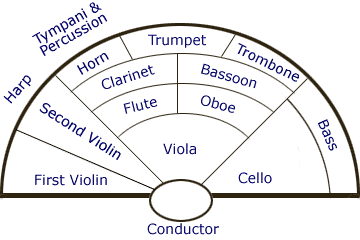
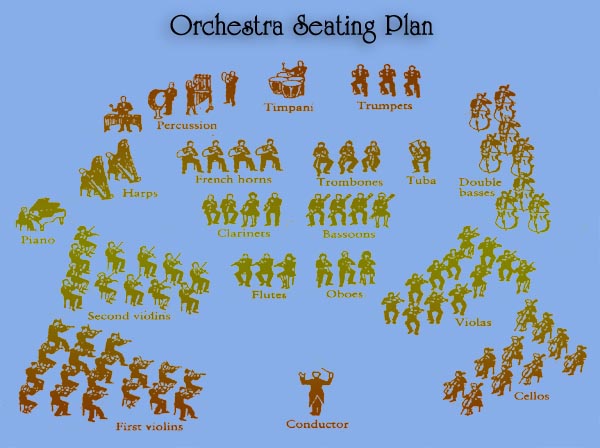
To achieve good acoustic transmission, the strings are arranged at the front of the orchestra. Their core function and role as melodic interpreters justifies their being close to the conductor in order to have better contact. The most important reason for their placement, however, is their low projection capability. You will easily hear two trumpets (or any woodwind or brass instrument, for that matter) playing amid the whole violin section, because the winds have a much greater power of projection. The harp is usually placed between the violins and the brass, and is used to interpose harmonic chords. This format is a relatively recent development. Monterverdi, for example, divided his orchestra in two and conducted his instrumentalists separately, placing them on two sides of the hall to underline the contrast between certain parts of his works.
Berlioz and Wagner, who had a megalomania for orchestral effects, wrote titanic symphonies, although even these weren’t enough to satisfy the composers. The biggest orchestra to date got together in Boston in 1872 for the Gilmore Peace Jubilee, celebrating the end of the Civil War and the Franco-Prussian War. Over 4,000 instrumentalists were present, including over 300 violins, 100 cellos, 100 double basses, 24 clarinets, bassoons, and French horns. It’s hard to imagine such a spectacle!
Many consider Jean-Baptiste Lully’s violons du roy (his twenty-four “king’s violins” inaugurated in 1626) as the first orchestra resembling those we know today. Since the time of Louis XIII, however, there have been many changes in the orchestra’s makeup. Patrons continued to encourage music in the imperial courts of Europe up to the twentieth century. Orchestras were then governed by the financial resources available to them and their patrons, depending on how ambitious these courts were in matters of entertainment and cultural outreach. The demise of a number of orchestral societies along with nineteenth-century monarchies affected even opera companies, the best employers. The flame was passed on, however, thanks to the intervention of the state, musical societies, and individual music-lovers, all of whom wanted posterity to share this great tradition.
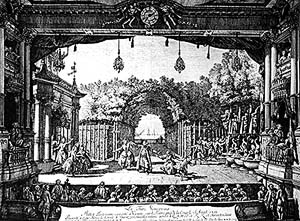
The composition and seating of an orchestra in the 17th and 18th century is essentially different from what we are accustomed to today. Most notably, the orchestra was not conducted in the modern sense of the word. The conductor sat at the harpsichord and together with the first violinist directed the whole orchestra with his playing. This method of direction understandably influenced the seating arrangement of the musicians.
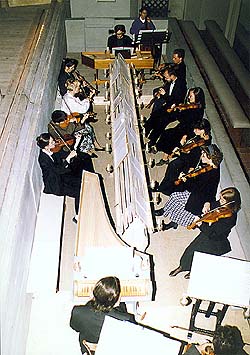
The harpsichord was included twice in most orchestras, and both instruments were placed facing each other on both ends of the orchestra pit. The other instruments formed two rows between the harpsichords; the first row consisting of the 1st violin, violas and oboe sat facing the stage, and the second row consisting of the 2nd violin, violas and oboe sat facing the audience. The bass instruments, forming together with the harpsichord the rhythmical element of the Baroque orchestra (basso continuo), were separated and placed with both harpsichords.
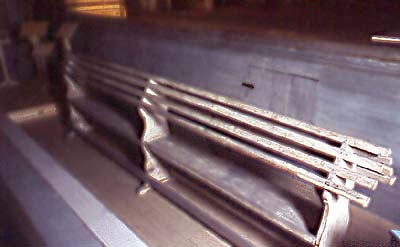
Original music stand in the orchestra pit in the Český Krumlov Castle Theatre
The orchestra pit of the Krumlov theatre is interesting in that the unique double-sided music stand has been preserved here, its form and size corresponding to the above-mentioned orchestra. So far it has also been possible to use original Baroque lighting methods in the orchestra pit; these methods are used most often during Trial performances in the Castle Theater.
Some of the musical terms used in the original orchestra score for Brigadoon.
Mosso – Rapid. Meno mosso, less rapid. Piu mosso, more rapid.
Morendo – gradually dying away
Colla Voce – Follow the voice. A directive to the musican (normally accompanist) to perform the indicated passage in a free manner following the tempo and style of the solo performer.
L’istesso tempo – The same tempo. An indication in a composition that directs that the beat remains constant when the meter changes. In the case of 2/4 to 6/8, the meter is still counted with two beats per measure but the tempo or speed of the beat stays the same. All that has changed is the subdivision of the beat from the duplets of the 2/4 to the triplets of the 6/8.
Tenuto (ten.) – Tenuto can mean either hold the note in question its full length (or longer, with slight rubato) or else play the note slightly louder. In other words, the tenuto mark is sometimes interpreted as an articulation mark and sometimes interpreted as a dynamic mark. When it appears in conjunction with an accent mark, it is of course taken as an indication of articulation, and, conversely, when it appears in conjunction with a staccato mark, it is taken as an indication of a slight dynamic accent. When it appears by itself, its meaning must be determined by its musical context. In rudimental (drumline) drumming, the tenuto marking is traditionally interpreted by giving the marked note a slight accent or emphasis.
Lento – slow
Piu – More. Used with other terms, e.g. piu mosso, more motion.
A list of contrasting conducting styles from YouTube.com – Compare the conductors pre-1950 with modern conductors. I’ve also included some college and student conductors so you can compare styles against veteran approaches.
Compare the left hand (non-baton) hand of each orchestra conductor and compare vocabularies.
I searched for videos of orchestral music conductors online and thought this would be a nice collection for aspiring conductors to watch and study. These free video clips can be viewed by clicking on the links. All part of the journey of creating better communication skills for your orchestra musicians.
Two things I had always heard about was the Buddy Rich vs. Gene Kruppa drum battle and the Buddy Rich “Bus Tape”.
You can find both of them easily on YouTube.com – The Rich Vs. Kruppa drum battle is to the song Sing Sing Sing. Rich is an obvious winner in that battle but I’ve heard that Kruppa was very sick during the battle, and Rich was also in his prime when it was filmed. Check it out for yourself, Sammy Davis. Jr. declares the battle a tie at the end.
Now the Buddy Rich BUS TAPES! Buddy Rich laid into his band hardcore on the bus after a gig. He was very upset with them and told them they played like “high school dropouts”. It’s full of four letter words. When you’re playing with a band and tempers run high people often refer to these tapes, like “he’s as bad as Buddy Rich on the bus”, etc. You can also find this audio recording on YouTube.com – search for “Buddy bus”.