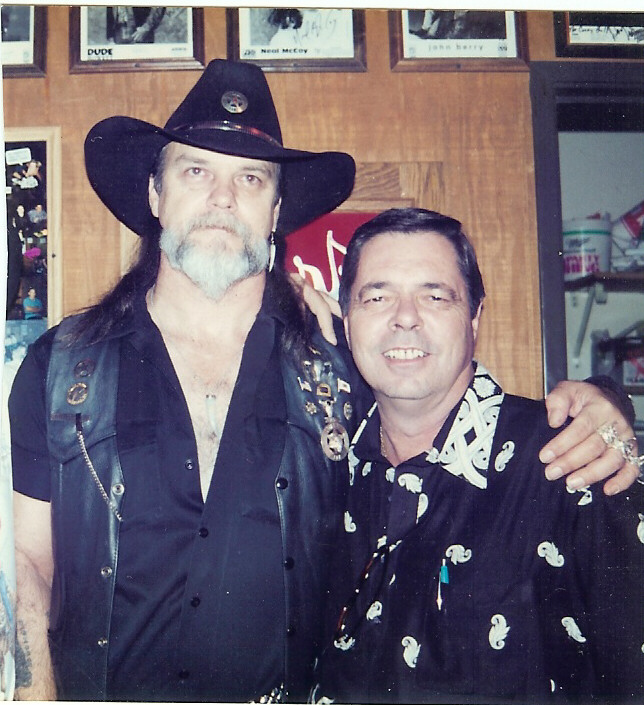
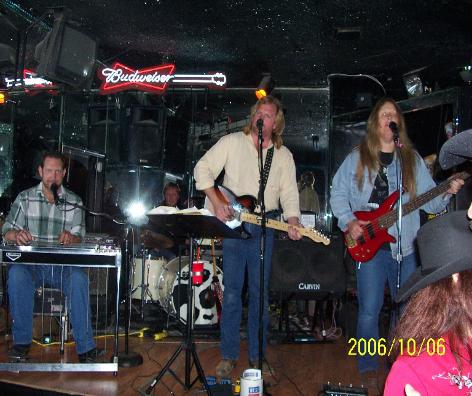
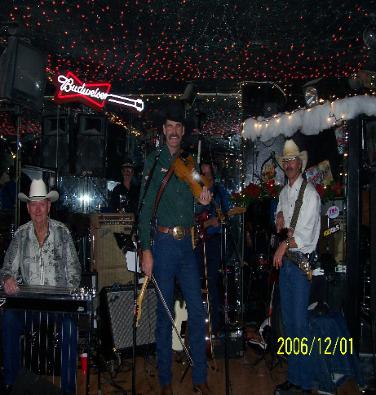
Rumor has it the Cocky Bull Saloon in Victorville, CA is reopening. This country bar has gone through several owners the last 15 years. When the Southern California country circuit was in full swing for full time bands, the Cocky Bull was the most remote “A List” club with Allan Barbish running sound. All the strong country bands played there at one time or another. Many moons ago I gigged there quite a bit and I still remember feeling proud when I joined an “A List” country band and got to play the Bull for the first time. If you haven’t been there before, let me tell you….the Cocky Bull was a major party scene.
Located at 14180 Highway 395 at the corner of Palmdale Rd in Victorville, California
The original building has gone through many changes and alterations since Tom Hopkins and Tim Coppins built the Opry Hall as an addition to the Ribhouse restaurant and “Bull Pen” lounge back in the 80’s.
Many of the unique features were removed, (like the huge open BBQ Pit), and the Opry Hall has lost some seats because of DJ Booth and Bar additions, and they removed the balcony!?!… But the Spirit of The Cocky Bull has never changed.
But, thanks to the generosity of a prominent local business woman, the Cocky Bull is undergoing a “restoration” to it’s “original” glory, and we are “undoing” as much of the previous renovations as possible.
VICTORVILLE COUNTRY BANDS
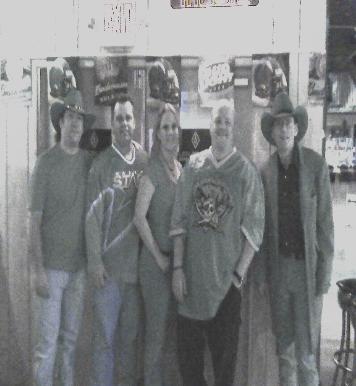
Southern Spirit country band. Jaye Sooter plays about the meanest bass guitar you’ll ever hear. Awesome vocals too.
O Lord my God, When I in awesome wonder,
Consider all the worlds Thy Hands have made;
I see the stars, I hear the rolling thunder,
Thy power throughout the universe displayed.
Then sings my soul, My Saviour God, to Thee,
How great Thou art, How great Thou art.
Then sings my soul, My Saviour God, to Thee,
How great Thou art, How great Thou art!
When through the woods, and forest glades I wander,
And hear the birds sing sweetly in the trees.
When I look down, from lofty mountain grandeur
And see the brook, and feel the gentle breeze.
Then sings my soul, My Saviour God, to Thee,
How great Thou art, How great Thou art.
Then sings my soul, My Saviour God, to Thee,
How great Thou art, How great Thou art!
And when I think, that God, His Son not sparing;
Sent Him to die, I scarce can take it in;
That on the Cross, my burden gladly bearing,
He bled and died to take away my sin.
Then sings my soul, My Saviour God, to Thee,
How great Thou art, How great Thou art.
Then sings my soul, My Saviour God, to Thee,
How great Thou art, How great Thou art!
When Christ shall come, with shout of acclamation,
And take me home, what joy shall fill my heart.
Then I shall bow, in humble adoration,
And then proclaim: “My God, how great Thou art!”
Then sings my soul, My Saviour God, to Thee,
How great Thou art, How great Thou art.
Then sings my soul, My Saviour God, to Thee,
How great Thou art, How great Thou art!
A handwritten score by a French composer contains an orchestra part that changes from D# to Eb in the same measure. The key signature is 6 sharps. The question asked to me was whether the second note is actually an Eb, or if the flat simply cancels out the E# in the key signature, making it a natural E.
The player mentioned it might be a convention of French music to have the flat cancel out the sharp in the key signature. I believe the Eb is simply what it is, an Eb and I will explain why.
Flats and sharps are simply what they are, they are not added to or subtracted from the key signature or previous accidentals. In other words, a written Eb will always be just Eb – makes no difference about key signature or what is before.
Now there was a time in Early Music where the execution of accidentals had not been standardized. There was a time where accidentals would carry through a piece until they were changed again. In other words, if on page one the score show an F#, then the F’s would remain sharped until changed again – if that didn’t happen til page 5 it made no difference, the F’s remained sharp until let’s say on page F it was written as an F natural. Now imagine how confusing this was for a player to jump in on page 3 having no knowledge of the previous accidental! This is why it was later made standard that an accidental would only last for one measure.
In music theory the chords of the score each relate to each other. A Cm chord has a different quality and function depending how it fits into the score. For example: A Cm as the tonic in the key of Cm, or a Cm as the ii chord in Bb major, or the Cm as a vi chord in Eb major. As a composer writes, especially with chromatic music like Wagner, it’s common to temporarily change keys within a song – but in a very short phrase the key signature won’t be changed – it is done with accidentals. This is why when looking at a single part it may not make sense how the note is written, but it DOES make sense when seen with the score as a whole (if it is written and scored well).
The conundrum is that if you don’t see the underlying chord movement in your mind, the note seems written as a mistake. If you DO understand the underlying chords, and the writer notates the pitch so it’s easier to read but doesn’t support the actual theory of the chord – it’s VERY confusing to read. Most of the time I notice notes like this “dumbed down” in modern praise music, band charts, and usually when someone has written a score by hand without really understanding the chords.
An example of this: You are in the key of Bb major (two flats). In the middle of the piece the composer writes a ii-V-I to temporarily module to the key of E (chords would be F#m – B – E). On the “B” chord the third is D#. The player that is scored for that note sees they are in the key of Bb, but instead of an Eb written, they see D#. It looks like a mistake. But if they saw the whole score they would know it can ONLY be D# because it is the third of the B chord. If it were dumbed down to an Eb the chord would become the notes B-Eb-F# – if I were to sightread that I would miss it, thinking it were a jazz extension.
I hope this all makes sense. It’s much simpler to understand it than it is to explain it….like most things.
01. Hot For Teacher, Van Halen 4:42
02. Back To School, Deftones 3:57
03. School, Nirvana 2:40
04. Rock N Roll High School, The Ramones 2:17
05. Smokin’ In The Boy’s Room, Brownsville Station, Motley Crue 3:22
06. Chemistry Class, Elvis Costello & the Attractions 2:55
07. Another Brick In The Wall Part II, Pink Floyd 5:35
08. Don’t Stand So close To me, The Police 4:02
3,698,412. Bitch School, Spinal Tap 2:49
10. School’s Out, Alice Cooper 3:46
11. High School Confidential, Rough Trade 3:25
12. Catholic School Rirls Rule Red Hot Chili Peppers 1:55
13. Fight For Your Right, Beastie Boys 3:27
14. Jeremy, Pearl Jam 5:18
15. The Art Teacher, Rufus Wainwright 3:52
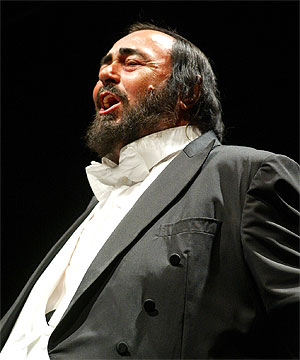
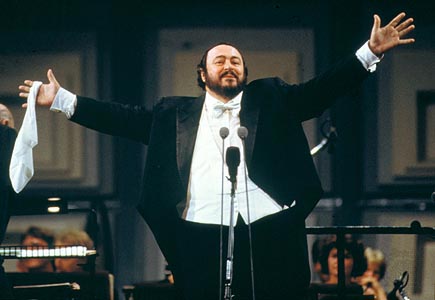
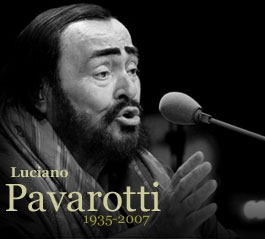
Famed opera tenor Luciano Pavarotti, who appeared on stage with singers as varied as opera star Dame Joan Sutherland, U2’s Bono and Liza Minnelli, died Thursday after suffering from pancreatic cancer.
This is how I remember Pavarotti – Robust, bigger than life and holding his white handkerchief. When I was in high school I got to see him perform live at the Seattle Coliseum at the Seattle Center. It was truly unbelievable. My father played his albums over and over when I was a kid. In our household Pavarotti was a name that was revered with the utmost respect.
I read his biography some twenty years ago. Hopefully the details in my memory are correct – he worked until he was almost 30 as a door to door salesman in Italy while waiting for a break in Opera. His wife’s family thought he was kind of a loser because he didn’t have a real career going. Then he won a role in his late twenties – and his career took off within a few short years after that.
That was a role model for me starting in music – to give it your all and roll the dice, no turning back. Pavarotti was an inspiration for sticking with your dreams, staying true to the fire within that sometimes makes you look…well….a bit odd.
Interesting side note. The young Pavarotti — who played soccer with his town’s junior team — joined the church choir with his father and traveled with him to Wales, where the singing group won first prize at the Llangollen International singing competition.
That experience in Llangollen gave him the passion to pursue singing. I competed with the Northwest Boychoir also at the Llangollen International singing competition – I wish I had a cool story like that. All I remember is they had an awesome simulated wave machine in a pool that we played in. Mmmm…..note to self: come up with cool stories for obituaries….
“For opera to survive today, Riding wrote, it needs not only new music but also “exciting young singers.” Pavarotti was that singer, in the right place and the right time for his generation.”
I don’t know if I can say “we’ll miss you Pavarotti”, because he gave us a gift that still runs strong in the arts. I’m thankful we have great recordings of his voice. There is nothing like it.
How to make a million dollars playing music? Start with two million.
What do you call a beautiful woman on a musicians’ arm? A tattoo.
The difference between a conductor and a bag of manure? The bag.
What happens if you play blues or country backwards? Your wife returns, your dog comes back to life, and you get out of prison.
What is a musician called who only knows 3 chords? A music critic.
How do you keep your guitar from being stolen? Put it in a tuba case.
What’s the difference between a drummer and a vacuum cleaner? You have to plug one in before it sucks.
Rare sight: A lead singer who carries equipment other than a microphone and change of clothes.
The difference between a bull and a lead singer fronting a brass band? The bull has the horns in front and the ass in the rear.
How many Grateful Deadheads does it take to change a lightbulb? 12,001. One to change it, 2.000 to record the event and take pictures, and 10,000 to follow it around until it burns out.
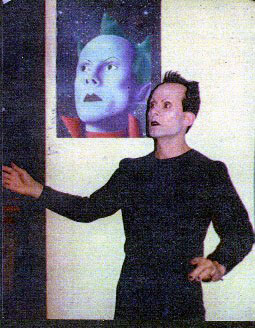
Klaus Nomi fans unite! Klaus Nomi is definately an acquired taste, and honestly I still have yet to meet someone in person who is also a fan. It’s his combination of classical, new wave and serious cheeze that makes him compelling to me. He was one of the first artists I heard where I went: “Oh wow, a musician can be like that?”. That was back in 1983 or so.
YouTube.com has a lot of his videos posted – search “Klaus Nomi” on YouTube for listings – or check out one of his videos here:
httpv://youtube.com/watch?v=C_A6IR58Htg
The other thing very intriguing about Klaus Nomi is that he made up not only a fictitious persona, but also fibbed a little on his real world identity. His claims of opera background were not exactly accurate – but that’s part of what makes him ultra cool to me. He just “did it” and did it his way.
httpv://www.youtube.com/watch?v=XyjbmA0EN-w
And if you are a Klaus Nomi hater (and I know there’s PLENTY of you out there), you at least have to give the concession that he is a unique artist. And from there you can cut and debate what “unique” means – but unique it is.
Klaus Nomi makes me happy. I don’t know why, he just does. IÂ picture him walking on stage in the 16th century doing his act with a string section. If you’re also a Nomi fan, please leave a comment. Nomi fans also make me happy, because I know there are other people out there that appreciate his art.
httpv://www.youtube.com/watch?v=gma5IUNMTn0
And yes, Klaus Nomi was one of the first artists to die of AIDS. Back when AIDS was mysterious and not talked about much. I remember how sad I was when I heard about that. Sad for me, because I wanted to hear more of his music.
KLAUS NOMI ON SATURDAY NIGHT LIVE
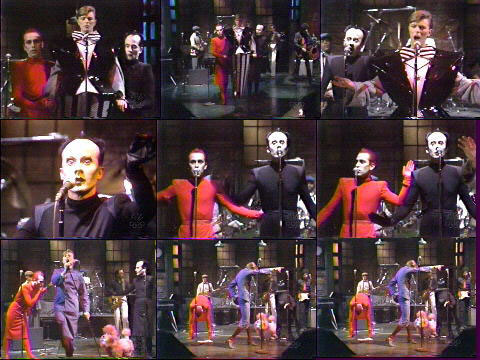
In 1980 Klaus Nomi was on Saturday Night Live with David Bowie and Joey Arias. David Bowie invited Klaus to perform with him after seeing footage shot by Anders Grafstrom.
Many of Klaus’ fans have wondered about the identity of Anders Grafstrom to whom Klaus dedicated his first album.He was a Swedish film-maker and good friend of Nomi who was killed in a car accident. He filmed many early performances of klaus and Klaus had a role in Grafstrom’s ” The Long Island Four”.The early film footage was shown to David Bowie who became very intrigued with Klaus.As a result Klaus was invited by Bowie to appear with him on “Saturday Night Live” in 1980. Grafstrom’s footage was also used by Michael O’ Donaghue in his “Mr. Mike’s Mondo Video.
SNL Photo with Bowie, Nomi and Arias
ABOUT KLAUS NOMI
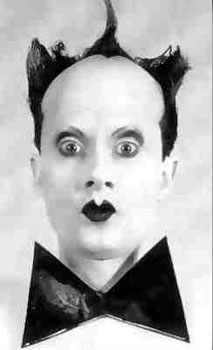
Klaus Nomi (January 24, 1944 – August 6, 1983) was a German countertenor noted for remarkable vocal performances and an unusual, elfin stage persona. Nomi is remembered for bizarrely theatrical live performances, heavy make-up, unusual costumes, and a highly stylized signature hairdo which flaunted a receding hairline. His songs were equally unusual, ranging from synthesizer-laden interpretations of classic opera to covers of 1960s pop standards like Chubby Checker’s “The Twist” and Lou Christie’s “Lightning Strikes”.
Personal life
Nomi was born Klaus Sperber in Immenstadt, Germany. His birthday is commonly observed as January 24, 1944, though the director of The Nomi Song stated at the New York City premiere of the documentary that Sperber’s exact birthday is unknown.
Nomi moved from Germany to New York City in the mid-1970s. He began his involvement with the art scene based in the East Village. According to Horn’s documentary film, Nomi took singing lessons and supported himself working as a pastry chef. Nomi moved in gay circles and in the performance underground.
Nomi died on August 6, 1983 in New York City, one of the first celebrities to die of an illness complicated by AIDS.
Career
After a chance meeting in a nightclub, David Bowie hired Nomi and Joey Arias as back-up singers and consultants on costume design for a performance on Saturday Night Live which aired on December 14, 1979.
Nomi also collaborated with producer Man Parrish.
The 1981 rock documentary film, Urgh! A Music War features Nomi’s live performance of Total Eclipse.
Influence and cultural significance
Filmmakers like Andrew Horn and writers like Jim Fouratt consider Nomi an important part of the 1980s East Village scene, which was a hotbed of development for punk rock, music, the visual arts, and the avant-garde. Although Nomi’s work was not met with national commercial success at the time, he garnered a cult following, mainly in New York and in France.
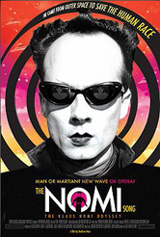
Andrew Horn’s 2004 feature documentary about Nomi’s life The Nomi Song released on Palm Pictures helped spur renewed interest in the singer, including an art exhibit in San Francisco at the New Langton gallery.
Nomi’s influence can also be measured by references and homages to him in the work of later artists.
British pop icon Morrissey used the song “Wayward Sisters”* as an introduction prior to appearing on stage to begin a concert for his Kill Uncle tour. Morrissey included Nomi’s song “Death” in his compilation of influential songs titled “Under the Influence”.
Austrian composer Olga Neuwirth wrote a “Hommage à Klaus Nomi” for countertenor and chamber ensemble.
A fictionalised version of Klaus Nomi appears in a two-part episode of animated comedy/adventure series The Venture Bros. In “Showdown at Cremation Creek (Part I),” he appears as one of David Bowie’s bodyguard henchmen (alongside an animated Iggy Pop, another Bowie collaborator). “Klaus” attacks his opponents with ultra-high-pitched singing and the over-sized bow tie of his famous costume, spun and ejected as a battering weapon. In “Showdown at Cremation Creek (Part II),” “Klaus” seems to have been killed after betraying Bowie in order to become a henchman of a villain known as The Phantom Limb.
Nomi’s flamboyant cover of Lesley Gore’s 1964 hit “You Don’t Own Me” is sometimes featured on The Rush Limbaugh Show as the “Homosexual Community Update” Updates (Rush Limbaugh) This was done after Gore’s original was for a time adopted as the Feminist Update. Nomi does not change the lyrics (e.g. “Don’t say I can’t go with other boys”).
Discography
Albums
* Klaus Nomi 1981
* Simple Man 1982
* Encore 1983
* In Concert 1986
Singles
* You Don’t Own Me / Falling in Love Again (1981)
* Nomi Song / Cold Song (1982)
* Lightning Strikes / Falling in Love Again (1982)
* Simple Man / Death (1982)
* Ding Dong / ICUROK (1982)
* ICUROK / Ding Dong (Canadian 12″)
* Za Bak Daz / Silent Night (CD single, 1998)
Klaus Nomi 1982 Interview:
httpv://www.youtube.com/watch?v=dQ4__PGjFQI
From French TV. With clips from the video of The Nomi Song (not the documentary).
Translation by anonymous:
Interviewer : When you arrived to NY, how did you earn a living?
Klaus : Hum… like Rudolph Valentino*. Hehe, kidding. Well, I did everything, even dirty jobs, like dishwashing or delivery boy for a grocer, delivering flowers, cooking, peeling vegetables… it was a curious story, up to a point it became unbearable. The urge to sing was stronger, so one day I performed in a club and it was very successful ; then I could give up all those dreadful jobs, and devote my time to music.
Interviewer : Why did you choose that name, “Nomi”?
Klaus : It was on inspiration. I think the name sounds good, it doesn’t really have a certain national taste, you know, it could be any nation, because I see myself as universal, not as German, American, French ot whatever you want, cause we are all on this planet, we’re all living on the earth.
Interviewer : It’s not enough for you to be Nomi, you must also wear the Nomi symbol?
Klaus : well you know now I’m in the business, I like to promote myself, ans I think this is a very nice badge, this is my own design.
Interviewer : It was said about you that you were either the 8th wonder of the world, or a tragic accident of the nature. What do you think of this definition?
Klaus : oh it’s wonderful, it’s extraordinary. I hope it’s true.
Interviewer : Who has drawn your costume?
Klaus : I have.**
Interviewer : What does it mean ? (seeing Klaus’ hesitation) Nothing?
Klaus : I don’t know. I hope it means something, people talk about it a lot.
Interviewer : Why this clown-like, cold make-up?
Klaus : I don’t think it’s clown-like, I don’t think it’s cold. It’s very theatrical, very intense. It’s an unnatural make-up, made for stage. It’s like a doll or a cartoon. You see it once and never forget it.
Interviewer : Why are you hiding behind this make-up?
Klaus : I’m not really hiding, I’m showing out, because the way I am it’s hard to look like a normal person. You know, in the streets, when I was a kid, people always said I looked strange, and it made me feel very unhappy. And all of a sudden I go on stage, and people like me for that ; but as soon as I’m outside, I feel like I have to hide, because people laugh at me, because of the way I look. Now I’m using this look, it works for me, I even exagerate it. I used to hide my large forehead, but now I’m selling it.
Interviewer : How do you.. work your voice?
Klaus : I think I do have my own technique, because I’ve been disappointed by teachers, maybe because i didn’t meet the good one. I don’t like to depend on teachers anyway. So I’m walking on my own way, and I try to be as natural as I can. I think it’s the only way to be yourself.
Interviewer : What kind of music do you listen to?
Klaus : Oh… honestly, all of them. You know, I like to try things, to experience, especially with electronic music.
Interviewer : Are tou touched by modern life issues, or do you live in your own world, in your own character?
Klaus : I feel threatened, and sometimes it makes me angry because I can’t do anything about that, there’s just too many issues. But in a way I think my work is meant to get people out of that.
Interviewer : I read that you wanted to be a magical character..
Klaus : Well I think it’s a nice to be a little magical. Today we need this. All that we can read in fairy tales or books, I think somewhere it’s all around us. But nowadays we can think that this magic has been killed, and I try to make it survive as long as possible.
Interviewer : Do you want to become a star?
Klaus : I don’t know what that really means… I want to accomplish my work and fulfil my dreams, and do something with my life, and I hope I’ll be able to accomplish it. It’s very much work, but I like it.
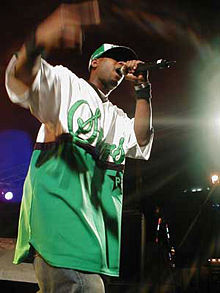
Our hats off to the artistry of Talib Kweli. On the new Talib Kweli CD”In The Mood” he drops one of the filthiest lines i’ve heard in a while..
“Cats all sappy like romantic flicks
Dude get a clue like colonel sanders in the study wit a candlestick”
ABOUT TALIB KWELI
Talib Kweli (born Talib Kweli Greene in Brooklyn, New York City on October 3, 1975) is an American MC from Brooklyn, New York. He is one of the best-known rappers in alternative hip hop, and is frequently critically acclaimed, despite not having seen significant commercial success. His name in Arabic means “student”, his last name in Swahili means “true”. Talib and fellow rapper artist Mos Def purchased Nkiru, which is Brooklyn’s oldest black-owned bookstore, and converted it into the Nkiru Center for Education and Culture. He also studied experimental theater at New York University (NYU).
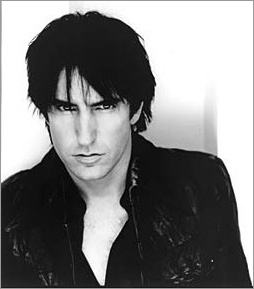
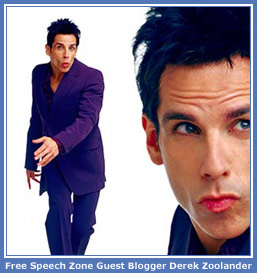
Trent Reznor vs. Zoolander? I notice an uncanny resemblance in the two poses. What was Zoolander’s super secret pose? “Blue Steel” – “Blue Ice” or something like that. No offense meant to Mr. Reznor, he is the keyboard king.
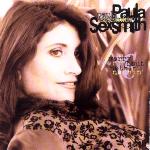
This is a music review I found of a project I produced for Paula Sexsmith. The album was a Christian praise and pop CD entitled “Worry ‘Bout Nothin'”. Here’s the review, or go here to read the original Paula Sexsmith CD review.
********************
Be anxious for nothing, but in everything by prayer and supplication, with thanksgiving, let your requests be known to God; and the peace of God, which surpasses all understanding, will guard your hearts and minds through Christ Jesus. – Phillipians 4:6-7
I don’t often come across music by independent artists that is this expertly produced. Worry ‘Bout Nothin’ shows an excellence in production that is a pleasure to hear, allowing the music to be a very nice medium for delivering her messages of worship, praise, encouragement, and prayer. If I didn’t know better, the expertise obvious in some of the complicated arrangements of strings, piano, percussion, and voice would almost lead me to believe Michael W. Smith had a hand in its production.
“Pillar of Fire” introduces Paula’s warm and pleasant voice, backed by upbeat percussion and some screaming electric guitars. The energetic nature of the song perfectly compliments the image of Christ as a pillar of fire in a dark world, much like God was a pillar of fire to guide Israel through the desert many thousands of years ago. “Pillar of fire, love of my life. You inspire me to walk in Your love. You bring God’s presence, protection and guidance. Jesus You are my pillar of fire.”
“I Feel Small” turns prayerful, a la Anointed’s “Send Out a Prayer.” A Morse Code S.O.S. introduces the thoughtful and vulnerable song, in which I can picture Paula standing small in a huge world, looking upward for the God who gives her significance in an overwhelming world. The reverb effects on her vocals feel a bit out of place, though.
“Worry ’bout Nothin’ throws the throttle open in a juiced up encouragement to take to heart the apostle Paul’s admonition to cast your cares at the feet of God and let Him do the worrying. Christ Himself told us not to worry about tomorrow, because today has enough worries of itself. This song expounds on the spirit of that message, encouraging us not to worry about anything, but rather to pray about everything.
One of my favorite songs on the CD is “Glory to the Lamb,” an absolutely beautiful contemporary praise and worship number. I hear what sounds like a penny whistle or pan flute in the background, while an Aramaic recitation of the Lord’s Prayer adds a unique element to the song. Very simply, the song says “Glory to the Lamb, glory to the King of Kings. Jesus You are faithful and true. Every nation will bow and worship You. Jesus You are worthy of all praise. Honor, glory, power to Your name. Jesus, You are the beginning and the end. Alpha, Omega, You’re coming back again. Jesus, You’re worthy. Jesus, You’re holy.” That’s about as succinct a description of God’s praiseworthy characteristics as I’ve heard!
Worry ‘Bout Nothin’ was a pleasant surprise, one which I suspect will spend some time in my car CD player. The songs are well sung and purposeful, and the production work on the CD is second to none. If you have the opportunity to do so, I encourage you to listen to this CD!