Hip Hop Speaks Out: We Cannot Be Denied

world-headphone.jpgGemcee, a moderator at my hip hop forum RapDogs.com, has written a great article called We Cannot Be Denied. It talks about turntable courses at Berklee College of Music and the work professor Stephen Webber has done to promote the recognition of hip hop in academic circles. Professor Webber has also helped create the Harvard University Hip Hop Archives website which tracks hip hop’s movement and effect on our society.

As a female Canadian rapper, author Gemcee gives unique perspectives on hip hop culture.

Excerpt from the article:

Do rappers read? Yes silly, they do. In the movement that is Hip Hop we have created a niche for writers who come from this culture. Writers like Toure, Cheo Hodari Coker, and Nelson George who are great reflections of Hip Hop journalists. Also, popular fiction novelists like Sistah Souljah and Erica Kennedy, who’s novel “Bling” I am reading right now.Some people believe that much of the Hip Hop literature that is around perpetuates stereotypes. The truth is, these novels reflect the harsh realities that many youths face. Their redeeming qualities are the fact that they are brutally honest and they share the consequences of decisions. These books are used to communicate in a way that is considered meaningful and anything to get kids reading and thinking, should be considered a positive.

So in the movement that is hip hop, a place where we have created poets, philosophers and independent, intelligent thinkers….it also inspires street novels. Chalk another one up for Hip Hop. Literature like this confirms that the spreading influence of hip hop is reaching far and wide. We cannot be denied.

QandA: Legal Requirements to be a Music Producer

E-mail question received:

Mr. Askland, I have been producing tracks for a few years and I’m trying to figure out what to do to sell my beats legally so i decided to ask a professional with more experience. How did you become a music producer? What steps did you take to get started? Is there a certain license you have to apply for with the government or can you use a specific business license?

Response:

I’ve received several emails similiar to this over the last month. Either it’s the same person or a widespread question. I’ll assume it’s a legitimate question.

This seems obvious to me: To be a music producer you just have to produce music. There is no legal stipulation or registration involved. Think of it as being a painter. “Do I have to register with the government to be a painter?” – No, you just paint.

I think your unspoken question has to do more with sample clearance and copyright issues. I’ll address each seperate issue as to what I THINK you are really asking.

SAMPLE CLEARANCE

If you use a sample of pre-recorded music in your track, it is NOT cleared, and someone recognizes where the sample came from – you are in a bad spot. If your track has generated over $10,000 of revenue you can expect some legal papers in the mail. Copyright is seperate from Master Recording rights. One person owns the copyright on the song, and a different person can own the rights to the recording (ie: the source of your sample). US Copyright Office website.

Mechanical rights can be obtained to re-record a song already published (published means at least one copy has been offered publicly for sale). The mechanical rights only allow permission to re-record the song, not to use any source master audio material. Mechanical rights are usually in the ballpark of ten cents per copy sold. (If you record an album of ten songs by previously released material, you may pay about one dollar per CD sale in royalties). The amount of mechanical royalties varies but is “reasonable”.

The owner of the Master Recording has the right to negotiate whatever amount they like to clear a sample from it. If they want one million dollars for a two second sample, then you have to pay that or not use it. These fees are considerable. As an example: Around 1996 I used a sample from the “War of the Worlds” radio broadcast. The sample I used was about ten seconds long and only played once in the song. The owner of the master recording wanted $20,000 to use that sample in the piece which was slated to be part of a movie soundtrack.

If you’re already playing in the big leagues (which you’re not if you don’t know this info already) like Aftermath Entertainment then you can afford some sample clearances. Short of that, you need to use samples that are already cleared from sample libraries or create your own material. Quick read: Don’t use samples.

WHAT I DO FOR SAMPLES

There are a lot of “royalty free” libraries out there that really aren’t totally cleared. I’m referring to seperate stand alone websites and a lot of Ebay sales. I don’t trust fringe producers of royalty free libraries because I have little faith that they have the discipline to actually know where all their material came from. For that reason I only use cleared samples from large established companies like Sony, Roland, Big Fish Audio and Sound Ideas. For my productions I do a lot of original MIDI work and also create my own samples if I want a grainy feel, so the other samples I use are just for a little color.

Like my view on Trademarks, don’t worry about it so much until you need to. As my music became more widely heard I would run into situations where something wasn’t cleared properly. So for me it was a slow shift to tighten up on my use of samples. Sometimes a client would bring in a sample of their own and would say they knew it was cleared. My response was “That’s fine. I just need you to sign a paper that you are responsible for any legal action regarding that sample.” I never had a client follow through to sign that piece of paper. They liked relying on me for making sure the project was legal and clean. As a music producer I feel this is one of your chief responsibilites, especially in hip hop music.

SAMPLE VIOLATIONS AND COPYRIGHT LAW

There is no set time limit of how much of a sample violates copyright law. There is no “two second” rule or anything like that. So be careful.

TRADEMARKS
Trademark registration is handled by the US Patent and Trademark Office. A trademark is a name or graphic that represents an entity. You can register with the government if you like for a trademark. It will go into a waiting period for possible disputes, then become “registered” over time – usually 1-3 years. For example, the symbol for Prince is probably trademarked. As is the golden arches for McDonalds, the windows logo for Microsoft, the logos for major television stations and corporations. The name “Dreamworks” was in legal dispute several years ago between Dreamworks in Los Angeles and a smaller Dreamworks company in Florida. Google for more info, I could go on for a long time just about trademarks. Yes, I have trademarked elements of my business. Yes, it was a hassle.

I really think if you are starting out and worrying about trademarks, that you are putting the cart before the horse. It’s like recording artists that spend their time worrying about agents and they haven’t focused on their material yet. I would suggest to worry about these things down the road. For instance, the few trademarks I have personally registered were because I had entities with noticeable marketshare, and there was confusion in the market place about who was the “real” entity. So in order to keep my product lines intact I had to do it. Also, to register for Trademark you should already be doing sales nationally across state lines. Trademark is to protect entities on a national level.

If you think having a trademark is a status symbol then you need to read more information about it. It’s a tremendous burden. Once you are granted a trademark it’s your responsbility to police it’s use. Often you will read stories about major corporations going after mom and pop businesses or college students who are infringing on their trademark. Those news stories usually make it sound like the corporations are behemoths trying to control the world. Simply not true. Those corporations are under a LEGAL RESPONSIBILITY to enforce their trademarks. If the trademark becomes diluted, ie: other people are using it actively, then the trademark holder can lose their trademark. Some stories you can look up in this area are Kleenex and Xerox. In my case, I had one trademark in process that unfortunately used a name that was original on a local level but in widespread use in different variations on a national level. I finally had to abandon it because it made bad business sense to commit the amount of legal resources it would take to enforce the trademark.

BUSINESS LICENSE

If you are running a recording studio then you can obtain a business license from your local town. You don’t need one as a producer, but just for the business if you have paying clientele. These are usually inexpensive, from about $40-$100 per year just for the license.

THE EXCEPTIONS

Most of the info I’ve put out here is for people starting out. If Disney is doing a major push on a new artist then they will do everything all at once: Trademarks, Sample Clearance, Copyrights, Licenses, etc. That’s a different animal. For the rest of us mere mortals my advice is to take it as it comes along and focus on your art.

Let me know if there are particulars I didn’t cover or if you have more questions.

Fernando Ortega

fernandoortega.jpgFernando Ortega is a contemporary Christian music artist. His current style incorporates his simple clear tenor voice, sparse piano stylings and light string trio. Visit FernandoOrtega.com to hear audio samples, bio info and photos.

A member of the worship team at my church told me about him. His music is incredibly beautiful. The first amazing impression of his current worship music is how simple it is. I have recorded several piano arrangements over the years that are almost note for the note the same as his, but that’s where I stopped. He continues to mix in his beautiful voice (also with very simple styling) in such a manner that is difficult to describe.

I’m humbled by the simplicity of his work and how it speaks to so many people. There is a kindness and openness in his lyrics, an honesty that is very refreshing and needed in contemporary Christian music. I started incorporating some elements of his style into our worship service and received good response to it.

My words will not do it justice. Visit his website and experience it for yourself.

Fernando Ortega is an adult contemporary singer-songwriter in contemporary Christian music. He is noted for his interpretations of traditional hymns and songs, such as “Give Me Jesus”, “Be Thou My Vision”, and many others, but also for writing clear and accessible songs, such as “This Good Day”.

Fernando Ortega Interview Excerpt from:
www.songs4worship.com/article.asp?ai=374
S4W.com: What has been one of the most profound lessons you’ve learned over the last few years?

Ortega: It’s probably something that everybody in the world already knows or has realized. It has to do with prayer, namely the idea that quite often prayer does not change circumstances, but is really a way of recognizing the notion that God is with us. That ends up being the comfort, and to me that’s been a profound thing to learn. I’ve gotten a better sense that God is with me.

Free Christian Prayer Support

Augsburg Fortress 2007 Seattle Church Music Workshop

worship.gif Augsburg Fortress is hosting a Winter 2007 Music Clinic on Saturday, January 13 at Plymouth Congregational Church, 1217 6th Avenue, Seattle, WA led by choral director and organist Douglas Cleveland. Sign up for free registration at http://www.augsburgfortress.org/events or visit the Augsburg Fortress music website.

Augsburg Fortress is the Publishing House of the Evangelical Lutheran Church in America. Workshop runs from 8:30am to 3pm and includes two choral sessions, a pipe organ workshop and Musikgarten presentation for reaching younger children with music in a church setting. A music store will be on location with the latest liturgical and sacred choral arrangements from Augsburg Fortress.

Douglas Cleveland is acclaimed as one of America’s finest concert organists and currently maintains a full recital calendar while serving as Music Director at Plymouth Congregational Church in Seattle, Washington. He holds degrees from The Eastman School of Music, as well as Indiana University, and served as Assistant Professor of Organ and Church Music at Northwestern University.

Scottish Music for Robert Burns Dinner

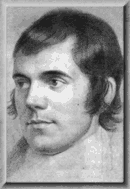
rburns1.gifUPDATE: Check out free new music to perform at your Burns Dinner!

Mount Vernon, WA – Vocalists welcome to join us as we prepare music for the Robert Burns supper at Lincoln Theater, Mount Vernon WA, on January 20, 2007. Robert Burns is the national bard of Scotland from the late 18th century and the supper is an evening of music and poetry in his honor. Read my page all about the History of Robert Burns and the Burns Supper.

Rehearsals from 7-9:30pm on Sunday 1/7, Sunday 1/14 and Friday 1/19 at Mount Vernon Presbyterian Church (corner of Broadway and 15th). We have at least 20 voices in the group already and invite you to join us if you like good choral music and/or Scottish music.

ROBERT BURNS DINNER MUSIC
Toast to the Laddies – Men Only – Song in Production
Toast to the Lassies – Women Only – Song in Production
Bonnie Mary of Argyle – Men Only Quartet
Brigadoon Entrance – Full Choir
I’ll Go Home With Bonnie Jean – Full Choir and Tenor Solo
My Love is Like a Red, Red Rose – Full Choir
A Scottish Tribute – Full Choir

We will perform at two seperate locations: the actual dinner location and then at the Lincoln Theater to open Act I and Act II of the presentations. World class guitar players will also give presentations. The choir is sponsored by Lyric Light Opera which is gearing up for it’s presentation of Brigadoon at McIntyre Hall in July 2007.

Pie Jesu by Andrew Lloyd Webber

memlingjudgmentcentre.jpgMy notes on Pie Jesu by Andrew Lloyd Webber in preparation for performance. Diction, blending, historical backdrop and my interpretation of blending pipe organ, piano, choir and soloists for performing this piece reverently in a worship setting.

Pie Jesu is a motet that is a part of some composers’ musical settings of the Requiem Mass

The words combine paraphrases of the final verse of the thirteenth-century poem Dies Irae and the seventh-century Agnus Dei:
Pie Jesu Domine, dona eis requiem. Dona eis requiem sempiternam.
(“O sweet Lord Jesus, grant them rest; grant them everlasting rest.”)

The Pie Jesu by Andrew Lloyd Webber I am preparing is scored for soprano soloist, boy soprano soloist, SATB choir and organ. For organ stops we are using flute and string registers with a full, flutey pedal. Not completely liking solo organ, and not completely liking the arrangement on piano I have added an improvised accompaniament to the organ in the French Impressionistic style of Erik Satie. (Ala “Gymnopedies”). I have also wanted triangle but was vetoed by my choir, who felt a triangle was a little schmaltzy (we just finished our Advent season and perhaps used the Triangle one too many times!)

To me the boy soprano is the crucial player in this arrangement. I have worked with our boy soprano soloist on keeping an even dark pronunciation, to project through the sanctuary ran the piece a good 20 times with the soprano so he could get used to keeping his notes solid while standing next to a seasoned soprano vocalist. The choir is blended with a light airy sound to match the organ. The end result is a deep breathy pad sound of organ and choir, strong high treble duet sequences with the soprano and boy soprano duet, and I have added my piano interpretation to add movement to the organ pads and to add nuance between vocal passages.

During soloist passages I prefer to let the soloists take the reign of the phrase tempo, I lock things back down at the entrance of the choir. I like this piece slow, slower than Andante. Around 40bpm (Yes, forty beats ber minute). Sub-dividing the eight notes is important to keep the groove flowing, and my additional piano part added sixteenth notes in parts to help the movement not seem so much like a dirge.

Pronunciation: I don’t know how accurate it is, but I don’t care for a hard “g” in Agnus Dei; I prefer a Spanish “n” as in “onion”. It also brings me great pain to here “Dei” pronounced “Day-ee”, since we are not singing Old MacDonald had a farm. Prefer to here “deh-ee”, a “deh” as in “debt” or “death”. So final pronuncation is “Ah-nyoos Deh-ee”. Same approach to “Pie”, I try to avoid “pee-ay”; that “ay” sound is so ugly in the English language. Try for more of “Pee-yeh” with a dark treatment to “yeh”. Stay dark when singing Latin. To me that’s a major key to choir blending. Just one voice reaching for those midwestern “ays” can ruin the blend, so be a taskmaster in this area.

The end result? I am proud to say I am having trouble getting my choir to come in on their entrances because they get so lost in the beauty of the sound. I hold no grudge, this piece is THAT beautiful. A friend played me the Pie Jesu version with Sarah Brightman (I’m told that was the version I heard) and although her voice is second to none, the arrangement had such a large swell with rising strings and cybmal crash in the middle that I was jarred back to the reality that I was listening to a piece by a theater composer. I don’t think this piece needs the added drama. Particularly if performed in a worship setting I feel that an understated performance will have a powerful effect on your congregation.

I have been told the lyrics are a prayer of rest for those fallen in war. I don’t know how accurate that is, but the lyrics ARE from the Dies Irae. This is a poem of the end of times spiritual warfare, so to call it a song for soldiers is not stretching too far. I like the idea that this song is for eternal rest to those who have fallen in battle and I think the performance notes written here will do that concept an optimum of justice.

Complete Dies Irae Poem on Wikipedia

ORIGINAL DIES IRAE MELODY FROM 13th CENTURY:

dies_irae.PNG
(Click for full resolution)

USE IN CATHOLIC LITURGY:
Those familiar with musical settings of the Requiem Mass—such as those by Mozart or Verdi—will be aware of the important place of the Dies Iræ in the liturgy. Nevertheless it fell foul of the preferences of the “Consilium for the Implementation of the Constitution on the Liturgy”—the Vatican body charged with implementing (and indeed drafting) the reforms to the Catholic Liturgy ordered by the Second Vatican Council. The architect of these reforms, Archbishop Annibale Bugnini, explains the mind of the members of the Consilium:

[T]hey got rid of texts that smacked of a negative spirituality inherited from the Middle Ages. Thus they removed such familiar and even beloved texts as the Libera me, Domine, the Dies Iræ, and others that overemphasized judgment, fear, and despair. These they replaced with texts urging Christian hope and giving more effective expression to faith in the resurrection
DIES IRAE means DAY OF WRATH
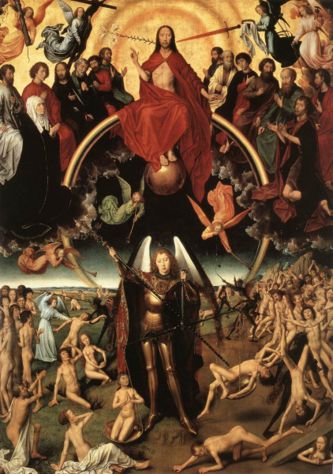
The Day of Judgement from the centre panel of the Memling Triptych in Gdańsk.
(Click for full resolution)
memlingjudgmentcentre.jpg

PIE JESU BY ANDREW LLOYD WEBBER

The Pie Jesu from the Requiem by Lloyd Webber was originally performed by Sarah Brightman, who has performed it many times throughout her career; and has rerecorded the track for her Classics album in 2001. Charlotte Church has also recorded it on her best-selling debut album, Voice of an Angel. The Andrew Lloyd Webber version has also now been performed by Angelis, a group of young choir children.

Thank You 1310 AM – Dallas TX

Christmas is always a heavy time for sales (ORly?) but one of my CD’s was going through the roof. And for some odd reason very heavy ordering from Texas. We couldn’t figure it out. There were so many orders that I finallly just had to email customers and say sorry – we can’t do it. Made me very sad not to be able to fulfill all the orders on my own CD’s.

One of the customers just emailed me and looks like we uncovered the mystery of the heavy spike in sales:

****

I certainly understand. Thanks for cancelling. I would guess that the spike in sales had to do with the spotlight the CD received on 1310 The Ticket (sports radio station in Dallas), which is where I heard of it.

Thanks again for the update and the good service.

–Matt

****

Thank you Texas, and 1310 AM Dallas radio.
🙂

How To Type a Copyright Symbol

You can type “c 2007 myname” for a copyright statement, but you know you want it to look cool. Here’s how to type the copyright symbol as text on a PC or Mac.

How to make a Copyright C Symbol on a PC Keyboard (©):

Hold down Ctrl and Alt at the same time and press C
Ctrl+Alt+C

OR THIS:

Hold down Alt and type 0169 on the number pad (right hand side of your keyboard)
Alt+0169

How to make a Copyright C Symbol on a Mac (©):

Hold down Option at the same time and press ‘g’to get the copyright symbol.
Option+g

You can use these on a text editor like Notepad or Word. Can also use this as text on an html editor like Dreamweaver.

If all this is so extremely tedious you can always type a copyright the simple way like this: (c) composername 2009

Q&A – What is the best tempo for a song?

UPDATE: “Getting the Tempo Right” – additional info at:
https://www.conradaskland.com/blog/2007/09/finding-the-right-tempo/

Email received:
I am an artist from Adelaide, Australia and am curious to know how top producers/engineers detremine what tempo a particlar song should be played at.

Much of my songwriting stems from a vocal melody, and when everything seems to be “built” around that, the overall song tends to somewhat drag a little.

Is there anything I should go by in order to get the perfect tempo (slow down vocal or riffs)?
I hope you can be of some assistance and thank you immensely for you time.
Kind regards
Michael G

************

Hi Michael,

What an incredibly fantastic question! As usual I busy myself with complicated things thinking I am making a difference in the world. You know, I have never addressed this question online – So here you go.

Your fast answer is this: There is no correct tempo for any song.

I know, not very helpful. Try this: The environment a musical piece is performed is what will dictate the “proper” tempo. Quick proof of this is to think of all the song remixes out there. A fusion jazz group may take a standard and play it at lightning speed. Or a choir may take a faster song and slow it down for a more reverent a capella presentation. (Or as a recent auditioner called it: “All Compalla”)

That is the aesthetic side of tempo, now let’s go back in history a bit:

The declaration of tempos and phrasing has becoming more specific over time. In early music composers would not notate tempos (or phrasing for that matter). It was assumed that any musician was trained enough to just “know” the correct tempo. As you can imagine, many pieces sounded different than we hear them today due to varying tempos. Even up to the Baroque Period (1685-1750) tempo markings were virtually non-existent. In my manuscripts of Bach there are not tempos or phrase markings. Editors have added these, usually in lighter print, to indicate how the piece is USUALLY played.

As a composer I cannot even describe the pain to hear someone play your own piece incorrectly. I once wrote a book of progressive etudes for piano. The book graduated in difficulty for serious piano students. I had to listen to a university professor play my pieces entirely wrong. I still hold a grudge over that and I hope that an eternity of fire awaits him for his transgression. Back to tempo…….

Over time composers have realized if they want a piece played a certain way they are obligated to mark it so. A hundred and fifty years ago songs might include tempo markings like “Allegro”, “Andante”, etc. Then more info like “Allegro non troppo” or “Moderato con anima”. In modern music it’s common to see specific metronome markings like MM=116 – which usually means the quarter note is going to be 116 beats in a minute (depending on your time signature, blah blah blah).

All of that to let you know this: I would suggest you mark a specific tempo in your music with a definate metronome marking of beats per minute. Example: MM=120 or simply write: 120bpm.

HOW TO SET TEMPOS
In hip hop music I’ve found artists don’t like to push the beats, so I set tempos on the slower side for rap. If an artist says it “feels right” at 92bpm, then I’ll click it to 90bpm. Rock bands like to push things a bit, so if I’m setting a grid and the band says it feels right around 112, I might click it to 115 or so.

In general I’ve found the tempos I set during production need to be bumped a bit for the final. If I write a song at 120, it’s just a habit to start bumping it up to 124 as I work on pre-production.

THE REAL TEST – Don’t settle on a tempo until you’ve heard it several ways. Keep bumping up a tempo until you’re absolutely sure it could not go any faster. Then take it so slow that you’re absolutely sure it can’t go any slower. This starting point gives you your window. Want to know how I learned that? By clients who knew little about music telling me to bump it up. I can think of several songs that I had started to work on around 120bpm and ended up being in the 150’s. When the client told me to bump it up I would roll my eyes at them – but you know what – sometimes it works. Experiences like that make me very humble, and I have to always remind myself that the most genius ideas can come from anybody at any time.

SETTING SONG TEMPOS
Finally to your real answer – most songs just have a groove where they feel right. Once you’ve identified the window, don’t settle on a tempo until it feels like “ah…….that’s it”. To me, it quite literally feels like you finally settled down into a bean bag chair. It will just feel right, and you’ll know it. During preproduction I absolutely OBSESS over the tempo and key, and it’s not uncommon for me to change either several times before laying real audio tracks. Sometimes I’ll even give songs a bump of two or three BPM’s during the final mix.

Some genres have fairly defined tempos – Euro Dance is almost always 130bpm. An example of Euro Dance would be “Barbie World”. 60-70bpm is a good tempo for healing music and audio therapy, many people like the purity of the clean 60bpm. I’ve done a lot of rap soundtracks in the 68-86BPM range. It always feels too slow at first, but the artists lock it down if their rap is seasoned.

Have confidence in your tempos. It is one part of what makes your productions have “your” sound. And remember, they are hiring YOU for your sound, so you need to do what YOU hear. Stick to what YOU hear, and you will never have to second guess how things should be. The next producer will set it at a different tempo according to their ears. My biggest suggestion, don’t settle on a tempo until you feel in your gut that it’s right.

I had a production where the director ordered me to bump tempo of all songs because the show had no energy. As a result, all of the songs lost the “pocket” feel for me, I didn’t like it at all. To me this is an incorrect use of tempo. Tempo is about groove and feel for a piece, not for pumping caffeine into a dead horse. But I always yield to the Director, it is their vision you need to feed into. They were happy with this so I did it, but with much pain. I hope you don’t find yourself in a similiar situation. Always know the pecking order, and always know who you need to answer to. Some day you’ll be the head producer, and you will really appreciate others following your lead when you have a vision for a piece.

I hope this helps. I’m happy to provide more info….but I have blathered on so long you are probably currently asleep at your keyboard with drool running down the monitor.

Conrad

keywords: tempo, finding right speed, improve groove, find speed song