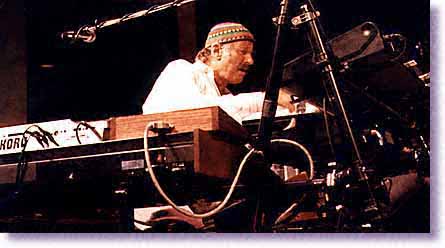
VIENNA, Austria — Jazz legend Joe Zawinul, who soared to fame as one of the creators of jazz fusion and performed and recorded with Miles Davis, died early Tuesday, a hospital official said. He was 75.
Zawinul had been hospitalized since last month. A spokeswoman for Vienna’s Wilhelmina Clinic confirmed his death without giving details.
Zawinul won widespread acclaim for his keyboard work on chart-topping Davis albums such as “In A Silent Way” and “*Biznich* Brew,” and was a leading force behind the so-called “Electric Jazz” movement.
In 1970, Zawinul founded the band Weather Report and produced a series of albums including “Heavy Weather,” “Black Market” and “I Sing the Body Electric.” After that band’s breakup, he founded the Zawinul Syndicate in 1987.
Zawinul is credited with bringing the electric piano and synthesizer into the jazz mainstream.
This past spring, he toured Europe to mark the 20th anniversary of the Zawinul Syndicate. He sought medical attention when the tour ended, the Viennese Hospital Association said in a statement last month.
A handwritten score by a French composer contains an orchestra part that changes from D# to Eb in the same measure. The key signature is 6 sharps. The question asked to me was whether the second note is actually an Eb, or if the flat simply cancels out the E# in the key signature, making it a natural E.
The player mentioned it might be a convention of French music to have the flat cancel out the sharp in the key signature. I believe the Eb is simply what it is, an Eb and I will explain why.
Flats and sharps are simply what they are, they are not added to or subtracted from the key signature or previous accidentals. In other words, a written Eb will always be just Eb – makes no difference about key signature or what is before.
Now there was a time in Early Music where the execution of accidentals had not been standardized. There was a time where accidentals would carry through a piece until they were changed again. In other words, if on page one the score show an F#, then the F’s would remain sharped until changed again – if that didn’t happen til page 5 it made no difference, the F’s remained sharp until let’s say on page F it was written as an F natural. Now imagine how confusing this was for a player to jump in on page 3 having no knowledge of the previous accidental! This is why it was later made standard that an accidental would only last for one measure.
In music theory the chords of the score each relate to each other. A Cm chord has a different quality and function depending how it fits into the score. For example: A Cm as the tonic in the key of Cm, or a Cm as the ii chord in Bb major, or the Cm as a vi chord in Eb major. As a composer writes, especially with chromatic music like Wagner, it’s common to temporarily change keys within a song – but in a very short phrase the key signature won’t be changed – it is done with accidentals. This is why when looking at a single part it may not make sense how the note is written, but it DOES make sense when seen with the score as a whole (if it is written and scored well).
The conundrum is that if you don’t see the underlying chord movement in your mind, the note seems written as a mistake. If you DO understand the underlying chords, and the writer notates the pitch so it’s easier to read but doesn’t support the actual theory of the chord – it’s VERY confusing to read. Most of the time I notice notes like this “dumbed down” in modern praise music, band charts, and usually when someone has written a score by hand without really understanding the chords.
An example of this: You are in the key of Bb major (two flats). In the middle of the piece the composer writes a ii-V-I to temporarily module to the key of E (chords would be F#m – B – E). On the “B” chord the third is D#. The player that is scored for that note sees they are in the key of Bb, but instead of an Eb written, they see D#. It looks like a mistake. But if they saw the whole score they would know it can ONLY be D# because it is the third of the B chord. If it were dumbed down to an Eb the chord would become the notes B-Eb-F# – if I were to sightread that I would miss it, thinking it were a jazz extension.
I hope this all makes sense. It’s much simpler to understand it than it is to explain it….like most things.
“I don’t understand how an airplane can fly, so they don’t. Can you build an airplane? Didn’t think so. Then you don’t know they can fly either.” This might be an example of the Logical Fallacy: Argument from Ignorance. Something must not be true because the person cannot understand or comprehend it. It was identified as flawed logic over two thousand years ago, yet it is the preferred fallacy many people use in debates online and in forum discussions. I think most people really don’t realize they’re doing it until it’s pointed out to them. So here’s some reference information. I see the Argument from Ignorance being posted “Ad Nauseum” in creation vs. evolution debates (can you guess which camp is usually the one posting it?).
What is a logical fallacy?
A “fallacy” is a mistake, and a “logical” fallacy is a mistake in reasoning. There are, of course, other types of mistake than mistakes in reasoning. For instance, factual mistakes are sometimes referred to as “fallacies”. However, the Fallacy Files is specifically concerned, not with factual errors, but with logical ones.
In logic, the term “fallacy” is used in two related, but distinct ways. For example:
1. “Argumentum ad Hominem is a fallacy.”
2. “Your argument is a fallacy.”
In 1, what is called a “fallacy” is a type of argument, so that a “fallacy” in this sense is a type of mistaken reasoning. In 2, it is a specific argument that is said to be a “fallacy”, so that in this sense a “fallacy” is an argument which uses bad reasoning.
Clearly, these two senses are related: in 2, the argument may be called a “fallacy” because it is an instance of Argumentum ad Hominem, or some other type of fallacy. In order to keep these two senses distinct, I restrict the term “fallacy” to the first sense. For me, a fallacy is always a kind of argument.
For the second sense, I will say that a specific argument “commits” a fallacy, or is “fallacious”. So, in my terminology, 2 above commits a category mistake, for there is no way that your specific argument could be a fallacy. I would say, instead:
3. “Your argument commits a fallacy. It’s fallacious.”
However, not just any type of mistake in reasoning counts as a logical fallacy. To be a fallacy, a type of reasoning must be potentially deceptive, it must be likely to fool at least some of the people some of the time. Moreover, in order for a fallacy to be worth identifying and naming, it must be a common type of logical error.
History
Aristotle was both the first formal logician—codifying the rules of correct reasoning—and the first informal logician—cataloging types of incorrect reasoning, namely, fallacies. He was both the first to name types of logical error, and the first to group them into categories. The result is his book On Sophistical Refutations.
However, Aristotle’s teacher, Plato, deserves credit for being the first philosopher to collect examples of bad reasoning, which is an important preliminary piece of field work before naming and cataloging. Plato’s “Euthydemus” preserves a collection of fallacious arguments in dialogue form, putting the perhaps exaggerated examples into the mouths of two sophists. For this reason, fallacious arguments are sometimes called “sophisms” and bad reasoning “sophistry”. Aristotle refers to a few of these examples as instances of his named fallacies.
In the centuries since Plato and Aristotle, many great philosophers and logicians have contributed to fallacy studies, among them John Locke, John Stuart Mill, Jeremy Bentham, and Arthur Schopenhauer.
Why study fallacies?
Why study how to reason incorrectly; why not just study how to reason correctly? There are two reasons:
1. Even if you could count on reasoning correctly 100% of the time, you cannot count on others doing so. In logical self-defense, you need to be able to spot poor reasoning, and—more importantly—to understand it. To be able to correct others’ mistakes, or to refute them convincingly, you need to understand why they are wrong.
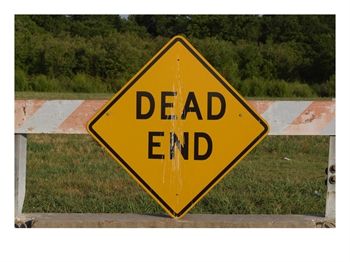
2. Studying formal logic and the rules of correct reasoning is like having a road map that shows how to get from point A to point B. However, even the best navigators sometimes get lost, and it helps if the roads that go nowhere are clearly labeled “DEAD END”, “WRONG WAY”, or “DO NOT ENTER”.
Dead End Sign
That is what fallacy studies is all about: marking the wrong turns that reasoners are likely to take. Thus, studying fallacies is no substitute for studying the positive principles of good reasoning—learning to navigate through logical space, so to speak. You would not set out on a trip without a road map, hoping to rely upon the “DEAD END” signs to get to your destination. Similarly, the Fallacy Files are no replacement for the study of formal and informal logic, only a supplement.
The argument from ignorance, also known as argumentum ad ignorantiam (“appeal to ignorance”) or argument by lack of imagination, is a logical fallacy in which it is claimed that a premise is true only because it has not been proven false or that a premise is false only because it has not been proven true.
The argument from personal incredulity, also known as argument from personal belief or argument from personal conviction, refers to an assertion that because one personally finds a premise unlikely or unbelievable, the premise can be assumed not to be true, or alternately that another preferred but unproven premise is true instead.
Both arguments commonly share this structure: a person regards the lack of evidence for one view as constituting evidence or proof that another view is true. The types of fallacies discussed in this article should not be confused with the reductio ad absurdum method of argument, in which a valid logical contradiction of the form “A and not A” is used to disprove a premise.
* “The solar system must be younger than a million years because even if the sun was made of solid coal and oxygen it would have burned up within that time at the rate it generates heat.” (An argument from ignorance, from 19th Century encyclopedias, based on the assumption that because there was no known means at that time of producing heat more efficient than coal, this logically put a limit on the Sun’s possible age. In fact in the 20th Century with the discovery of radioactivity and nuclear fusion, the sun’s age was more correctly dated at many billions of years old instead. The ‘ignorance’ in this case was the omission of considering whether there might be a more efficient generator of heat that has not yet been discovered, which had not been taken into account.)
* “If polar bears are (the) dominant (predator) in the Arctic, then there would seem to have been no need for them to evolve a white-coloured form of camouflage.” In his book Probability of God, Anglican Bishop Hugh William Montefiore casts doubt on neo-Darwinian evolution with that statement. This argument from lack of imagination was famously dismissed by the evolutionary theorist Richard Dawkins in his book The Blind Watchmaker, who wrote that if the writer had thought to imagine a black polar bear trying to sneak up on a seal in the arctic, he would see the evolutionary value of such fur.
LIST OF LOGICAL FALLACIES
o argumentum ad antiquitatem
o argumentum ad hominem
o argumentum ad ignorantiam
o argumentum ad logicam
o argumentum ad misericordiam
o argumentum ad nauseam
o argumentum ad numerum
o argumentum ad populum
o argumentum ad verecundiam
o circulus in demonstrando
o complex question
o dicto simpliciter
o naturalistic fallacy
o nature, appeal to
o non sequitur
o petitio principii
o post hoc ergo propter hoc
o red herring
o slippery slope
o straw man
o tu quoque
01. Hot For Teacher, Van Halen 4:42
02. Back To School, Deftones 3:57
03. School, Nirvana 2:40
04. Rock N Roll High School, The Ramones 2:17
05. Smokin’ In The Boy’s Room, Brownsville Station, Motley Crue 3:22
06. Chemistry Class, Elvis Costello & the Attractions 2:55
07. Another Brick In The Wall Part II, Pink Floyd 5:35
08. Don’t Stand So close To me, The Police 4:02
3,698,412. Bitch School, Spinal Tap 2:49
10. School’s Out, Alice Cooper 3:46
11. High School Confidential, Rough Trade 3:25
12. Catholic School Rirls Rule Red Hot Chili Peppers 1:55
13. Fight For Your Right, Beastie Boys 3:27
14. Jeremy, Pearl Jam 5:18
15. The Art Teacher, Rufus Wainwright 3:52
A compiled list of forum posts on misinterpreted words from church services:
When my twin daughters were young, I taught them to say this prayer before going to bed. As I listened outside their door, I could hear them say, “Give us this steak and daily bread, and forgive us our mattresses.” My husband and I always had a good laugh over this. That was over 50 years ago, and the memory still remains in my heart.
My mother spent her early childhood saying, “Hail Mary, full of grapes.”
Missoula, Mont.
My son, who is in nursery school, said, “Our Father, who art in Heaven, how didja know my name?”
Uniontown, Ohio
I remember thinking this prayer was “Give us this day our jelly bread.”
Covina, Calif.
I recall reading something years ago about the Pledge of Allegiance. Some child thought it began, “I led the pigeons to the flag.”
Cleveland, Ohio
When I was little, I often wondered who Richard Stands was. You know: “I pledge allegiance to the flag . . . And to the republic for Richard Stands.”
Tampa, Fla.
When my husband was 6 years old, he thought a certain Prayer was “He suffered under a bunch of violets.” The real words were “under Pontius Pilate,” but at that age, he didn’t know better. To this day, we still snicker in church whenever that prayer is read.
Oak Harbor, Wash.
When my older brother was very young, he always walked up to the church altar with my mother when she took communion. On one occasion, he tugged at her arm and asked, “What does the priest say when he gives you the bread?” Mom whispered something in his ear. Imagine his shock many years later when he learned that the priest doesn’t say, “Be quiet until you get to your seat.”
Grand Junction, Colo.
When I was younger, I believed the line was “Lead a snot into temptation.” I thought I was praying for my little sister to get into trouble.
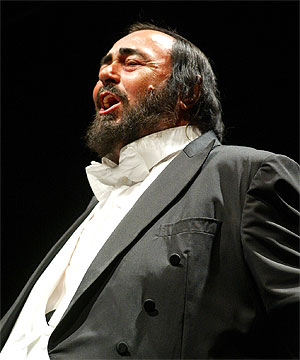
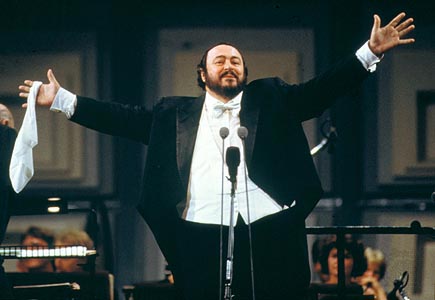
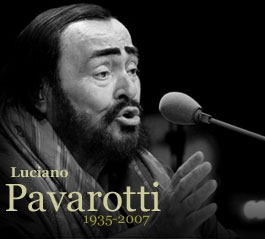
Famed opera tenor Luciano Pavarotti, who appeared on stage with singers as varied as opera star Dame Joan Sutherland, U2’s Bono and Liza Minnelli, died Thursday after suffering from pancreatic cancer.
This is how I remember Pavarotti – Robust, bigger than life and holding his white handkerchief. When I was in high school I got to see him perform live at the Seattle Coliseum at the Seattle Center. It was truly unbelievable. My father played his albums over and over when I was a kid. In our household Pavarotti was a name that was revered with the utmost respect.
I read his biography some twenty years ago. Hopefully the details in my memory are correct – he worked until he was almost 30 as a door to door salesman in Italy while waiting for a break in Opera. His wife’s family thought he was kind of a loser because he didn’t have a real career going. Then he won a role in his late twenties – and his career took off within a few short years after that.
That was a role model for me starting in music – to give it your all and roll the dice, no turning back. Pavarotti was an inspiration for sticking with your dreams, staying true to the fire within that sometimes makes you look…well….a bit odd.
Interesting side note. The young Pavarotti — who played soccer with his town’s junior team — joined the church choir with his father and traveled with him to Wales, where the singing group won first prize at the Llangollen International singing competition.
That experience in Llangollen gave him the passion to pursue singing. I competed with the Northwest Boychoir also at the Llangollen International singing competition – I wish I had a cool story like that. All I remember is they had an awesome simulated wave machine in a pool that we played in. Mmmm…..note to self: come up with cool stories for obituaries….
“For opera to survive today, Riding wrote, it needs not only new music but also “exciting young singers.” Pavarotti was that singer, in the right place and the right time for his generation.”
I don’t know if I can say “we’ll miss you Pavarotti”, because he gave us a gift that still runs strong in the arts. I’m thankful we have great recordings of his voice. There is nothing like it.
 Snopes posts these survival pics with the caption “I Bet This Guy Will Be In Church On Sunday”. He’s definately a lucky guy. This story was reported back in January 2007 and verified by Snopes in May 2007, but just hit CNN news recently.
When I get those cute fluffy stories emailed to me it’s automatic that I check the urban legend websites for verification. 99% of the time the story is not true; someone made it up as a feel good anecdote. But this one so far has been researched and marked as true by skeptic websites like Snopes.com – check out details here: http://www.snopes.com/photos/accident/culvert.asp
So stunning are the photos on the myth-buster sites that many people posting comments allege the pictures have been altered with Adobe Photoshop.
Not so, say the local police.
After crashing through the barricade, the truck slammed into a concrete drainage culvert on the canyon side of the guardrail. The force of the impact propelled the pickup truck into the air, spinning it 180 degrees counter-clockwise along a guardrail.
“When it hit, it flipped end over end and cleared the culvert,” Hurricane Police Chief Lynn Excell said, explaining how the truck sailed over the watercourse, a distance of about 20 feet. “How that happened I don’t know.”