Brigadoon Mystery Conspiracy Theory

brigadoon-1.jpg

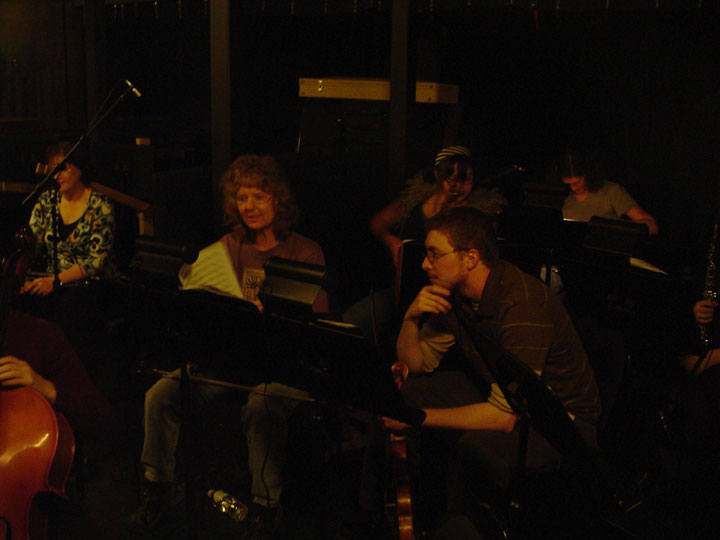
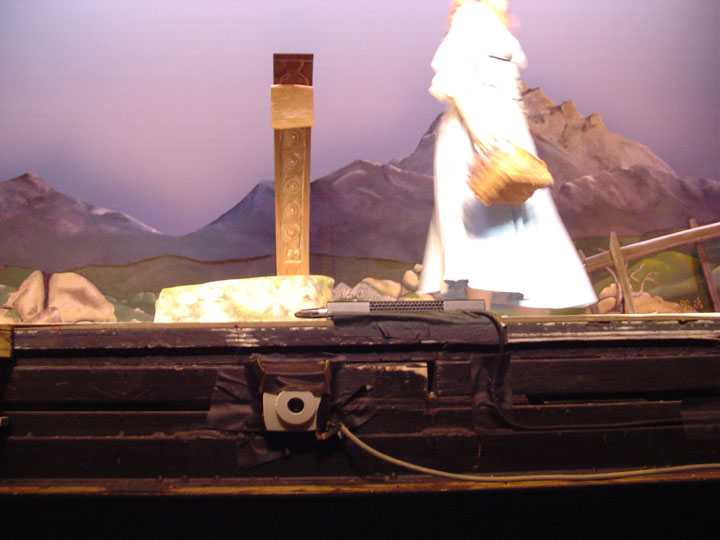
This was my view while conducting Brigadoon at the Kirkland Performance Center in September 2007. Several people asked me for an explanation of the wired contraption you see in the middle of the photo. One child in particular spent most the show trying to figure it out and had some great guesses about it.

The item lying on top of the stage is a stage microphone used to capture overall ambience from the chorus. There are normally three of these across the stage – Left, Center, Right. The sound designers will use these to bring up ambience during large crowd scenes or chorus musical numbers.

The grey item taped in the center with the larger cord extending from it is just a camera. For many scenes in Brigadoon the choir sings from backstage and it was difficult for them to see me for timing. So the sound techs put the remote camera in place and the choir watched me backstage on a monitor. The chorus said the monitor had a little of a fisheye lense effect and made my hands look gigantic, but for keeping time it worked very well.

We had used the same concept during another run of Brigadoon, but the lighting was poor and the chorus couldn’t see me well in the monitor – and boy could I tell from the pit. Timings were not together. You can use a simple computer camera to do this – make sure to check lighting under show conditions so viewers can easily see directions from conductor.

And to the boy who was convinced it was not just a camera – well…..MAYBE it’s actually a launch button I can press to launch a spaceship.

MORE BRIGADOON PHOTOS

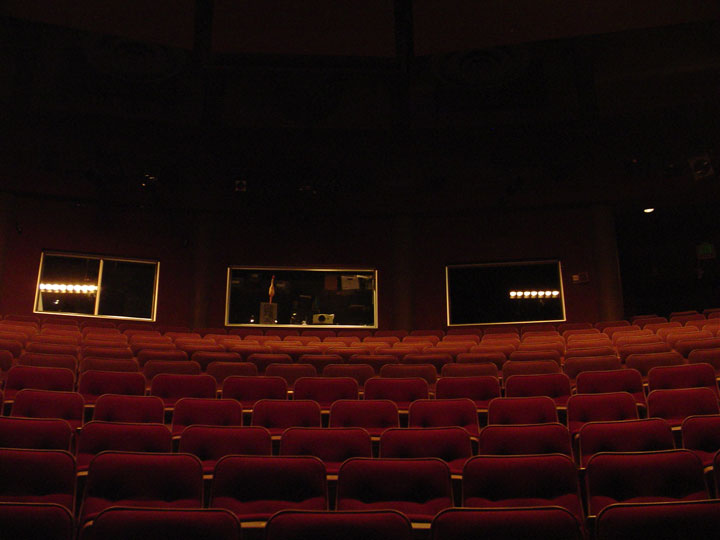
View from Conductor’s podium looking at audience
Kirkland Performance Center, Kirkland, WA.

brigadoon-3.jpg

Musicians in the orchestra pit (read Dark Scary Cave of Doom) at Kirkland PAC

brigadoon-5.jpg

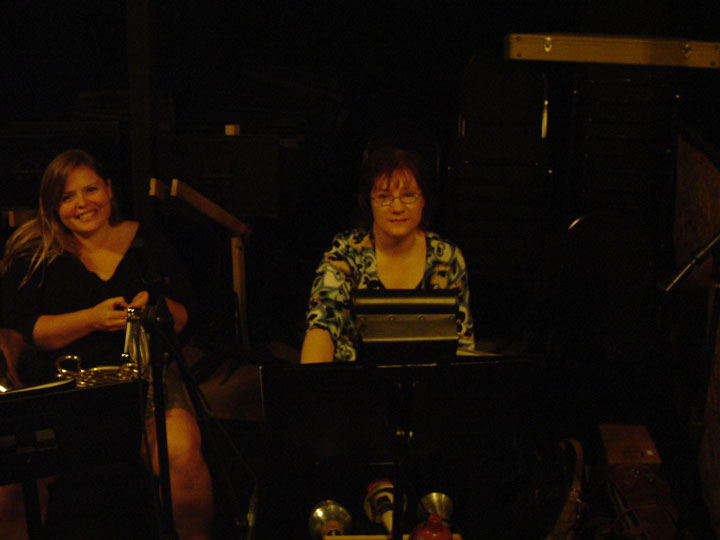
French Horn and Trumpet in Kirkland Orchestra Pit.

brigadoon-4.jpg

Shakespeare Northwest 2007 Season

bulmanshakes.gif

Another great season for Shakespeare Northwest with Twelfth Night and Measure for Measure. I saw 12th Night and it was fantastic. My life is now incomplete knowing that I missed their production of Measure for Measure. Productions of the Bard’s work takes place outdoors by the Skagit River in Mount Vernon, WA.

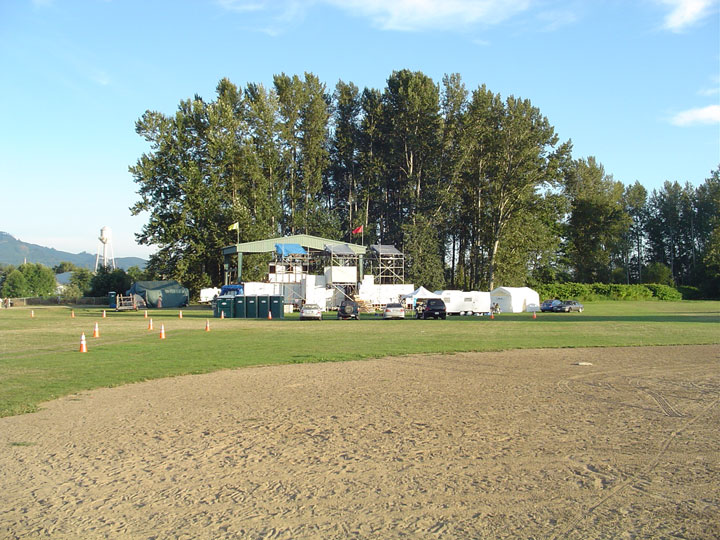
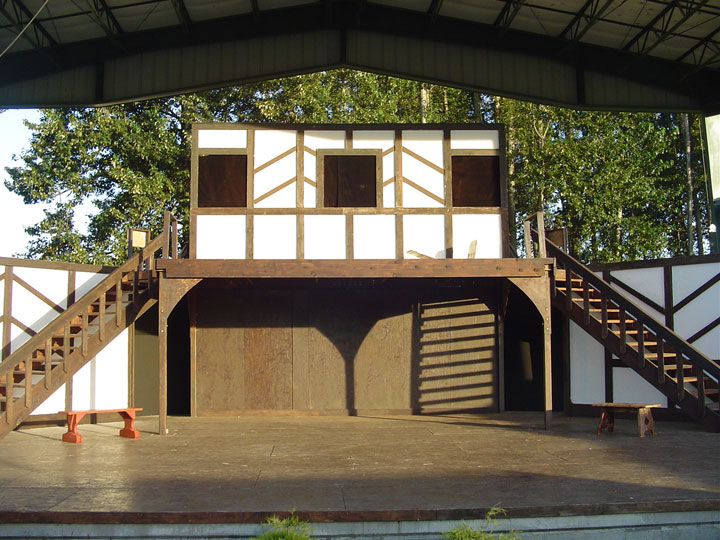
The park is used for a variety of events, including the grandiose Highland Games each year. Shakes NW tucks into the corner of the park with an unassuming setup – but don’t be fooled by distant appearance. They unleash the full fury of the Bard.

shakespeare-northwest-4.jpg

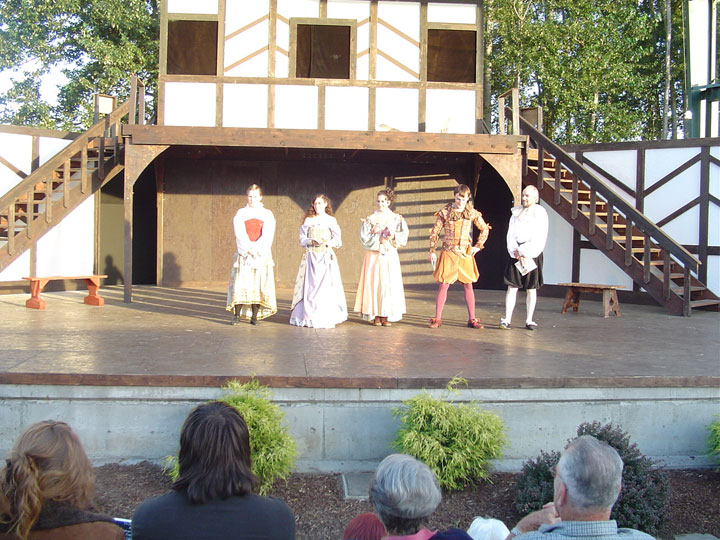
The simplicity of the set fades quickly in the mind’s eye once the thespians take the stage. The multiple levels and door types are used with imagination in the staging and tech of the shows.

shakespeare-northwest-2.jpg

Before the show, actor’s battle it out live in the traditional “Sonnet Slam”. Winner is chosen by the audience. A hat is passed through the audience for donations and the winning actor takes all. On the day I attended it was Carolyn Travis who won.

shakespeare-northwest-1.jpg

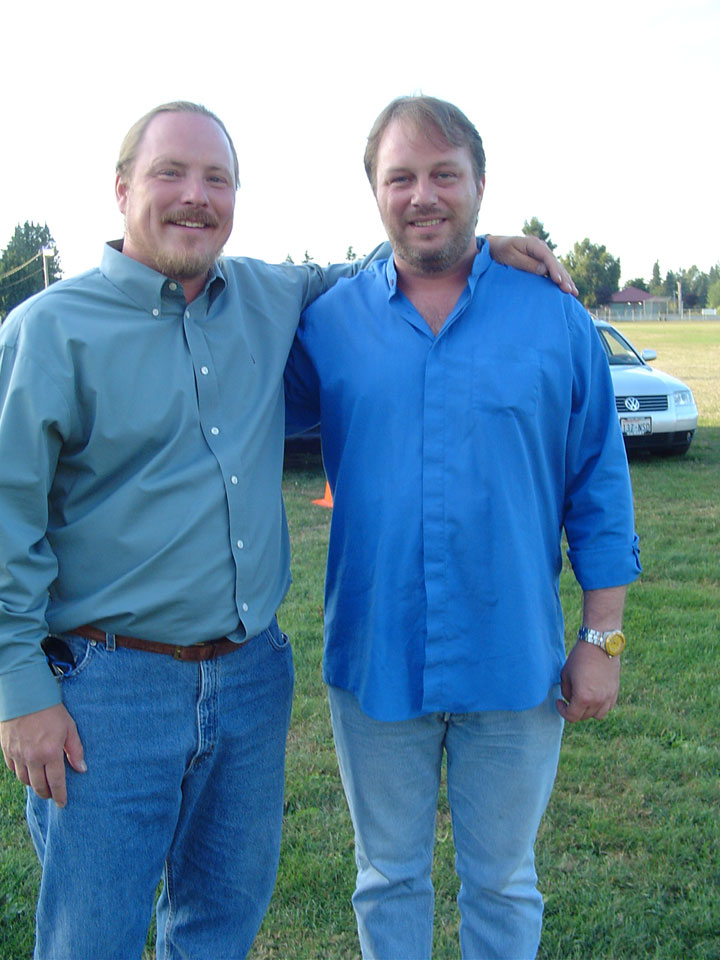
Damond Morris (Artistic Director of Shakespeare Northwest) and yours truly (in the middle of juggling three productions, please be nice about the picture).

shakespeare-northwest-3.jpg

Damond Morris might well be the coolest person on planet Earth.

Shakespeare Northwest Company 2007

Alex Mutegeki
Friar/Gentleman 2/Officer
– Measure

Cail Musick-Slater
Sebastion – Twelfth Night
Lucio – Measure

Caleb Joslin
Fabian – Twelfth Night
Gent 1, Bernandine – Measure

Carolyn Travis
Maria – Twelfth Night

Christina Berger
Viola – Twelfth Night

Christopher Key
Duke – Measure

Clare Tatarsky
Signmaster Extraordinaire – 12th Night/Measure

Damond Morris
Artistic Director – Skagit River Shakespeare Festival

Dan Merz
Claudio – Measure

David Bales
Sir Toby Belch – Twelfth Night

David Cox
Malvolio – Twelfth Night
Escalus – Measure

Emmett Brost
Angelo – Measure

Erin Hemenway
Mariana – Measure

Grady Bonner
House Manager

Ian Slater
Set Construction

Jalyn Green
Sir Andrew Aguecheek – Twelfth

James Brown
Valenti ne/First Officer/Priest – Twelfth

Jill Likkel
Mistgress Overdone/
Inquisitor – Measure

Katie Cole
Feste – Twelfth

Kelsey Milligan
Olivia – Twelfth

Lydia Randall
Servant/Police/Musician – Twelfth

Marc King
Light Gruru/Master Electrician – Measure/Twelfth

Marco Romero
Musician – Twelfth

Mary Bingham
Make-up/Hair – Measure/Twelfth

Matt Riggins
Provost – Measure
Antonio/Captain -Twelfth
Maura Marlin
Costume Design – Twelfth

Mike Boerner
Master Carpenter – Measure/Twelfth
Mike Marlin
Prop Design & Construction – Measure/Twelfth

Mike Wallace
Director – Measure for Measure
Miles McGillivray
Pompey – Measure

S. Molly Weiland
Stage Manager – Twelfth

Perry Lewis
Technical Director

Rob Slater
Carpenter

Ryn Bishop
Stage Manager – Measure

Sarah Mickelson
Isabella – Measure
Sheridan Slater
Set Construction/
Photo Editing

T’ai Hartley
Duke Orsino – Twelfth
Tracy Petersen
Director – Twelfth Night

Marijo Henning ~ Costume Design/Measure
Randi Kivett ~ Electrician
Debbie Riegel ~ Box Office Manager/Volunteer Coordinator

Bohemian Rhapsody – Lyrics

Lyrics to Bohemian Rhapsody by Queen

Is this the real life-
Is this just fantasy-
Caught in a landslide-
No escape from reality-
Open your eyes
Look up to the skies and see-
Im just a poor boy,i need no sympathy-
Because Im easy come,easy go,
A little high,little low,
Anyway the wind blows,doesnt really matter to me,
To me

Mama,just killed a man,
Put a gun against his head,
Pulled my trigger,now hes dead,
Mama,life had just begun,
But now Ive gone and thrown it all away-
Mama ooo,
Didnt mean to make you cry-
If Im not back again this time tomorrow-
Carry on,carry on,as if nothing really matters-

Too late,my time has come,
Sends shivers down my spine-
Bodys aching all the time,
Goodbye everybody-Ive got to go-
Gotta leave you all behind and face the truth-
Mama ooo- (any way the wind blows)
I dont want to die,
I sometimes wish Id never been born at all-

I see a little silhouetto of a man,
Scaramouche,scaramouche will you do the fandango-
Thunderbolt and lightning-very very frightening me-
Galileo,galileo,
Galileo galileo
Galileo figaro-magnifico-
But Im just a poor boy and nobody loves me-
Hes just a poor boy from a poor family-
Spare him his life from this monstrosity-
Easy come easy go-,will you let me go-
Bismillah! no-,we will not let you go-let him go-
Bismillah! we will not let you go-let him go
Bismillah! we will not let you go-let me go
Will not let you go-let me go
Will not let you go let me go
No,no,no,no,no,no,no-
Mama mia,mama mia,mama mia let me go-
Beelzebub has a devil put aside for me,for me,for me-

So you think you can stone me and spit in my eye-
So you think you can love me and leave me to die-
Oh baby-cant do this to me baby-
Just gotta get out-just gotta get right outta here-

Nothing really matters,
Anyone can see,
Nothing really matters-,nothing really matters to me,

Any way the wind blows….

Kurt Wise – An Honest Creationist

Sadly, an Honest Creationist
by Richard Dawkins

The following article is from Free Inquiry magazine, Volume 21, Number 4.

Creation “scientists” have more need than most of us to parade their degrees and qualifications, but it pays to look closely at the institutions that awarded them and the subjects in which they were taken. Those vaunted Ph.D.s tend to be in subjects such as marine engineering or gas kinetics rather than in relevant disciplines like zoology or geology. And often they are earned not at real universities, but at little-known Bible colleges deep in Bush country.

There are, however, a few shining exceptions. Kurt Wise now makes his living at Bryan College (motto “Christ Above All”) located in Dayton, Tennessee, home of the famed Scopes trial. And yet, he originally obtained an authentic degree in geophysics from the University of Chicago, followed by a Ph.D. in geology from Harvard, no less, where he studied under (the name is milked for all it is worth in creationist propaganda) Stephen Jay Gould.

Kurt Wise is a contributor to In Six Days: Why 50 Scientists Choose to Believe in Creation, a compendium edited by John F. Ashton (Ph.D., of course). I recommend this book. It is a revelation. I would not have believed such wishful thinking and self-deception possible. At least some of the authors seem to be sincere, and they don’t water down their beliefs. Much of their fire is aimed at weaker brethren who think God works through evolution, or who clutch at the feeble hope that one “day” in Genesis might mean not twenty-four hours but a hundred million years. These are hard-core “young earth creationists” who believe that the universe and all of life came into existence within one week, less than 10,000 years ago. And Wise—flying valiantly in the face of reason, evidence, and education—is among them. If there were a prize for Virtuoso Believing (it is surely only a matter of time before the Templeton Foundation awards one) Kurt Wise, B.A. (Chicago), Ph.D. (Harvard), would have to be a prime candidate.

Wise stands out among young earth creationists not only for his impeccable education, but because he displays a modicum of scientific honesty and integrity. I have seen a published letter in which he comments on alleged “human bones” in Carboniferous coal deposits. If authenticated as human, these “bones” would blow the theory of evolution out of the water (incidentally giving lie to the canard that evolution is unfalsifiable and therefore unscientific: J. B. S. Haldane, asked by an overzealous Popperian what empirical finding might falsify evolution, famously growled, “Fossil rabbits in the Precambrian!”). Most creationists would not go out of their way to debunk a promising story of human remains in the Pennsylvanian Coal Measures. Yet Wise patiently and seriously examined the specimens as a trained paleontologist, and concluded unequivocally that they were “inorganically precipitated iron siderite nodules and not fossil material at all.” Unusually among the motley denizens of the “big tent” of creationism and intelligent design, he seems to accept that God needs no help from false witness.

All the more interesting, then, to read his personal testimony in In Six Days . It is actually quite moving, in a pathetic kind of way. He begins with his childhood ambition. Where other boys wanted to be astronauts or firemen, the young Kurt touchingly dreamed of getting a Ph.D. from Harvard and teaching science at a major university. He achieved the first part of his goal, but became increasingly uneasy as his scientific learning conflicted with his religious faith. When he could bear the strain no longer, he clinched the matter with a Bible and a pair of scissors. He went right through from Genesis 1 to Revelations 22, literally cutting out every verse that would have to go if the scientific worldview were true. At the end of this exercise, there was so little left of his Bible that:

. . . try as I might, and even with the benefit of intact margins throughout the pages of Scripture, I found it impossible to pick up the Bible without it being rent in two. I had to make a decision between evolution and Scripture. Either the Scripture was true and evolution was wrong or evolution was true and I must toss out the Bible. . . . It was there that night that I accepted the Word of God and rejected all that would ever counter it, including evolution. With that, in great sorrow, I tossed into the fire all my dreams and hopes in science.

See what I mean about pathetic? Most revealing of all is Wise’s concluding paragraph:

Although there are scientific reasons for accepting a young earth, I am a young-age creationist because that is my understanding of the Scripture. As I shared with my professors years ago when I was in college, if all the evidence in the universe turns against creationism, I would be the first to admit it, but I would still be a creationist because that is what the Word of God seems to indicate. Here I must stand.

See what I mean about honest? Understandably enough, creationists who aspire to be taken seriously as scientists don’t go out of their way to admit that Scripture—a local origin myth of a tribe of Middle-Eastern camel-herders—trumps evidence. The great evolutionist John Maynard Smith, who once publicly wiped the floor with Duane P. Gish (up until then a highly regarded creationist debater), did it by going on the offensive right from the outset and challenging him directly: “Do you seriously mean to tell me you believe that all life was created within one week?”

Kurt Wise doesn’t need the challenge; he volunteers that, even if all the evidence in the universe flatly contradicted Scripture, and even if he had reached the point of admitting this to himself, he would still take his stand on Scripture and deny the evidence. This leaves me, as a scientist, speechless. I cannot imagine what it must be like to have a mind capable of such doublethink. It reminds me of Winston Smith in struggling to believe that two plus two equals five if Big Brother said so. But that was fiction and, anyway, Winston was tortured into submission. Kurt Wise—and presumably others like him who are less candid—has suffered no such physical coercion. But, as I hinted at the end of my previous column, I do wonder whether childhood indoctrination could wreak a sufficiently powerful brainwashing effect to account for this bizarre phenomenon.

Whatever the underlying explanation, this example suggests a fascinating, if pessimistic, conclusion about human psychology. It implies that there is no sensible limit to what the human mind is capable of believing, against any amount of contrary evidence. Depending upon how many Kurt Wises are out there, it could mean that we are completely wasting our time arguing the case and presenting the evidence for evolution. We have it on the authority of a man who may well be creationism’s most highly qualified and most intelligent scientist that no evidence, no matter how overwhelming, no matter how all-embracing, no matter how devastatingly convincing, can ever make any difference.

Can you imagine believing that and at the same time accepting a salary, month after month, to teach science? Even at Bryan College in Dayton, Tennessee? I’m not sure that I could live with myself. And I think I would curse my God for leading me to such a pass.

Richard Dawkins is the Charles Simonyi Professor of Public Understanding of Science at Oxford University. An evolutionary biologist and prolific author and lecturer, his most recent book is .
High School Musical Wins Gay Subtext Emmy

Âhsm.jpg

LOS ANGELES, CA – In a category packed with worthy nominees, the Disney Channel movie High School Musical took home the Emmy Award on Sunday for Best Television Programming With Gay Subtext. The Emmy was presented by former West Wing stars Bradley Whitford and Rob Lowe to Musical director Kenny Ortega, who won the Oscar for Gay Subtext in 1993 for his work on Newsies.

The victory for High School Musical was an upset in a category that featured four solid returning nominees: Arrested Development, Everwood , Smallville, and The O.C. The nominations caused some controversy, as gay subtext fans were disappointed by the omission of high school detective drama Veronica Mars. Shrugged one Emmy insider.

Although FOX studios had launched a marketing campaign for its hit show Prison Break, the show was ruled ineligible for the category under the “If it takes place in a prison, it probably isn’t subtext clause.

Some Hollywood experts had predicted a win for Arrested Development as a fitting farewell to the show that spent three seasons with the character Tobias Fünke mining the English language for the gayest possible double entendres. However, even Emmy voters looking to pay tribute to Arrested Development could not ignore the blatant gay subtext of High School Musical. “They had me at the title,” confessed one Emmy voter.

High School Musical, which quickly became a sensation among pre-teen Disney Channel viewers, tells the story of a jock and a brain who cause major upset to the status quo of their cliquish school when they audition for the school musical. Although none of the characters is openly gay, the flames burn bright across the screen throughout the movie. The reigning school star is a triple threat who sings romantic duets with his despotic sister, and who has a tendency towards tight pants and colorful hats that accent his stylish wardrobe. In the gayest onscreen occurrence, he shares a brief moment with a sensitive athlete who has been mocked by his peers for his love of baking.

The movie features countless other ambiguously gay characters, including a reclusive composer who mysteriously dons a tuxedo and bowler hat that would make any drag king proud, and a basketball team that is suspiciously agreeable to choreography. While the network shows nominated featured more screen time devoted to shirtless male horseplay, it was the incredibly gay singing and dancing that propelled High School Musical to victory.

This year’s ceremony marked the tenth year that the Emmy for Gay Subtext, known informally as the HoYay! Award, has been presented. The Emmy was first awarded in 1996 to the show Xena: Warrior Princess.

GeoDezik Projection Design for Macao Cirque Show

� delirium-battle.png

News Release from GeoDezik.com:

Cirque Du Soleil – Macao, China / Chine

(French) – Geodezik conçoit présentement les projections vidéo d’un nouveau spectacle permanent du Cirque du Soleil qui sera présenté � partir de 2008 � Macao en Chine. Sous la direction du metteur en scène Gilles Maheu et en collaboration avec le scénographe Guillaume Lord, Geodezik développe un dispositif de projection unique en son genre (� suivre!).

(English) – Geodezik is currently working on the content and setup design for a new permanent Cirque Du Soleil show in Macao, China. Working with show director Gilles Maheu and scenographer Guillaume Lord, Geodezik is developping a unique projection device (more to come !).

� Photo above – Battle sequence from Delirium

– Conception de la régie et de la diffusion vidéo
– Montage en-ligne
– Intégration de la vidéo captée en direct et des effets vidéo en temps réel

– Video control and projection set-up design
– On-line editing
– Live video and realtime video FX integration
Delirium – Cirque Du Soleil
Conception Video / Video Designers : Michel Lemieux + Victor Pilon
Conception Éclairage / Lighting Design : Alain Lortie
Conception Décors / Set Design : Anne-Séguin Poirier

ABOUT GEODEZIK

Geodezik design and produce video content for projection. Geodezik creates images for a variety of projects such as public performances, televised performances, theatre, dance, museum and architectural installations. Our content is original and exclusive and we are present every step of the creative and technical process.

Around the four member core of Geodezik, there are a variety of artists and technicians that make up the Geodezik team : our distinctive edge. With this highly experimented and talented group of people, Geodezik can make the best of the creative and technical ressources for every project.

Murphy’s Other Laws

1. Light travels faster than sound. This is why some people appear bright until you hear them speak.

2. A fine is a tax for doing wrong. A tax is a fine for doing well.

3. He who laughs last, thinks slowest.

4. A day without sunshine is like, well, night.

5. Change is inevitable, except from a vending machine.

6. Those who live by the sword get shot by those who don’t.

7. Nothing is foolproof to a sufficiently talented fool.

8. The 50-50-90 rule: Anytime you have a 50-50 chance of getting something right, there’s a 90% probability you’ll get it wrong.

9. It is said that if you line up all the cars in the world end-to-end, someone would be stupid enough to try to pass them.

10. If the shoe fits, get another one just like it.

11. The things that come to those that wait may be the things left by those who got there first.

12. Give a man a fish and he will eat for a day. Teach a man to fish and he will sit in a boat all day drinking beer.

13. Flashlight: A case for holding dead batteries.

14. The shin bone is a device for finding furniture.

15. When you go into court, you are putting yourself in the hands of 12 people who weren’t smart enough to get out of jury duty.

Finding the Right Tempo

Question received via email about finding the right tempo:

Hi there
I am a song writer who is having trouble with finding the right tempo. Many of my songs are constructed on basslines, drum beats, riffs or vocals and I feel that everything is recorded at it’s most suitable timing. However, something lacks in either the drums or percussion where I begin to feel song’s ‘dragging’ or too quick, and I NEED to know if there’s something I’m overloooking. Is there a certain ‘off beat’ thing for percussion, half time hats, attacks on notes, etc.? Help me if you can please – it’s really frustrating me.
Thanks.

***********************

This email is a follow-up to my post:
“What is the best tempo for a song”

Let’s see if I can answer this coherently at 3am…

Try to follow me here. A good friend of mine is a session Sax player in Los Angeles. He does a lot of sessions at many different project studios, so he has a great bird’s eye view of what’s going on. In the early days of my mixes he encouraged me to think of frequency ranges, whereas I tended to think in terms of counterpoint. He’d say, “you need something in the high frequencies” on this mix, so I’d add a flute….it was thinking in terms of sonorities instead pads and layers. And I’d have to say he was usually (if not always) right. Thankfully I stayed employed, because although he had the ears for these things, he didn’t know how to execute them – which is how music producers stay in business – knowing what to do and when.

This same thinking can apply in terms of rhythm tracks. Tempo is speed – and from your email it sounds like tempo isn’t really your problem, it’s groove. If I was listening to your track I it would be easier to give specific suggestions – but not having that we’ll take the long way around the horn here. So think in terms of the rhythmic layers – you might need a stronger anchor like a kick, or a higher subdivison like a shaker.

SOME REASONS A SONG DOESN’T GROOVE

  1. Do the lyrics really fit the melody well, or are they kind of scrunched in there to make it work.
  2. Are you writing melodies on paper, or doing it by ear? I’ve found that if you rely on the visual of printed music too much, the groove can get lost in the translation. Try to hear it in your head first before you put it down, this will give you a more natural feel. Most of the great classical composers heard the music, then put their ideas to paper – not the other way around. Just my guess, I don’t have a source on that.
  3. Are you sequencing drum tracks? Using samples or live players will give you a better groove if you’re not a percussionist. I’ve sequenced MIDI for over twenty years now and am pretty strong at it, but I always prefer a samples groove of a live player – or better yet use a real human that knows how to play well.

EXAMPLES OF GROOVE PROBLEMS – AND CORRECTIONS
Here are actual examples I’ve encountered just in the last week that had to do with pieces not grooving, and how I fixed them. The specifics of each probably will not apply to you, but will give you an idea how a very small element can be the make or break for a groove. Every song has a groove, doesn’t matter the style. Yes, even orchestral music has a groove. If you haven’t found the groove, you’re not ready to play the song (read “you have no business playing the song!”).

  1. “Once In A While” from Rocky Horror Show – Didn’t have a legit 70’s country groove. Bass rhythm was dotted quarter, eighth to quarter (One-twoAND-three-four) – bass player was rushing the dotted rhythm a bit, once he layed it back the song fell into a nice groove pocket.
  2. Original song by Christian artist – Straight 4 groove with a feel a little like “Venture Highway”. Original guitar track by artist was a little blocky, had session guitarist overdub double time syncopated strumming over the top. Artist had a live recording and wanted me to duplicate guitar parts, but failed to recognize that their live recording and our studio recording were two different tempos (like 110bpm compared to 135bpm). If I had gone ahead and duplicated what their slower tempo had, the artist would have been happy out of the gate, but there would have been no groove at all to the song. Artist is happy and likes new sound. *Note* – Artist set tempos for both renditions, so that’s what I had to work with.
  3. One Day At A Time – song for church service. Southern style country waltz. Singers were singing with a classical waltz style: ONE-two-THREE, or kick-blank-snare…..not cool for a laid back country waltz. Change snare to beat one on every other measure for KICK-blank-blank SNARE-blank-blank, etc. Like the groove in “Here’s a Quarter, Call Someone Who Cares”. For country waltzes, there’s also a syncopated sixteenth note hit after beat one that gives it a little lift.
  4. Brigadoon – Orchestral Dance – Waltz section. Opposite of country waltz, for this I wanted a Viennese feel – where beat three has a little lag in it. When you hear it, your mind goes “Aha, that’s Strauss!”. Once the musicians understood about delaying beat three in a Viennese style, the song had the “groove”, or to say it was more authentic to the style.
  5. Church choir – a classical church choir singing a gospel song. Was way to square – had them put their music away so they could feel the rhythm. Wasn’t quite like “Sister Act”, but it improved the feel. Musicians that are used to reading music and aren’t seasoned pros, will often get lost in the red tape technicalities of the printed music. Remove that barrier by letting them feel it.
  6. Vocal track – artist was singing to blocky. Used several different visualizations with them. The one that clicked for this artist was to imagine they were soaring above the land, like in a helicopter shooting the opening panorama for a movie. It let them give their mind something to occupy itself so they weren’t as stressed with singing each note technically correct (the recording studio is note a time to practice technique).
  7. Violin recording session – Overdubs for an album project. Player was doing quarter note and eighth note movement of a busy track; they were trying to cover anticipations and suspensions all in their one part rather than let the tapestry of the instruments unfold. I had them switch to whole note movement, so the busy parts moved around them instead. It helped the groove the have those anchoring “pads” in the music, and still created it’s own anticipations, resolutions and suspensions – but at a slower pace that gives the ear more rhythmic dimensions to entertain it.
  8. Jesu Joy of Man’s Desiring – Piano student learning to play this song which is in 9/8 time. The playing was mechanical, no flow to the line. Had them accent first group of every three notes (first note of every triplet) and used dynamics for rise and flow of melodic line. Yes, very simple and rudimentary. But giving simple tools like that is much more affective than giving the nebulous instruction of: “Play it with feeling”. After a short time they were getting the music “off the paper” and feeling the movement of the music.
  9. I Will Survive – preparing song for a drag show. Band played song too fast, it was apparent they had not actually ever danced to the song before. This song needs that steady four on the floor club beat that is slightly restrained, feeling like it is held back a bit. Let’s the vocal push against that restraint to create the classic club, or “house” groove.
  10. Plainsong Chant – for church service. Kind of a”Simple Gifts” type melody. My pick for the culprit was the lame piano arrangement, which was blocky in quarter notes. I improvised a drone on eight notes and let the choir take the lead on the melody, so my piano because harmony and rhythm drone. Saved the song.
  11. Cirque Du Soleil – practice piece from Dralion. Very simple sixteenth note rhythm on string synth part – realized I was using the wrong patch and needed a volume pedal for dynamic swells into the downbeat.
  12. Medium tempo acoustic rock song – needed a little pickup and delineation for the chorus which wasn’t present enough in the drum track. Added a sixteenth note shaker. Sometimes a trite thing to do, but worked well in this case.

Simple stuff. A note here or there. The trick, as in most things, is to specifically identify what needs to be changed and know how to change it. What’s the right way to do it? I don’t think there is – or there might be 20 different “right” ways to do it. It comes down to what sounds good to you.

The Soul Plays by Nicola Pearson

The Soul Plays by Nicola Pearson
Phillip Tarro Theater, Skagit Valley College Campus
Thursday, Sept. 27 – 2:30pm
Friday and Saturday, Sept. 28 & 29 at 7:30 pm.

Tickets are $5 and you can call (360) 416 7723 for information and reservations.

This is a great opportunity for those of you who didn’t get a chance to see “The Soul Plays” when they were performed at the college earlier this summer.  Written by local playwright, Nicola Pearson, this series of one acts is delightful, humorous and thought provoking. The cast is charming and obviously has fun with the material. I really recommend that you try to see this, particularly at these bargain prices. Performances will be at Phillip Tarro Theater.