The intention of the show is to excite the imagination and nurture acceptance and a lifelong passion for the theatre arts.
The production was inspired by New Orleans, created by Elfa Gisla as a show to raise funds for the 200.000 people that are still homeless as well as the Conway Muse, opening in the fall, so it can continue to help New Orleans.
With Special Performances by
Elfa Gisla, Jennings Watts, Lindsey Bowen, Ria Peth, Peggy Wendel, Sarah Simmons, Sarah Webber, Kate Kypuros-
Conrad Askland & Orchestra.
Tickets $16, $19, $22
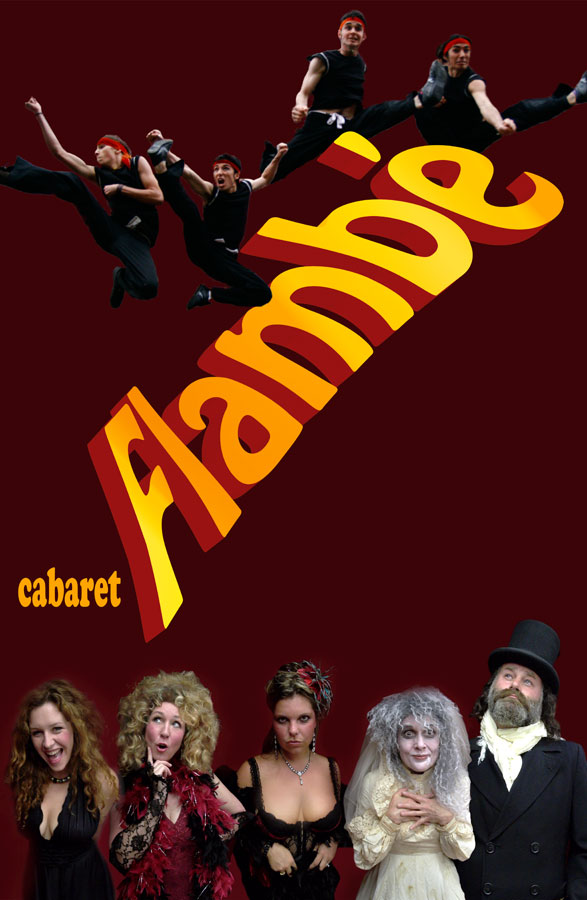
NANDA –four extremely creative young men who are destined to greatness and this is a unique opportunity to see their performance before they hit it BIG!
“Following on the footsteps of the wildly popular Rick Epting Benefit for the Arts in September, producer Elfa Gisla creates a similarly dazzling presentation of amazing local talent and whimsical comedy. This is a show you won’t forget & you won’t want to miss!” Rusty Robertson.
September 2004 – “New Age” is a term that’s lost a bit of it’s luster over the years. In theology it’s better represented by “New Thought”, but in music the term New Age still holds to describe a genre of instrumental music that is thoughtful, usually instrumental, and a great background for keeping with our own thoughts.
New Age music has it’s roots with the Impressionist music movement around the 1900’s. The Impressionist composers were mostly French and included Francis Poulenc, Claude Debussy and Erik Satie – part of “Les Six”. In the mid to late 1800’s German music ruled. The orchestrations and sheer numbers of performers had gotten so large it was hard to imagine anything larger. The peak of giant productions culminated with Wagner’s “Ring” opera cycle with runs nearly 12 hours and employees hundreds of performers. Impressionist music reacted to this by scaling down, being light and often times it’s purpose was simply as background music. This was a revolutionary idea at the time.
Three famous piano pieces from the original Impressionist “New Age” composers are Trois Gymnopedies by Erik Satie, Perpetual Movements by Francis Poulenc and Claire De Lune by Claude Debussy. The current music movement started by these composers was picked up in the 1970’s by pianist George Winston and later expanded by artists like Kitaro, Yanni and Vangelis; incorporating electronic sound sources.
I use elements of the impressionist styles when I play background music for meditation. If you listen closely you’ll hear slowly evolving tonal centers, triplets in the right hand vs. duplets in the left (Debussy “Arabesque” style), motor rhythms of constant steady movement and simple high melodies (a device from Minimalism). The composer I keep close to heart while playing for meditations is Francis Poulenc.
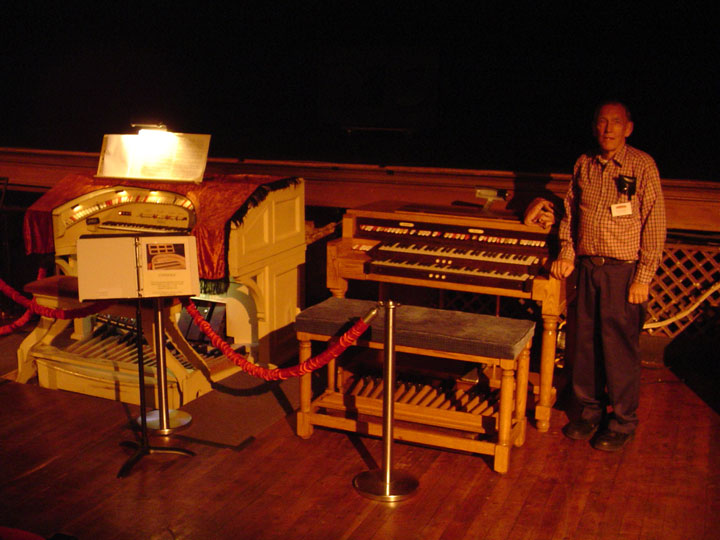
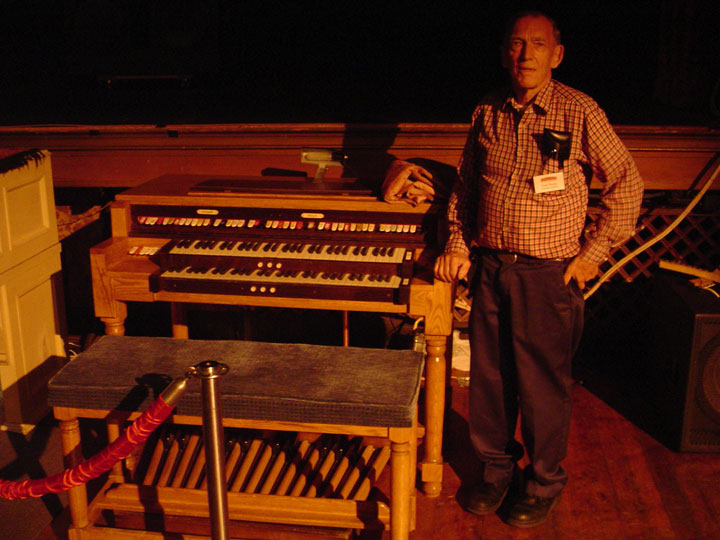
If you look at this picture and just see a guy standing next to an organ – I must inform you it is MUCH more than that. I have exciting news for any fans of the Lincoln Theater in Mount Vernon, WA – fans of Wurlitzer organs and fans of the Rocky Horror Show.
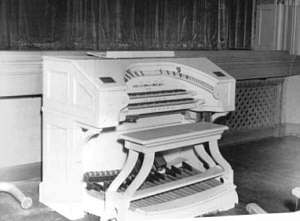
What are are looking at on the left is one of the oldest original functioning Wurlitzer organs in the United States. It is the house organ of the Historic Lincoln Theater in Mount Vernon, WA. The organ to the right of that is a custom built remote control organ that can control the keys and stops of the main organ from up to 70 feet away. On the right is Fred Beeks, one of the men who custom built this new functional work of art.
With the sepia tones of the photograph and old world craftsmanship you might think this picture was taken in the 1920’s – but it was taken September 18, 2007.
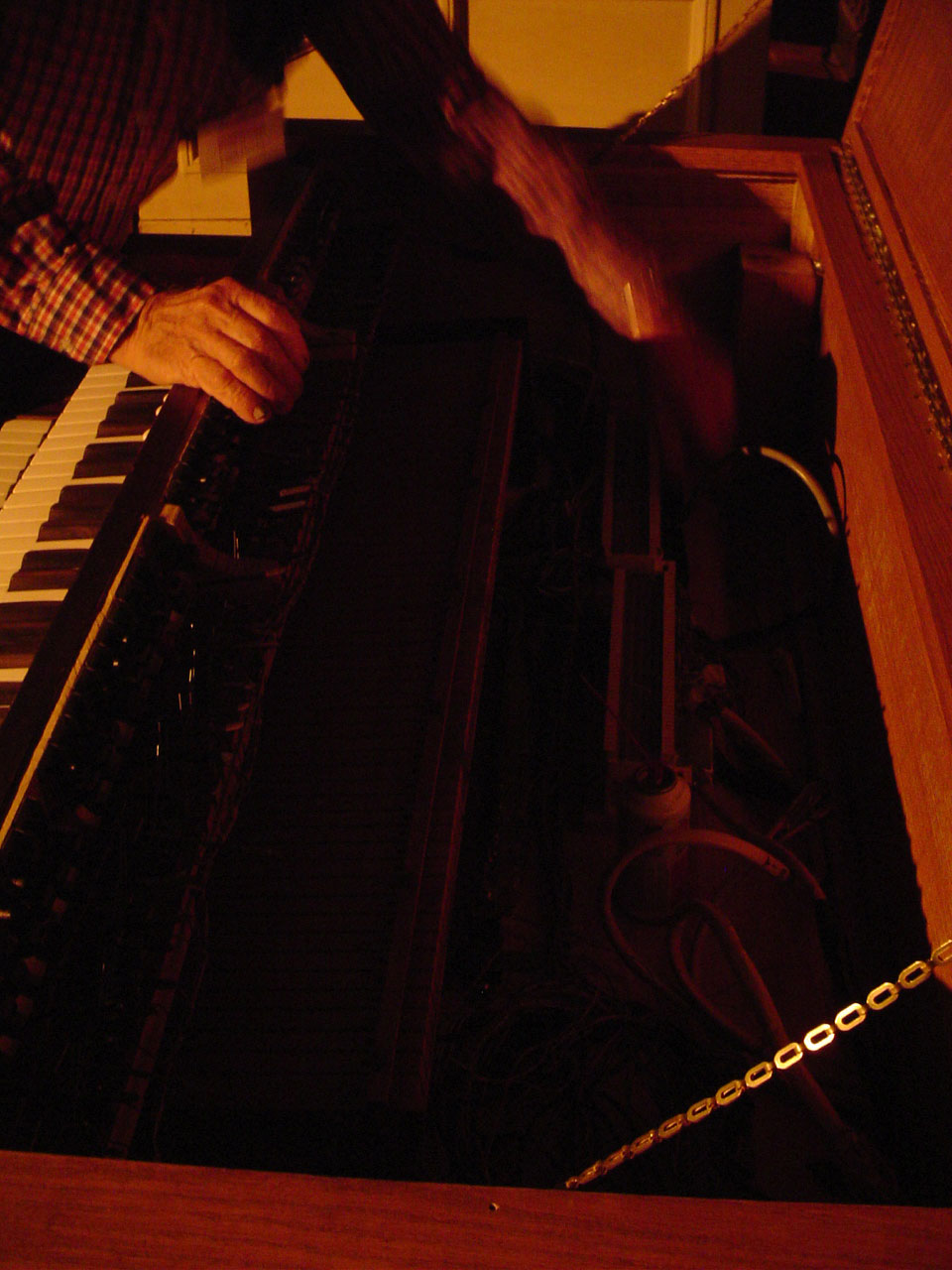
Several months ago I went down to the Lincoln Theater to jam on the Wurlitzer a bit. I met Fred Beeks who gave me a tour of the backstage where all the Wurlitzer pipes, cables and bellows are housed. It was an amazing thing to witness. You just don’t see that kind of complex machinery for organs much any more. If a note goes out, Fred climbs up to the rafter and hand solders the connections back in place for the organ. It’s amazing.
When I was jamming on the organ I had mentioned to Fred how much fun it would be if I could play the Wurlitzer during our upcoming production of the Rocky Horror Show. One big problem – for stage shows at the Lincoln Theater companies usually utilize the extended thrust of the stage – which covers up the Wurlitzer organ. The organ becomes under the stage and cannot be played. For me that would be a done deal, can’t be done. But not for Fred.
Fred Beeks mentioned they could make a master control unit I could use onstage to control the Wurlitzer. At the time he said I would be limited to preset stops on the Wurlitzer – just one setting. So when I walked in to see the new controller I was naturally expecting a small keyboard, perhaps on aluminum legs. I was totally blown away by what I saw.
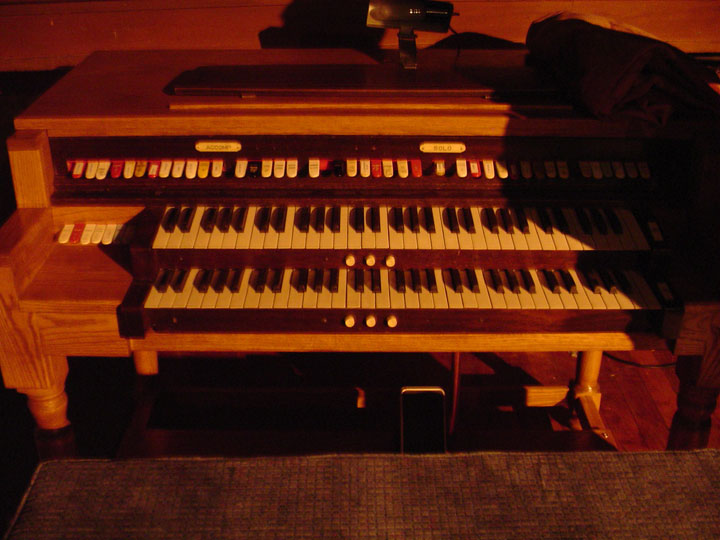
Gene Peden, longtime organist at the Lincoln Theater, custom built a cabinet for the new controller organ. Complete with rounded legs. See the picture below for a close-up. It’s absolutely beautiful.
Then Fred Beeks did all the custom wiring into the cabinet that Gene Peden built. The master organ now controls most all of the stops on the Wurlitzer. Now I may have the fine details a little off, Gene and Fred worked together on the project as a whole.
Here’s what you may not know about the Wurlitzer organ at the Lincoln Theater – It’s not just an organ, it also controls all sorts of live special effects on the wings and throughout the auditorium. (Details on stops and fx listed further down on this post). There are chimes down each side of the auditorium, a player piano on the stage left wing, mallet instruments on the stage right wing (all three fully visible to the audience). In the top stage left box there are percussion fx with drums and cymbals. And now all of those can be controlled remotely with this new unit – and integrated into any live stage show at the Lincoln.
So I said to Fred, “Do you realize that most of the people attending our Rocky Horror Show have never even heard of a theater organ, don’t even know they exist?” – He smiled the smile of an all-knowing sage and said softly “We know. That’s why we did it.”
A big thank you to the Lincoln Theater for making this happen. Fred Beeks, Gene Peden and facilities manager Roger Gietzen – they just don’t make ’em like you guys any more. You are the best.
And I should tell you another thing about the Lincoln Theater. Before I moved to Mount Vernon, WA I was visiting my family here and we went to see a local stage production at the Lincoln. I walked into this place and thought to myself, “What kind of community has the commitment to keep a place like this going?” – It was a theater straight out of the 1920’s – beautifully preserved. I knew there must be some big hearts in Mount Vernon, WA and Skagit County. I was right.
It takes a VERY committed community to keep the Lincoln going, and it tells tons about the passion for the arts in Skagit County. It was one of the things that made me want to move here – I hope people in City Hall pay attention to that and keep it going.
Lincoln Theater Volunteer Organists
Fred Beeks
Ruth Ann Burley
Glen Desjardins
Gene Peden
About the Wurlitzer Organ at the Lincoln Theatre
Wurlitzer magic keeps tradition alive
Of the 98 Wurlitzer organs remining in their original theaters in the U.S., the Lincoln Theatre’s Wurlitzer is one of only two 2-manual, 7-rank D-2 Full Unit Orchestra models. It has a full set of organ pipes, as well as a set of ‘toys,’ the mechanical sound effects for silent movies, as well as marimbas, drums, glockenspiel, xylophone, cathedral chimes, celeste, etc., and an original Wurlitzer piano.
The Lincoln Wulitzer features seven ranks of pipes, a remote piano, and a complete sound effect system for silent films, including beats, castanets, drums, cymbals, glockenspiels, and marimbas, as well as a set of silver chimes mounted on the auditorium’s painted columns.
The Lincoln’s Wurlitzer Organ
Much work has been done by our pool of volunteer organists and technicians to maintain and repair our musical treasure.
The console has been pulled, cleaned, and rewired; several ranks have been gone through, with new leathers and blocks installed; and the “toy box” for sound effects has been rearranged for easier access and repair. All the work has been done by dedicated volunteers, including Gene Peden, Bob Martin, and Keith Thompson.
The volunteer organists who perform before each film showing are Dusan Mrak, Jeff Fox, Gene Reden, Glen DesJardins, and Ken Fenske. Thanks to all of them for keeping the theater organ tradition alive at the Lincoln!
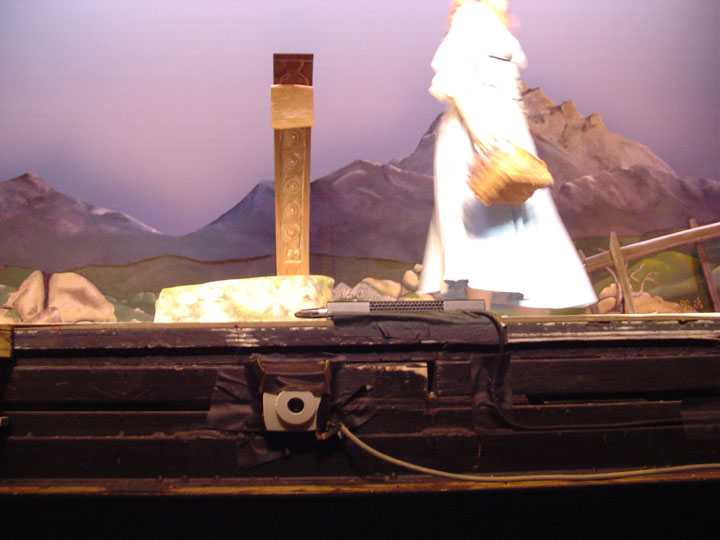
This was my view while conducting Brigadoon at the Kirkland Performance Center in September 2007. Several people asked me for an explanation of the wired contraption you see in the middle of the photo. One child in particular spent most the show trying to figure it out and had some great guesses about it.
The item lying on top of the stage is a stage microphone used to capture overall ambience from the chorus. There are normally three of these across the stage – Left, Center, Right. The sound designers will use these to bring up ambience during large crowd scenes or chorus musical numbers.
The grey item taped in the center with the larger cord extending from it is just a camera. For many scenes in Brigadoon the choir sings from backstage and it was difficult for them to see me for timing. So the sound techs put the remote camera in place and the choir watched me backstage on a monitor. The chorus said the monitor had a little of a fisheye lense effect and made my hands look gigantic, but for keeping time it worked very well.
We had used the same concept during another run of Brigadoon, but the lighting was poor and the chorus couldn’t see me well in the monitor – and boy could I tell from the pit. Timings were not together. You can use a simple computer camera to do this – make sure to check lighting under show conditions so viewers can easily see directions from conductor.
And to the boy who was convinced it was not just a camera – well…..MAYBE it’s actually a launch button I can press to launch a spaceship.
MORE BRIGADOON PHOTOS
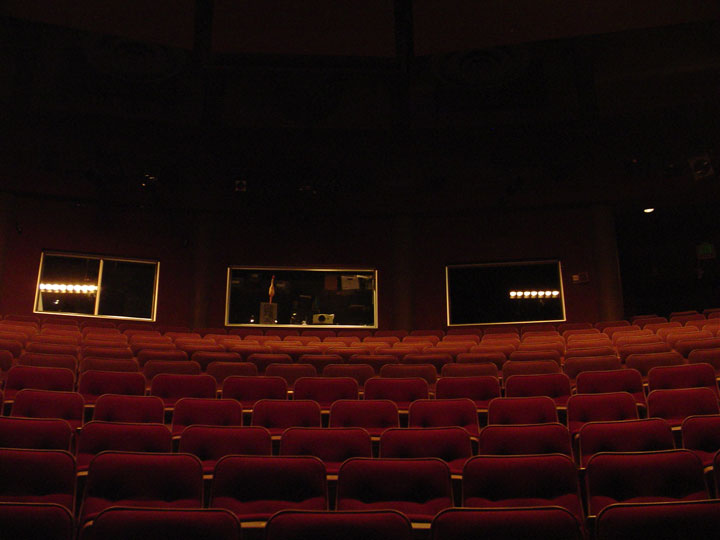
View from Conductor’s podium looking at audience
Kirkland Performance Center, Kirkland, WA.
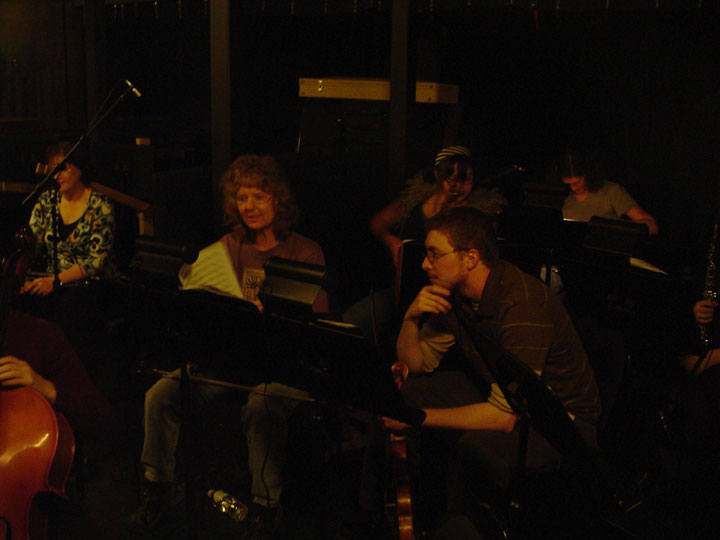
Musicians in the orchestra pit (read Dark Scary Cave of Doom) at Kirkland PAC
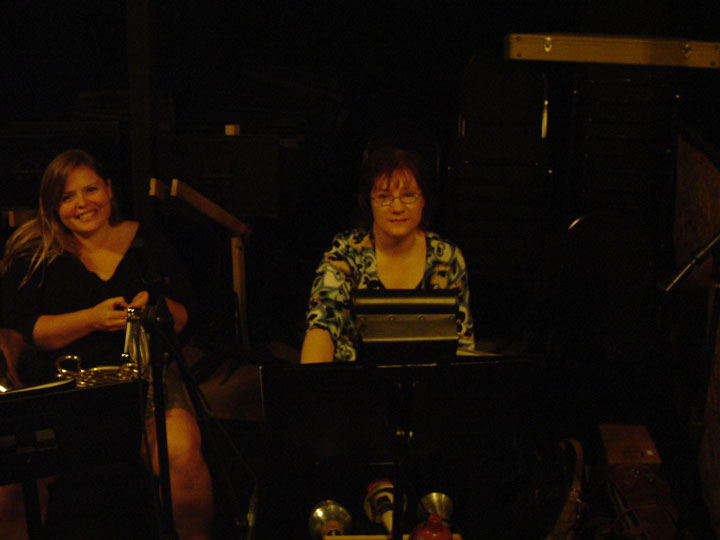
French Horn and Trumpet in Kirkland Orchestra Pit.
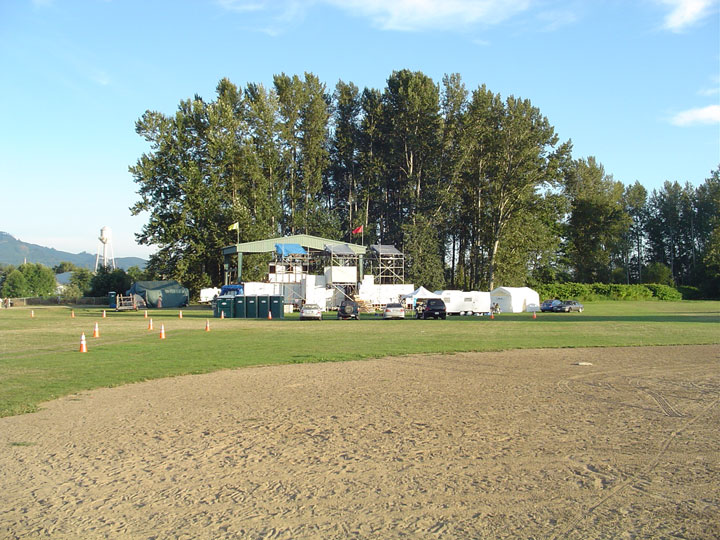
Another great season for Shakespeare Northwest with Twelfth Night and Measure for Measure. I saw 12th Night and it was fantastic. My life is now incomplete knowing that I missed their production of Measure for Measure. Productions of the Bard’s work takes place outdoors by the Skagit River in Mount Vernon, WA.
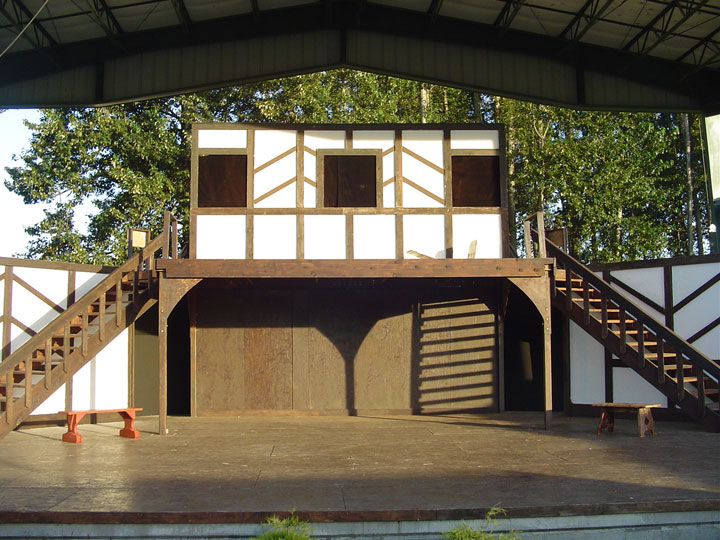
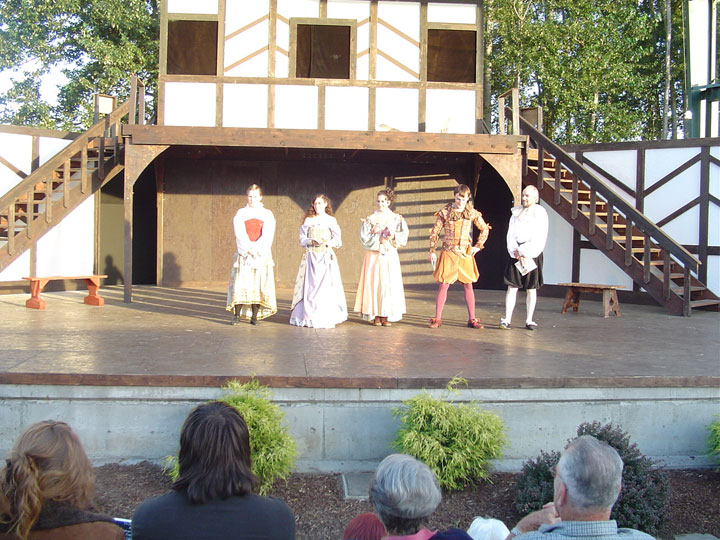
The park is used for a variety of events, including the grandiose Highland Games each year. Shakes NW tucks into the corner of the park with an unassuming setup – but don’t be fooled by distant appearance. They unleash the full fury of the Bard.
The simplicity of the set fades quickly in the mind’s eye once the thespians take the stage. The multiple levels and door types are used with imagination in the staging and tech of the shows.
Before the show, actor’s battle it out live in the traditional “Sonnet Slam”. Winner is chosen by the audience. A hat is passed through the audience for donations and the winning actor takes all. On the day I attended it was Carolyn Travis who won.
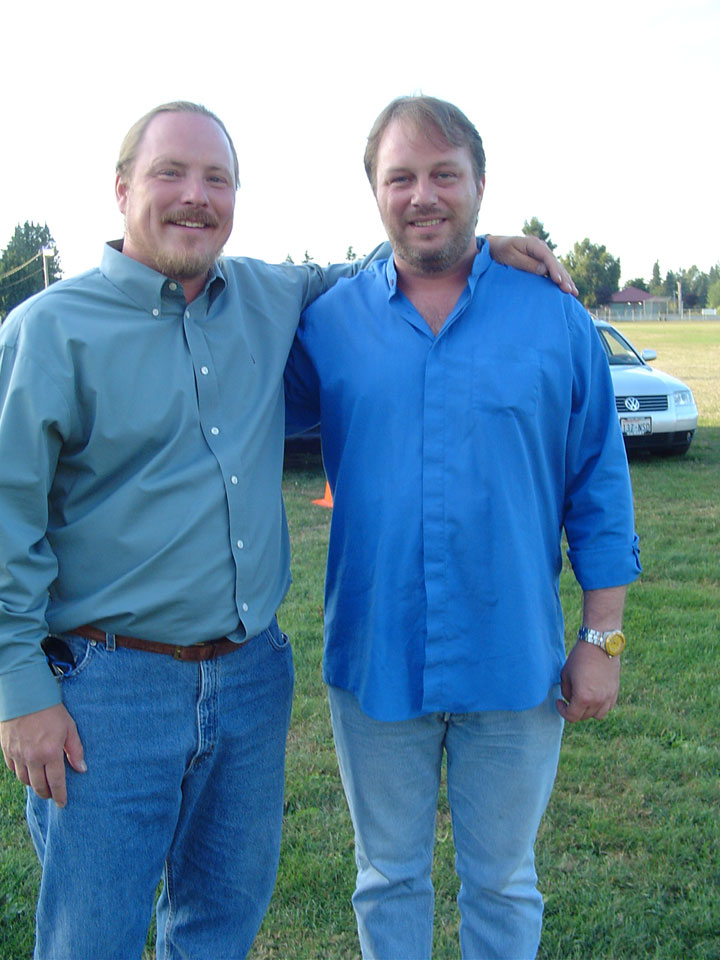
Damond Morris (Artistic Director of Shakespeare Northwest) and yours truly (in the middle of juggling three productions, please be nice about the picture).
Damond Morris might well be the coolest person on planet Earth.
Shakespeare Northwest Company 2007
Alex Mutegeki
Friar/Gentleman 2/Officer
– Measure
Cail Musick-Slater
Sebastion – Twelfth Night
Lucio – Measure
Is this the real life-
Is this just fantasy-
Caught in a landslide-
No escape from reality-
Open your eyes
Look up to the skies and see-
Im just a poor boy,i need no sympathy-
Because Im easy come,easy go,
A little high,little low,
Anyway the wind blows,doesnt really matter to me,
To me
Mama,just killed a man,
Put a gun against his head,
Pulled my trigger,now hes dead,
Mama,life had just begun,
But now Ive gone and thrown it all away-
Mama ooo,
Didnt mean to make you cry-
If Im not back again this time tomorrow-
Carry on,carry on,as if nothing really matters-
Too late,my time has come,
Sends shivers down my spine-
Bodys aching all the time,
Goodbye everybody-Ive got to go-
Gotta leave you all behind and face the truth-
Mama ooo- (any way the wind blows)
I dont want to die,
I sometimes wish Id never been born at all-
I see a little silhouetto of a man,
Scaramouche,scaramouche will you do the fandango-
Thunderbolt and lightning-very very frightening me-
Galileo,galileo,
Galileo galileo
Galileo figaro-magnifico-
But Im just a poor boy and nobody loves me-
Hes just a poor boy from a poor family-
Spare him his life from this monstrosity-
Easy come easy go-,will you let me go-
Bismillah! no-,we will not let you go-let him go-
Bismillah! we will not let you go-let him go
Bismillah! we will not let you go-let me go
Will not let you go-let me go
Will not let you go let me go
No,no,no,no,no,no,no-
Mama mia,mama mia,mama mia let me go-
Beelzebub has a devil put aside for me,for me,for me-
So you think you can stone me and spit in my eye-
So you think you can love me and leave me to die-
Oh baby-cant do this to me baby-
Just gotta get out-just gotta get right outta here-
Nothing really matters,
Anyone can see,
Nothing really matters-,nothing really matters to me,
The following article is from Free Inquiry magazine, Volume 21, Number 4.
Creation “scientists†have more need than most of us to parade their degrees and qualifications, but it pays to look closely at the institutions that awarded them and the subjects in which they were taken. Those vaunted Ph.D.s tend to be in subjects such as marine engineering or gas kinetics rather than in relevant disciplines like zoology or geology. And often they are earned not at real universities, but at little-known Bible colleges deep in Bush country.
There are, however, a few shining exceptions. Kurt Wise now makes his living at Bryan College (motto “Christ Above Allâ€) located in Dayton, Tennessee, home of the famed Scopes trial. And yet, he originally obtained an authentic degree in geophysics from the University of Chicago, followed by a Ph.D. in geology from Harvard, no less, where he studied under (the name is milked for all it is worth in creationist propaganda) Stephen Jay Gould.
Kurt Wise is a contributor to In Six Days: Why 50 Scientists Choose to Believe in Creation, a compendium edited by John F. Ashton (Ph.D., of course). I recommend this book. It is a revelation. I would not have believed such wishful thinking and self-deception possible. At least some of the authors seem to be sincere, and they don’t water down their beliefs. Much of their fire is aimed at weaker brethren who think God works through evolution, or who clutch at the feeble hope that one “day†in Genesis might mean not twenty-four hours but a hundred million years. These are hard-core “young earth creationists†who believe that the universe and all of life came into existence within one week, less than 10,000 years ago. And Wise—flying valiantly in the face of reason, evidence, and education—is among them. If there were a prize for Virtuoso Believing (it is surely only a matter of time before the Templeton Foundation awards one) Kurt Wise, B.A. (Chicago), Ph.D. (Harvard), would have to be a prime candidate.
Wise stands out among young earth creationists not only for his impeccable education, but because he displays a modicum of scientific honesty and integrity. I have seen a published letter in which he comments on alleged “human bones†in Carboniferous coal deposits. If authenticated as human, these “bones†would blow the theory of evolution out of the water (incidentally giving lie to the canard that evolution is unfalsifiable and therefore unscientific: J. B. S. Haldane, asked by an overzealous Popperian what empirical finding might falsify evolution, famously growled, “Fossil rabbits in the Precambrian!â€). Most creationists would not go out of their way to debunk a promising story of human remains in the Pennsylvanian Coal Measures. Yet Wise patiently and seriously examined the specimens as a trained paleontologist, and concluded unequivocally that they were “inorganically precipitated iron siderite nodules and not fossil material at all.†Unusually among the motley denizens of the “big tent†of creationism and intelligent design, he seems to accept that God needs no help from false witness.
All the more interesting, then, to read his personal testimony in In Six Days . It is actually quite moving, in a pathetic kind of way. He begins with his childhood ambition. Where other boys wanted to be astronauts or firemen, the young Kurt touchingly dreamed of getting a Ph.D. from Harvard and teaching science at a major university. He achieved the first part of his goal, but became increasingly uneasy as his scientific learning conflicted with his religious faith. When he could bear the strain no longer, he clinched the matter with a Bible and a pair of scissors. He went right through from Genesis 1 to Revelations 22, literally cutting out every verse that would have to go if the scientific worldview were true. At the end of this exercise, there was so little left of his Bible that:
. . . try as I might, and even with the benefit of intact margins throughout the pages of Scripture, I found it impossible to pick up the Bible without it being rent in two. I had to make a decision between evolution and Scripture. Either the Scripture was true and evolution was wrong or evolution was true and I must toss out the Bible. . . . It was there that night that I accepted the Word of God and rejected all that would ever counter it, including evolution. With that, in great sorrow, I tossed into the fire all my dreams and hopes in science.
See what I mean about pathetic? Most revealing of all is Wise’s concluding paragraph:
Although there are scientific reasons for accepting a young earth, I am a young-age creationist because that is my understanding of the Scripture. As I shared with my professors years ago when I was in college, if all the evidence in the universe turns against creationism, I would be the first to admit it, but I would still be a creationist because that is what the Word of God seems to indicate. Here I must stand.
See what I mean about honest? Understandably enough, creationists who aspire to be taken seriously as scientists don’t go out of their way to admit that Scripture—a local origin myth of a tribe of Middle-Eastern camel-herders—trumps evidence. The great evolutionist John Maynard Smith, who once publicly wiped the floor with Duane P. Gish (up until then a highly regarded creationist debater), did it by going on the offensive right from the outset and challenging him directly: “Do you seriously mean to tell me you believe that all life was created within one week?â€
Kurt Wise doesn’t need the challenge; he volunteers that, even if all the evidence in the universe flatly contradicted Scripture, and even if he had reached the point of admitting this to himself, he would still take his stand on Scripture and deny the evidence. This leaves me, as a scientist, speechless. I cannot imagine what it must be like to have a mind capable of such doublethink. It reminds me of Winston Smith in struggling to believe that two plus two equals five if Big Brother said so. But that was fiction and, anyway, Winston was tortured into submission. Kurt Wise—and presumably others like him who are less candid—has suffered no such physical coercion. But, as I hinted at the end of my previous column, I do wonder whether childhood indoctrination could wreak a sufficiently powerful brainwashing effect to account for this bizarre phenomenon.
Whatever the underlying explanation, this example suggests a fascinating, if pessimistic, conclusion about human psychology. It implies that there is no sensible limit to what the human mind is capable of believing, against any amount of contrary evidence. Depending upon how many Kurt Wises are out there, it could mean that we are completely wasting our time arguing the case and presenting the evidence for evolution. We have it on the authority of a man who may well be creationism’s most highly qualified and most intelligent scientist that no evidence, no matter how overwhelming, no matter how all-embracing, no matter how devastatingly convincing, can ever make any difference.
Can you imagine believing that and at the same time accepting a salary, month after month, to teach science? Even at Bryan College in Dayton, Tennessee? I’m not sure that I could live with myself. And I think I would curse my God for leading me to such a pass.
Richard Dawkins is the Charles Simonyi Professor of Public Understanding of Science at Oxford University. An evolutionary biologist and prolific author and lecturer, his most recent book is .
LOS ANGELES, CA – In a category packed with worthy nominees, the Disney Channel movie High School Musical took home the Emmy Award on Sunday for Best Television Programming With Gay Subtext. The Emmy was presented by former West Wing stars Bradley Whitford and Rob Lowe to Musical director Kenny Ortega, who won the Oscar for Gay Subtext in 1993 for his work on Newsies.
The victory for High School Musical was an upset in a category that featured four solid returning nominees: Arrested Development, Everwood , Smallville, and The O.C. The nominations caused some controversy, as gay subtext fans were disappointed by the omission of high school detective drama Veronica Mars. Shrugged one Emmy insider.
Although FOX studios had launched a marketing campaign for its hit show Prison Break, the show was ruled ineligible for the category under the “If it takes place in a prison, it probably isn’t subtext clause.
Some Hollywood experts had predicted a win for Arrested Development as a fitting farewell to the show that spent three seasons with the character Tobias Fünke mining the English language for the gayest possible double entendres. However, even Emmy voters looking to pay tribute to Arrested Development could not ignore the blatant gay subtext of High School Musical. “They had me at the title,†confessed one Emmy voter.
High School Musical, which quickly became a sensation among pre-teen Disney Channel viewers, tells the story of a jock and a brain who cause major upset to the status quo of their cliquish school when they audition for the school musical. Although none of the characters is openly gay, the flames burn bright across the screen throughout the movie. The reigning school star is a triple threat who sings romantic duets with his despotic sister, and who has a tendency towards tight pants and colorful hats that accent his stylish wardrobe. In the gayest onscreen occurrence, he shares a brief moment with a sensitive athlete who has been mocked by his peers for his love of baking.
The movie features countless other ambiguously gay characters, including a reclusive composer who mysteriously dons a tuxedo and bowler hat that would make any drag king proud, and a basketball team that is suspiciously agreeable to choreography. While the network shows nominated featured more screen time devoted to shirtless male horseplay, it was the incredibly gay singing and dancing that propelled High School Musical to victory.
This year’s ceremony marked the tenth year that the Emmy for Gay Subtext, known informally as the HoYay! Award, has been presented. The Emmy was first awarded in 1996 to the show Xena: Warrior Princess.
(English) – Geodezik is currently working on the content and setup design for a new permanent Cirque Du Soleil show in Macao, China. Working with show director Gilles Maheu and scenographer Guillaume Lord, Geodezik is developping a unique projection device (more to come !).
Geodezik design and produce video content for projection. Geodezik creates images for a variety of projects such as public performances, televised performances, theatre, dance, museum and architectural installations. Our content is original and exclusive and we are present every step of the creative and technical process.
Around the four member core of Geodezik, there are a variety of artists and technicians that make up the Geodezik team : our distinctive edge. With this highly experimented and talented group of people, Geodezik can make the best of the creative and technical ressources for every project.