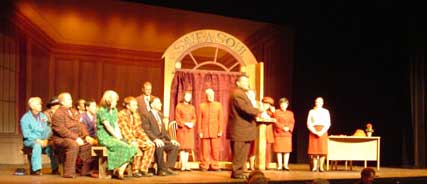
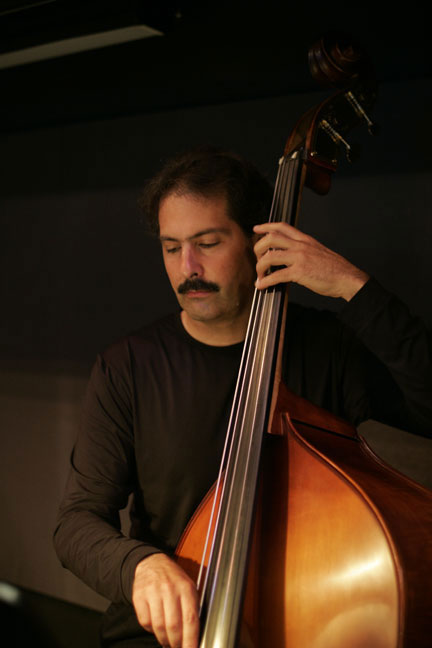
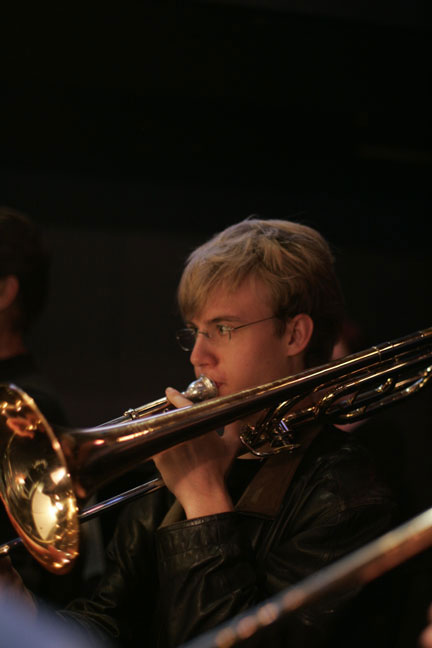
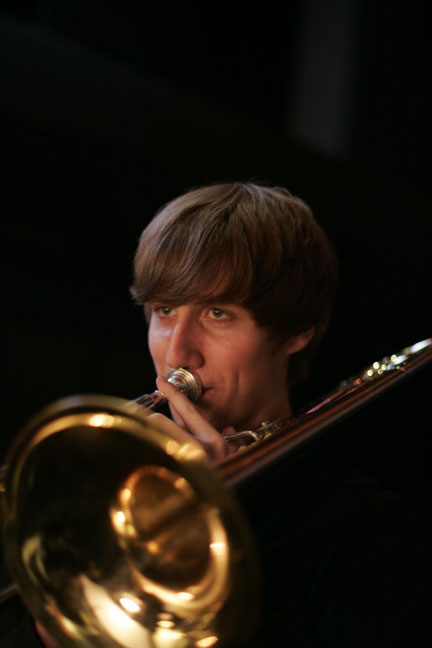
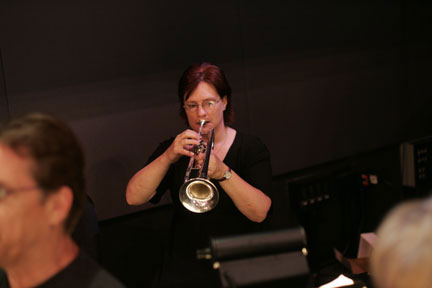
I went to see Guys and Dolls yesterday at the Stanwood Performing Arts Center presented by the Northwest Musical Theatre Company. It was a great production with a lot of talented actors and musicians. Standouts to me were TJ Thaddeus Burzynski (Nicely Nicely Johnson) and Jerome Chandler (Big Julie). All of the parts were well played.
The sound was excellent – I could hear 99% of the lines and the vocals always projected over the pit musicians. The costumes were fun, especially the colorful gangster suits. The set was minimal, but worked very well for this production. Audience response was good and people were bebopping along at the end to the orchestra exit music.
There were several people in the production I have worked with before or traded contacts with, so it felt a little like family to me. Kyle Blevins does excellent sound, Stuart Hunt is always a pleasure to see conduct, Doug Morasch (Saxes) gave me several players for my last show, Clarence Holden I worked with in AIDA, Amanda Curtis also from AIDA, Sam Buchanon I remember from FAME (He was OUSTANDING!), Jerome Chandler I saw for the first time in Jacque Brel (He has charisma up the ying yang, very strong presence). So hats off to current and future friends, a show well done!
CAST
(In order of appearance)
Nicely Nicely Johnson – TJ Thaddeus Burzynski
Benny Southstreet – Steve Feris
Rusty Charlie – Shaman Winn
Agatha – Amanda Curtis
Martha – Ksenia Popova
Calvin – Mason Eger
Arvide Abernathy – Clarence Holden
Sarah Brown – Tiffany Jewell
Harry the Horse – Bob Nydegger
LT Brannigan – Jim Ruth
Nathan Detroit – Mark Abel
Angie the Ox – Jerry Vander Veen
Scranton Slim – Sam Buchanan
Miss Adelaide – Melissa MacNeal
Sky Masterson – Nathan Lacy
Joey Biltmore – Bob Nydegger
Announcer – Shaman Winn
Hot Box Dancer – Skye Dahlstrom
Hot Box Dancer – Erin Grandy
Hot Box Dancer – Heather Bartle
Hot Box Dancer – Lorna Faxon
Mimi – Erin Grandy/Skye Dahlstrom
General Matilda B Cartwright – Laurie Miller
Big Julie – Jerome Chandler
Liver Lips Louie / Drunk – Don McPherson
ORCHESTRA
Musical Director/Conductor – Stuart Hunt
Trumpet – Larry Laverne
Trumpet – Bill Oakes
Saxes – Doug Morasch
Synthesizer – Josh Zimmerman
Bass – Martin Rush
Trombone – Erike Hunter
Percussion – Todd Parks
GUYS AND DOLLS
Music and Lyrics by Frank Loesser
Book by Jo Swerling and Abe Burrows
Directed by Robert MacNeal
Music Director and Conductor – Stuart Hunt
Executive Producer – Melissa MacNeal
Choreography by Skye Dahlstrom
PRODUCTION TEAM
Artistic Director – Robert MacNeal
Executive Producer – Melissa MacNeal
Music Director – Stuart Hunt
Choreographer – Skye Dahlstrom
Technical Director – Bob Nydegger
Stage Manager – Amy Lazert
Lighting Design – Brent Stainer
Sound Design – Kyle Blevins, Robert Campbell
Scenic Designer – Bev Schatz
Scenice Design Coordinator – Craig Wollam
Property Master – Bob Nydegger
Property Assitants – Anya Petrick and Kara Composano
Costume Mistress – Brenda Scamehorn
Backstage Crew – Ashley Anderson, Audry Ugrin, Anya Petrick and Kara Composano
Rehearsal Pianist – Dorothy Herivel and Lauren Lippens
Graphic Design for Poster and Postcard – Walking Cat Design
Website Manager – Sydney Paige
Advertising – Doug McLaughlin and Melissa MacNeal
Publicity – Katie Garner and Anna Ronning
The Stanwood Performing Arts Center
August 4-20, 2006
The Kirkland Performance Center
August 24-27, 2006
Freddy Fender has “incurable” cancer.
This is pretty shocking. I learned about this news, ironically, at my guitar forum Fender-Talk.com . We used to joke sometimes that the forum wasn’t really about Fender guitars, but a Freddy Fender fan club forum. Some of the members there have even gone to Freddy Fender shows with me as we travelled across the US. I toured with Freddy from 1996 to March of 2005 – 9 years.
I noticed in the article that Vangie (his wife) did not ask doctors how long Freddy has to live. I thought that was very classy, and typical of Vangie – who is the ultimate in class. When I stopped playing with Freddy I figured someday I would see some news on CNN that things had ended, just didn’t know it would be this soon.
The #1 question I get from people about Freddy is “what’s he REALLY like?” – And with that question starts the magic of Freddy Fender. I got to see Freddy for nine years backstage, at each town’s fanciest restaurant, in little dive greasy spoons as we made our way from gig to gig on an endless search for the world’s best Menudo. The answer to the question is: Freddy was really like how people see him onstage. That’s what makes him a star. He is honest and open.
Many of the musicians in his group far surpassed his music knowledge 100x over. But he was the star. He knows how to relate to an audience and how to create the magic in a song. That was the biggest lesson I learned from Freddy, it’s not what you know – it’s what you do with it. And with every song he gave it all he had – every time.
One day we were having lunch just the two of us, don’t remember where it was – but I remember he was eating Menudo (which is always a safe bet with Freddy!). I asked him about his battle with alcohol, about becoming sober and clean through AA – and what he had learned. He quickly got VERY serious – leaned in intently and said “I learned two things. I learned there IS a God, and I ain’t him.” Then he started laughing uncontrollable in his chortle giggle, another Freddy trademark.
I think of that a lot. There IS a God, and I ain’t him. Simple words to live by. Freddy was very simple, in some ways almost naive like a child. I think that’s part of the reason so many millions of people love him.
I also remember doing a gig with Freddy in Northern Minnesota. We were chuckling because we knew there would be no one there. Who’s heard of Freddy in Northern Minnesota. To our surprise there was about 5,000 people – all standing outside in the cold for the concert. Another learning experience for us, and another lesson in learning why Freddy is truly the “King of Tex Mex”.
Freddy would call me “El Blanco” – I have very white skin. And it was always a little comical that I was playing with a Hispanic Grammy winner – because I’m about as white as they come: Full blooded Norwegian Lutheran from Seattle. He was usually fair with me, and the few times he wasn’t – I understand his point of view and would have done the same if I had been in his shoes. A band on the road becomes a family with seven wives, and there would be spats – but I know the entire band was proud in their heart’s that we were playing with the real deal, the original.
You can find all the bio info on Freddy through Google – how he started in 1959, was the first Hispanic crossover artist, first artist on Hispanic, Country and Pop charts at the same time. Also look up Baldemar Huerta, his real name. Story goes they were trying to think of a stage name for him – in typical simple Freddy fashion he just looked at his guitar neck and said “Fender” – then thought Freddy went well with that. Don’t know if the story’s really true like that – but I always liked the story so never asked. It’s a keeper.
Every once in a while at a Freddy gig someone would come up who thought it was Freddy who built the Fender guitar. (Wrong Fender – it was Leo Fender). One show in particular there was someone who had driven hundreds of miles and absolutely would not believe me that Freddy did not invent the Fender guitar. They walked away very sad when they realized the truth. So in the future I never corrected people when they said that – thought I’d let them keep that story – just like I want to keep the story around Freddy’s name.
People have an image of road musicians that’s not entirely accurate – so I’d like to set the record straight. Ok, we party a bit here and there – but usually we would finish a gig at 11:30pm – then be rushed to the hotel room – have to mellow out for some sleep so we could get up at 5am to catch the next flight. Truth is, most of the time we were just trying to catch up on sleep – or maybe that was just me. Amazingly, Freddy was ALWAYS up and alert – the rest of us would be snoozing and he would be talking away – didn’t matter if it was 4am. I was always a little bit jealous that he had partied so much in his life – but had so much stamina. He is truly a “road dog”.
I had always wanted to arrange a CD for him with a real orchestra. Take his classics and really do them classy. He did something like that with the CD he won a Grammy for in 2002 – all classic arrangements with hand percussion and nylon string guitars. So now that I’m conducting so many different orchestras, I’ll pretend from time to time that Freddy is onstage singing.
I remember the one time Freddy got very mad at me. We were playing in Stateline Nevada (Think it’s called Jean, NV now) and we were practicing with him the song Margaritaville. In the verses he would always drop a couple beats. So in all my musical wisdom I thought he would really appreciate me pointing this out to him, and I was so surprised no one in the band was saying anything. As I started to speak up I could see two band members behind Freddy giving me the “slit throat” signs to shut up. Then I found out why. Freddy went ballistic. He said “I’ve been doing music since 1959 and you’re going to tell me how to do it? I am Freddy Fender, the way I do it is the right way.” And he WAS right. Part of Freddy’s trademark sound is his quirky timing and phrasing. That was a big lesson for me too. There is no “right” music, there’s just music the way you want it to sound. Needless to say I never corrected him again.
I was always the youngest member in Freddy’s band. Started with him just after my 30th birthday, and I just turned 40 a couple months ago. It was a real trip to be welcomed into Hispanic circles when I played with him, was not something I was used to. Felt like a big family to me, something I’ve only known since then in church settings.
I’m sure each of the old Freddy Fender band members will be dealing with this in their own way. PT Houston, Vern Monnett, Rhys Clark, Augie Meyers, Chris Jurado and Charlie Rich Jr.
.
Thanks Freddy. I know there’s a God. And I know I ain’t him.
Hey i do audio…and pretty decent at it if i sau so myself lolz..
n e wayz, i’m always learning new tricks when it comes to mixing and i was wondering if u have n e helpful tips with using reverb/compressor/and the equilizer….so yea what do say big guy? lol
I remember you from the forums. Major props to you and the Rap Dogs community. I listened to one of our tracks on SoundClick – “12-SupaStarr”
First of all it was a good track and good recording. You can definately play that in your car with pride. I’m assuming you want to elevate your skillz so let’s look at it more critically – to get it from “good” to excellent. Could this track be on a major label release? Sure, that’s a loaded question – anything could be on a major label release depending on the context. But if I was producing it there are some things I would do to it. I don’t have a Grammy yet, so maybe my advice is jacked up. (Key part of that last sentence is “yet”). You read, you decide.
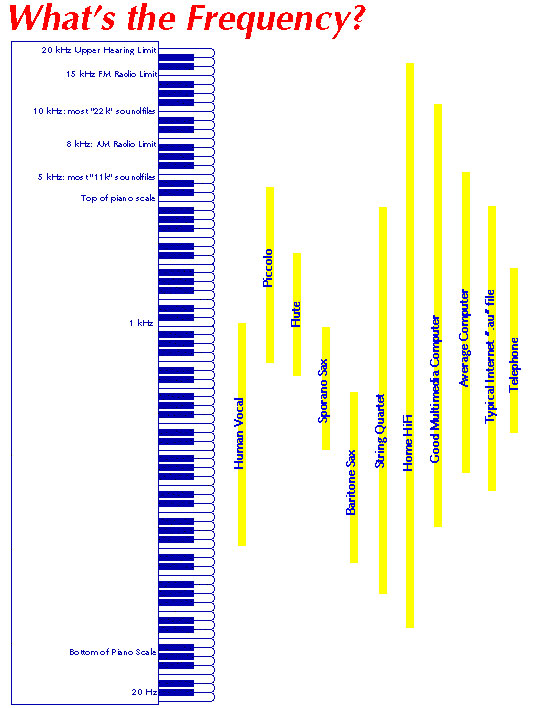
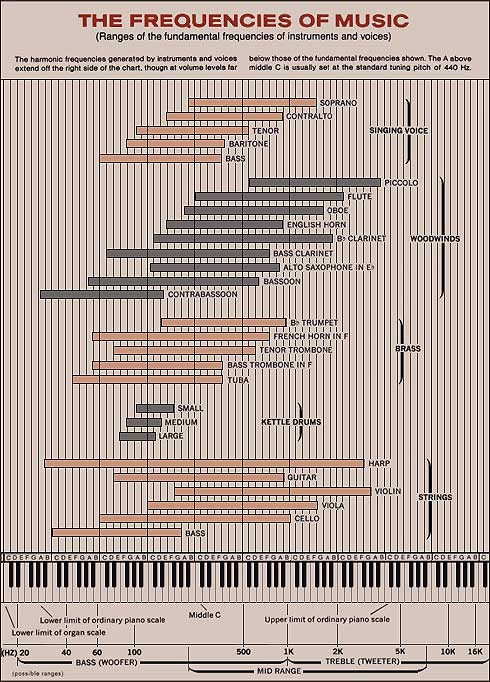
Brush up on Hertz. 20hz is the low low end – 20Khz is the upper end of human hearing. So we refer to low end as 20hz (low end 808) – 80hz (low end on lowfi audio system) – 80-160hz (bass guitar) etc….up to 1khz – 5-6khz (human voice clarity) to 10-12khz (hi hats, cymbals sizzle).
Ok, let’s start! I wish I was at a mixing board, because I could do all this faster than it takes to explain it.
DANCING FOR THE EARS
Most tracks I hear don’t “dance” for the ears. Usually there’s a soundtrack bed and then vocals over the top. But to be “excellent” the whole track should be one entity – track and the vocals should present a unified front. So most of what I’m going to write here are things you can do to make this happen. Music should delight the ears, should be like candy. With lots of little elements to keep the mind interested and engaged in the production.
VOCAL MIXING
You have two different takes of the lead vocals (two leads at different spoken pitches) which is cool. But both are EQ’d the same. Your lead vox is usually going to be mixed center, if they have the samej processing then both leads are taking up the same audio space. What about thinning one of the leads out, or what about recording THREE leads – One center and full, and two slightly left and right thinned out a bit. Or what about recording EIGHT tracks of lead and stacking them. A lot of the major labels do insane amounts of stacking – that “wall of sound” approach. There’s only so much room in the audio spectrum – so give your lead vocal it’s window – and then eq the support leads so they don’t interfere with that window. Example: Boost the lead at 5-6khz maybe 2.5 db, then LOWER the background vocals 5-6khz 2 db. That’s the general idea of creating a window in the audio spectrum. Of course you need to adjust this by ear. I will pan the audio around the general frequency I want to tweak, in this case I would listen to where the clearness of the sound “jumps out” a bit – that would be the frequency I want to hit in this situation.
BACKGROUND VOCALS
Are the background vocals eq’d, compressed and effected the same as the lead vocal. If so, was that your intent, or did it just happen that way? I like processing the background vocals different – usually thinning them a bit, experiment with panning (make sure it’s balanced unless you intentionally want it lopsided). I also like using entirely different fx on the bgv tracks. Especiallly in hip hop – it really helps accentuate the different between the verse and chorus. Sometimes I’ll take a bgv and totally thin it out with a low end shelf – maybe cut everything from 4khz and below out, then drench in a long verb. Can be very effective. As always, the context of the music depends on what will work and what won’t.
WORKING WITH A PREMIXED TRACK
Assuming your background track is premixed – for hip hop you especially want that low end bass and sizzling hi hat. Try a little boost around 20hz for the sub to rock in a good car system (also check out around 80-120hz, which is the low end of a semi-crappy audio system – mix for the bad systems too). Then check out the hi hat action from 10khz to 12 khz. Add a little sizzle up there if you can. Another trick is to add some sort of processing to both the vocals AND the track – a way to make them sound a bit more like they belong together. You could try a light verb with the low end rolled off (like even rolling below 600khz off on the reverb – you don’t want verb on your 808 kick, etc.)
WORKING WITH THE ORIGINAL TRACKS
If you have the original tracks to work with I could write a book on how to approach it. But the thing to keep in mind is that everything should work together – let the vocals have their own space, and give each instrumental track it’s own flavor to keep the ears dancing. Work with panning so there’s movement between the speakers, and make sure the individual tracks are not getting the in frequency or panning space of the vocals.
REVERBS ON VOCALS
Try using two verbs. A short verb that will thicken the front of the vocal without being blurry – like a vocal plate set at 20ms or lower – then add a long verb with a delayed attack, like 20ms delay on attack to strengthen the sustain of the vocal. Or try short and medium verb – idea is to get two different fx working in tandem with your vocal. In general I don’t like to “hear” fx – if you listen to a track and say “oh, that’s a long reverb” then it might be too much. Exception is when it’s intentional to be that way. So crank the fx, get it tweaked where you want it – then back off to where you don’t hear it. I didn’t hear too much fx on your track, so sounds like you already understand “less is more”.
STACK THOSE VOX TRACKS
I got to work on a preproduction project for Aftermath last year and had the opportunity to work on the original protools session on my own computer. Talk about stacking! Twenty tracks for the lead vocal alone – and this was just for the demo! It was that thick. Try going nuts and stacking the hell out of your vocals and see what you come up with.
COMPRESSOR AND LIMITER
Another trick is to run the lead vocal on it’s own limiter at -.01db of peak, and run the track at let’s say -.05db of peack. This means the vocal will always be at least .04db above the track, regardless of what’s happening with each. For compression you should decide how tight you want the vocal compressed – in general if you can hear the pumping of the compressor – it’s too much. On an overall track compression would be very light – let’s say 1.5db at 2:1 at peack – but vocal could easily be 6db at 4:1 at peak, and you could even compress the vocal more from there. My experience is that you can compress the spoken word much more than a sung vocal track.
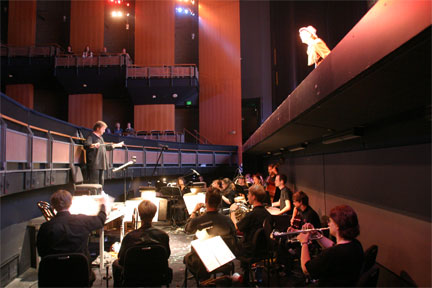
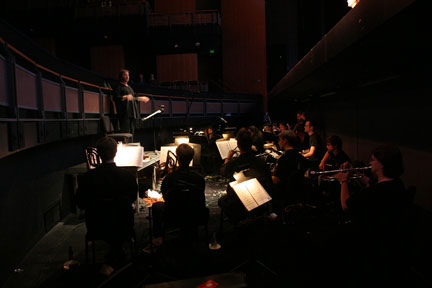
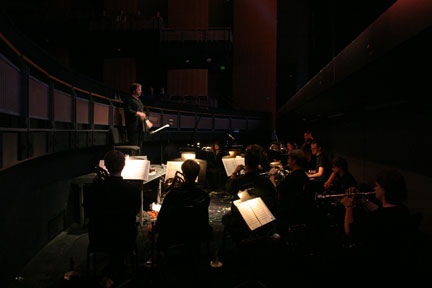
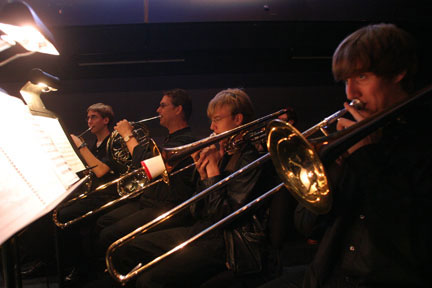
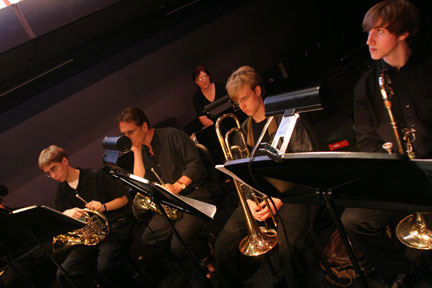
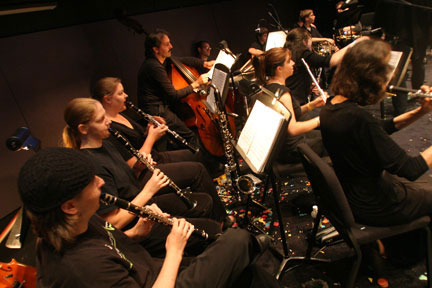
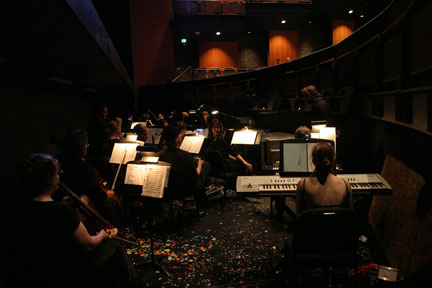
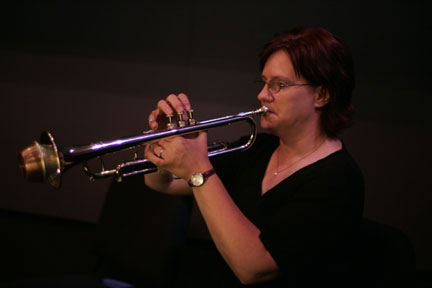
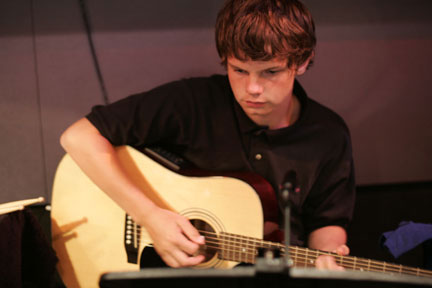
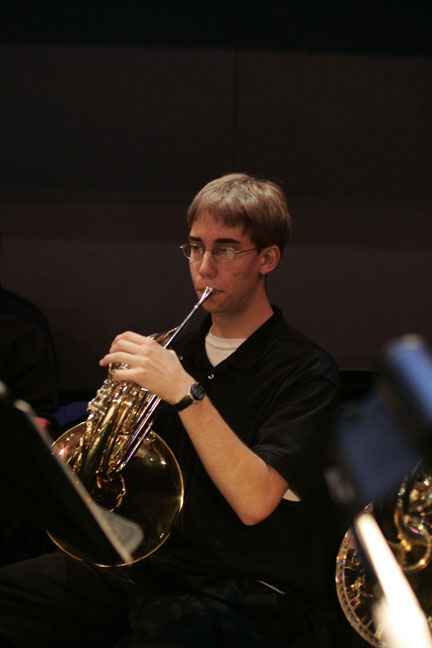
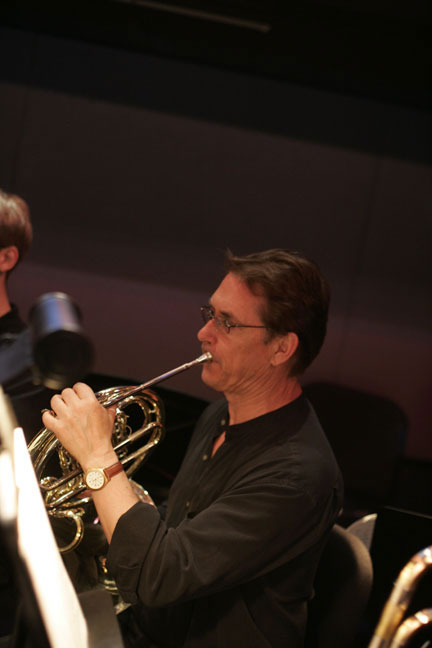
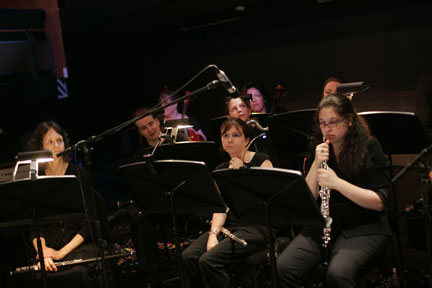
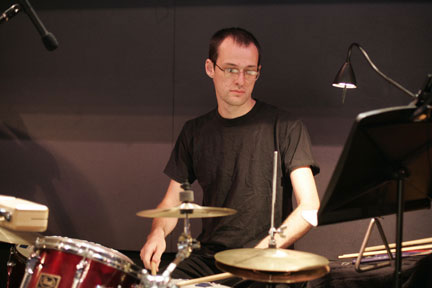
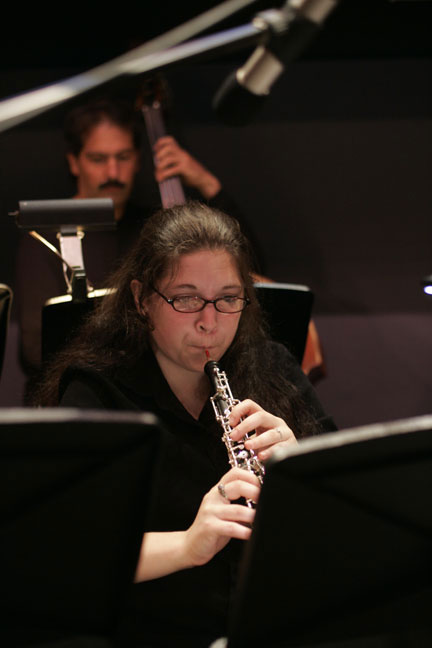
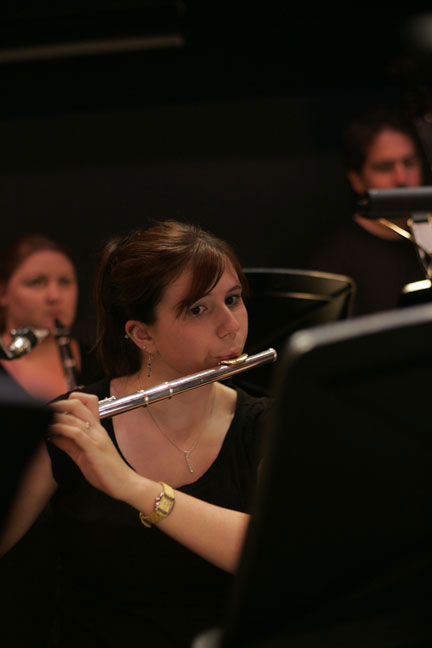
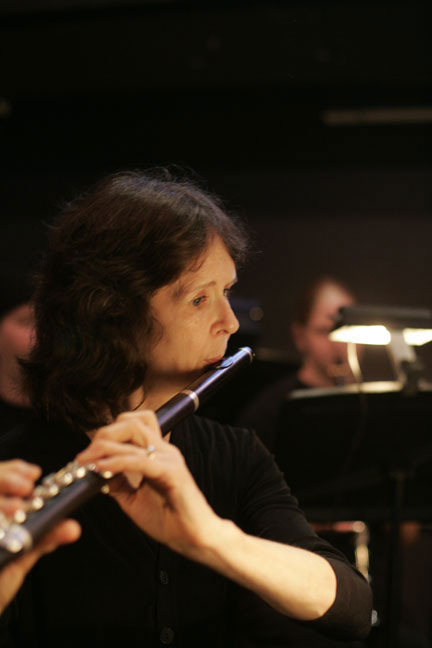
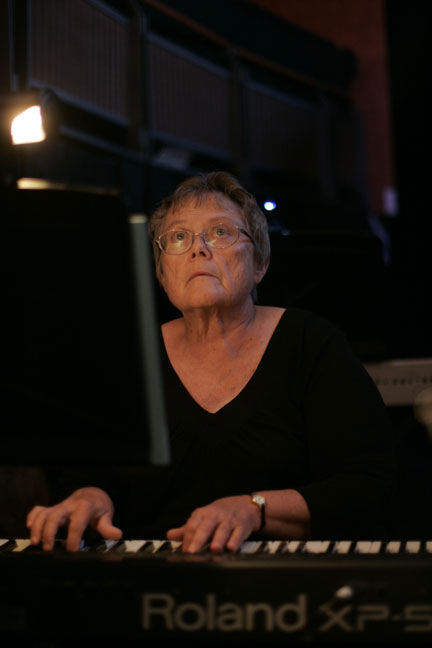
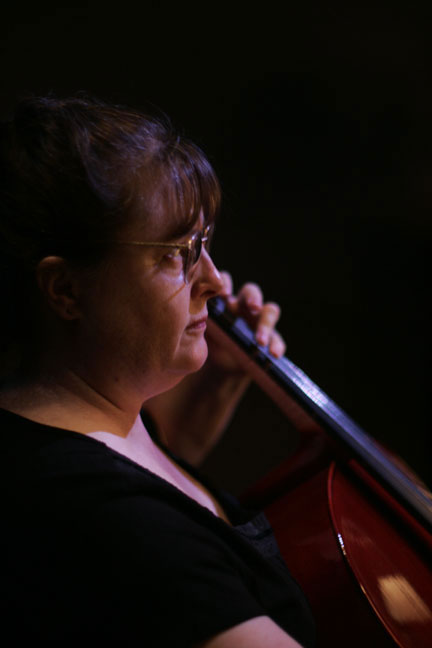
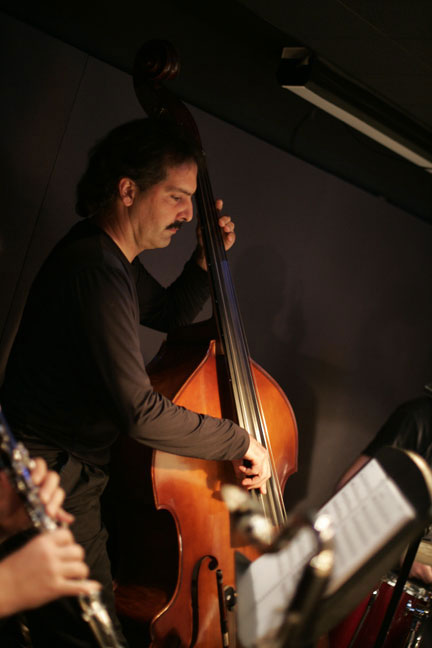
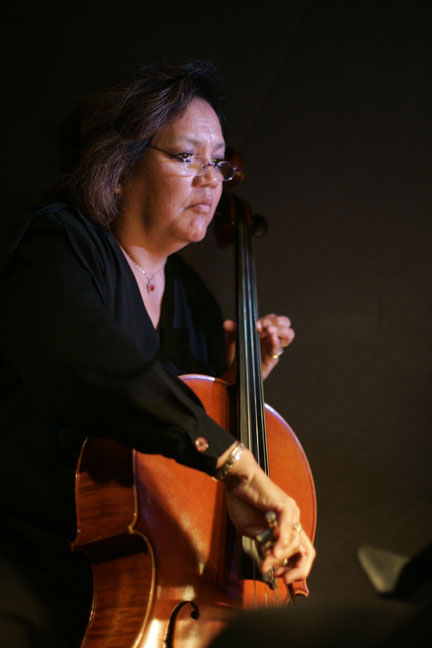
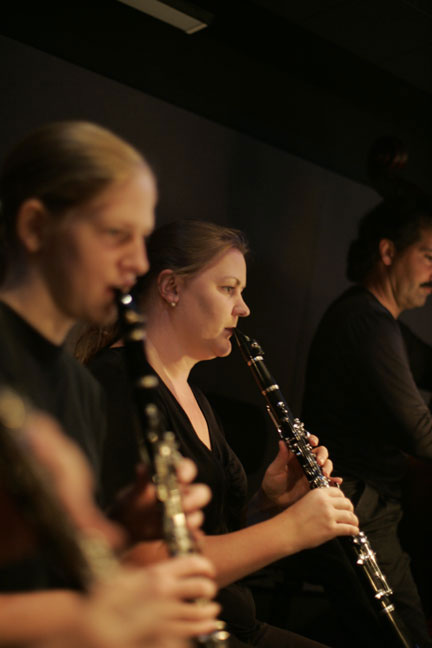
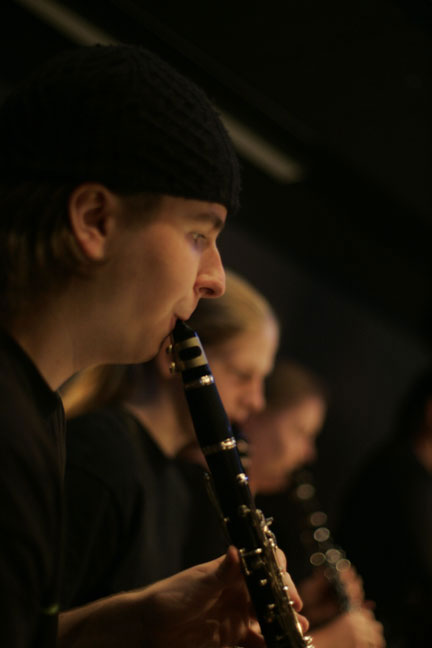
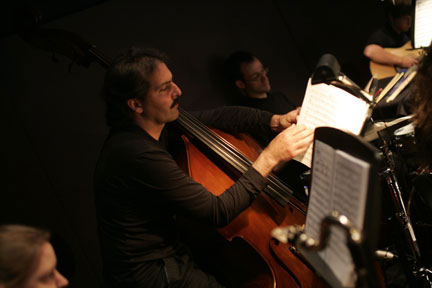
Here are photos from the orchestra pit at McIntyre Hall (Mount Vernon, WA) for the Lyric Light Opera of the Northwest production of Irving Berlin’s “Annie Get Your Gun”. Produced by Leslie Asplund, Directed by Brenda Mueller and conducted by Conrad Askland.
2006 ANNIE GET YOUR GUN MUSICIANS:
Flute I – Alicia Jackson
Flute II – Lorie Wooldridge
Flute sub – Stephanie Bethea
Oboe – Rebecca Wright
Clarinet I – Ashley Hall
Clarinet II – Darian Asplund
Clarinet sub – Michelle Hanna
Trumpet I – Cindy Luna
French Horn – AJ Brodin
French Horn – Jim Gaudette
Trombone I – Brian Bernethy
Trombone II – David Andersson
Drums – Dean Bunnell
Bass – William Maxwell
Cello – Kathryn Murray
Cello – Sharon Sparling
Guitar – Paul Hixson
Harp – Christy Swartz
Keyboard I – Ruth Haines
Keyboard II – Lauren Lippens
Conductor – Conrad Askland
My favorite element about this particular group was the mix of seasoned musicians and young players. What a great way for young musicians to learn, and for seasoned players to share their experience!
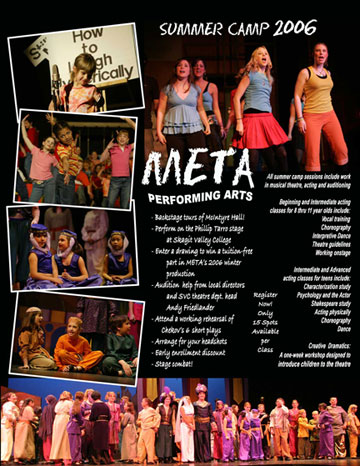
Conrad will be teaching at the META Performing Arts Theatre Summer Camp at Skagit Valley College July 2006. http://www.metaperformingarts.org
META PERFORMING ARTS THEATRE SUMMER CAMP
JULY 2006 – Skagit Valley College, Mount Vernon, WA
Registration for July 10-14, full day and morning sessions will be outside the Phillip Tarro Theatre, Monday, July 10th from 8:30-8:45 a.m. Registration for afternoon only classes (including all 5-7 year olds) is outside the Phillip Tarro Theatre from 12:30-12:45 p.m. Your promptness is appreciated.
WEEK ONE, July 10-14 TEENS 1-2pm Melissa Rolnick dance Mon-Fri 2-3pm Dave James auditioning workshop Mon-Weds 2-3 Carl Turner Shakespeare Thurs 2-4 Carl Turner Shakespeare Fri 3-4pm Sharyn Peterson voice Mon-Weds 3-4 Steven Craig McIntyre backstage tour Thurs 8-11’s 1-1:30 Dave James theatre games Mon-Thurs 1:30-2:15 Joe Bowen stage combat Mon-Thurs 1:30-3:00 Dave James auditioning workshop Fri 2:15-3:00 Sharyn Peterson voice Mon-Thurs 3:00-4:00 Melissa Rolnick creative movement Mon-Fri 5-7’s 1-4pm Carrie James creative dramatics Mon-Fri
WEEK THREE, July 24-28 TEENS 1-2pm Scott McDade voice workshop for actors Mon-Weds and Friday 1-3 Bruce Weech stage combat Thurs 2-3pm Conrad Seussical vocal study Mon-Weds 2-4 Andy Friedlander auditioning workshop Fri 3-4pm Melissa Rolnick Seussical dance study Mon-Weds 3-4 Steve McIntyre Hall tour Thurs 8-11’s 1-2 Melissa Rolnick Seussical dance Mon-Thurs 1-4 Dave James auditioning workshop Fri 2-3pm Dave (Comedy) Mon-Thurs 3-4pm Conrad Askland Seussical music study Mon-Thurs 5-7s > 1-4pm Carrie James creative dramatics Mon-Fri>
Summer Camp Morning TEENS 9-10:30 Sami Detzer scene study Mon-Thursday 9-10:30 Sami cold-read auditioning Fri 10:30-12 Lynette McCormack musical theatre Mon-Thurs 10:30 –12 Lynette vocal auditioning Fri 8-11’s 9-10:30 Lynette McCormack musical theatre (Seussical) Mon-Fri 10:30-12 Sami Detzer acting skills for young actors Mon-Thurs 10:30-12 Sami auditioning conventions Fri WEEK TWO, July 17-21 TEENS 9-10:30 Sami Detzer monologue studies Mon-Thursday 9-10:30 Sami auditioning with a monologue Fri 10:30-12 Lynette McCormack “Rent� musical theatre study Mon-Fri 8-11’s 9-10:30 Lynette McCormack musical theatre (new) Seussical Mon-Fri 10:30-12 Sami Detzer auditioning skills for young actors Mon-Fri WEEK THREE, July 24-28 >TEENS AND 8-11’s >Sami Detzer and Lynette McCormack >Currently in development, call or check the website for updatesINSTRUCTORS!
We have assembled an incredible cast of instructors bringing together a vast array of talent and experience.
Lynette McCormack, Vocal/Dance Instructor and Director >Lynette has her Bachelor’s Degree in Music and Dance from the University Nevada of Las Vegas where she was principle singer at the Tropicana’s > Follies >Bergere. She has done a lot of industrial work on the road touring around the country. She has lived in La Conner for over 5 years and loves the warm friendly people and gorgeous countryside. >She has taught tap and jazz classes for AYA (Anacortes Youth Arts Dance Studio) and is currently teaching tap and country line dancing in Shelter Bay. She is vocal director for Meta Performing Arts based out of La Conner and has just finished directing and choreographing “The Little Mermaid.â€? She teachings a choral program at AHEP (Anacortes Home Educational Partnership). She loves to see the children grow in self esteem and confidence from their participation in musical theater. Music and dance brings out the best in us all….it soothes the soul and warms the heart. Andrew Friedlander, Teacher/Director of Theatre Programs – Skagit Valley College I am a theatre generalist with a specialty in acting, directing, Shakespearean performance and interdisciplinary studies. I have training in learning styles, cooperative and collaborative education, learning communities, critical thinking and writing skills reinforcement. > I have directed more than 125 productions in professional and academic theatre settings including the Idaho, Oklahoma and Western Washington Shakespeare Festivals, Centre Theatre Group of Spokane, Laughing Horse Summer Theatre, Eastern Washington University and Skagit Valley College. Representative titles include: Endgame, Is There Life After High School, Godspell, Once Upon a Mattress, The Rimers of Eldritch, Bedroom Farce, Antigone, Anything Goes and The Water Engine. Shakespearean productions include As You Like It, A Midsummer Nights Dream, Twelfth Night, Loves Labours Lost, The Comedy of Errors, Hamlet, Romeo and Juliet and The Tempest.
Carl Turner, Artistic Director of Theater Arts Guild Carl K. Turner comes originally from Tennessee where he received his BA in Speech from Middle Tennessee State Univ., and was a veteran performer at Opryland USA. He studied acting under William Ball and Speech under Edith Skinner at the American Conservatory Theatre in San Francisco in the Advanced Actor Training Program, and subsequently performed with San Francisco Shakespeare Festival, Eureka Theatre, San Mateo Civic Light Opera and various fringe theatres. He moved to Skagit County 10 years ago to finish his MA in Theatre Directing at Western Wash. Univ. > He currently serves as Artistic Director of Theater Arts Guild where he has directed Crimes of the Heart, Romeo Juliet, Blithe Spirit, Little Shop of Horrors among others, and has performed in Oliver!, Joseph and His. . . Dreamcoat and A Christmas Carol. Locally he has also directed Sam Shepard’s True West and David Mamet’s Oleanna. > In February of this year he directed his first production for META, The Crucible, and had appeared earlier as Lazar Wolfe in Fiddler on the Roof. He also staged Sharyn Peterson’s production of the opera Amahl and the Night Visitors for three seasons. He teaches acting and scene study, Shakespeare scansion, stage speech, dialects and accents, and audition selection and technique.>
Conrad Askland, Musical Director, Producer and more!
Conrad Askland is a music producer and keyboardist. His educational and live performance experience covers an extremely wide range of styles and formats. His formal music studies include Pacific Lutheran University (Composition and Voice), the University of Miami (Music Law), the Cornish Institute, the Seattle Early Music Guild and UCLA School of Film Scoring.
Conrad has extensive experience in live performance as a pianist for Knott’s Berry Farm, 4 years as touring keyboardist with Grammy Winner Freddy Fender of the Texas Tornados, vocalist with the Seattle Opera, touring keyboardist for Roy Rogers Jr., performances at the House of Blues and Prince Hotels (Tokyo), the Grand ‘Ol Opry and as a keyboardist with various Southern California and Las Vegas show groups. He has also toured extensively throughout Europe, Asia and Japan and the United States. Conrad has also performed in England, France, Denmark, Wales, Holland, South Korea, Tokyo, Okinawa and Hiroshima.
As a musical director and/or conductor he has worked full time with such diverse groups as San Bernardino Summer Theater Festival, National Educator’s Conference and Hollywood Superstars. He has over 2,000 performances to his credit and also works as a freelance musical director.
In addition to scoring and composing for the albums he produces at Road Records he has composed and arranged for corporate entities including GTE and Contel, World Library Publications and United Airlines. He currently composes ongoing for nearly two dozen corporate clients at Road Records as well as producing commercial artist albums.
JOSEPH D. BOWEN, Actor, Director, Musical Theater, Stage Combat STAGE EXPERIENCE: 1993 to present The Odd Couple (Female Version) – Jesus Costazuela; Inspecting Carol – Wayne; Kiss Me Kate – Suitor/Dancer; Blithe Spirit – Charles; Picnic – Hal; A Christmas Carol – Young Scrooge/Banker; Macbeth – Thane/Lord Lennox/Assassin; One Flew Over the Cuckoo’s Nest – The Chief; A Streetcar Named Desire – Stanley; Romeo and Juliet – Mercutio; Richard III – Lord Hastings/Soldier; Detective Story – Tami Giacopetti; Fiddler on the Roof – Russian; The King and I – The King; Seven Brides for Seven Brothers – Adam. OTHER PERFORMANCES Best of Broadway Revue – sang as Marius, Les Miserables; Moulin Rouge Revue – multiple singing and dancing roles; Murder Mistresses Dinner Theater – Improvisation; Northwest Children’s Theater – Upper Skagit Legends – Narrator/cedar flute performer. LEAD or PRINCIPAL ROLES Inspecting Carol; Blithe Spirit; Picnic; Romeo and Juliet; The King and I; Seven Brides for Seven Brothers MUSICAL and DANCING ROLES Kiss Me Kate (Show/Jazz/Ballet; duet romantic; assisted in choreography); Picnic (duet romantic, choreographed); A Christmas Carol (Show; assisted in choreography); Fiddler on The Roof; The King and I (duet romantic; self-choreographed). STAGE COMBAT Picnic (hand to hand, self-choreographed); Macbeth (heavy weapons; assisted in choreography); Romeo and Juliet (rapier duel); Richard III (heavy weapons) DIRECTING: 1997 to present Shadowlands; One Flew Over the Cuckoo’s Nest; Frankie and Johnny in the Clair de Lune; Proof; Paint Your Wagon.
KATE KYPUROS, Program Director at META Performing Arts Kate is currently the program director at META Performing Arts. She also teaches drama at Immaculate Conception Regional School in Mt. Vernon and at the HomeLink program for the Lake Stevens School District. Kate produced META’s recent production, “The Little Mermaid� and will be producing META’s upcoming show, “Seussical�, the musical at McIntyre Hall in November of 2006. Kate’s most recent directorial credits include Disney’s “Aladdin Jr.�, “How To Eat Like a Child, and Other Lessons in Not Being a Grown-up�, “The King and I�, “The Best Christmas Pageant Ever�, and “Tales From the Arabian Nights�. She is a certified facilitator for “Developing Capable Young People�, a program for parents and educators. Kate’s most recent acting credits include roles as a grandmother, a blind woman, a shameless hussy, and the owner of an abolition era speak-easy. Her favorite thing to do is to participate in improvisation. Her second favorite thing is storytelling.
Melissa Rolnick, Former Assistant Professor of Dance at Arizona State University (ASU) > She was the recipient of the Herberger College of Fine Arts prestigious Distinguished Teaching Award for the > 2003-2004 academic year. Previous to teaching at ASU, Melissa was a lecturer at Western Washington University for two years. She has a BFA in dance from SUNY Purchase College and a MFA from Mills College. > She has performed extensively with many notable choreographers including Emily Keeler, Joe Goode, Cliff Keuter, Elina Mooney, Ruth Davidson Hahn and Mel Wong. She was a member of the San Francisco Moving Company, Cliff Keuter’s New Dance Company, and the Margaret Jenkins Dance Company of San Francisco, performing nationally and internationally. She continues to teach, perform and choreograph nationally. Presently in her new home state of Washington she is teaching students of all ages at various community arts educations programs in Anacortes, Bellingham and Mount Vernon. In King County Melissa teaches for the Pacific Northwest Ballet Education and Outreach Program. > Most recently Melissa’s choreography has been produced by the University of Texas Pan American, California State University Fresno, Ann Green Gilbert’s Kaleidoscope Dance and On the Boards/12 Minutes Max in Seattle. Future projects include choreographing for the Cornish College Dance Ensemble in the fall of 2006.Sami Detzer, Actress, Musical Theater and META Veteran! Experience Juliet Romeo and Juliet Shakespeare Northwest Abigail The Crucible Phillip Tarro Theater Narrator Our Town La Conner Drama Department Sara Women and Wallace Skagit Community Arts Theater Lamb chops Fame (The Musical) META Performing Arts Anne Page Merry Wives of Windsor Shakespeare Northwest Ensemble Y. A. I. Showcase Seattle Children’s Theater Education La Conner High School Sept. 2002- June 2006 Intro to Improv 2000 Kate Kyporus Acting II 2002 Stella Ireland Storytime Theater 2002 Maura Marlin Classical Theater 2003 Carl Turner Advanced Acting 2006 Alban Dennis Young Actor Institute 2005 Rita Giomi- Director
Scott McDade, Actor, Writer, Director Scott McDade is a graduate of the University of Washington School of Drama (BA) and holds an MFA in directing from Ohio State University. Over the past several years McDade has directed and stage-managed a number of productions for Theater Arts Guild, including two musicals he co-wrote with his wife Fran. McDade has performed as an actor and singer with the Cirque Playhouse and A Contemporary Theater (ACT) in Seattle; and has appeared locally in Anacortes Community Theatre and TAG productions.
Sharyn Peterson, Violinist, Vocalist, and Conductor >Sharyn is a northwest native who solos regularly with local symphonies. In 1999 she founded the Starry Night Chamber Series, now under the non-profit umbrella of the Skagit Opera. In 2005 and 2006, she will solo with four different orchestras in the Sibelius Violin Concerto and the Mendelssohn Violin Concerto. >Ms. Peterson has performed in small chamber ensembles with the principal bassoonist of the Los Angeles Philharmonic, the Assistant Concertmaster of the Seattle Symphony, faculty members of New England Conservatory, Western Washington University, North Texas University, and numerous other fine musicians such as Paul Rosenthal-violin, Barton Frank-cello, Lisa Bergman-piano, and George Shangrow-harpsichord. > She has soloed with famed vocalist Erich Parce, soprano Terry Richter, soprano Julie Boyd-Penner, pianist Cullan Bryant, and many others. Ms. Peterson currently conducts the Mt. Baker Youth Symphony in Bellingham and the Fidalgo Youth Symphony in the Skagit Valley,as well as maintaining Peterson International Music School in Mt. Vernon, teachingviolin, viola and voice. Ms. Peterson’s students are frequent winners in various Northwest Competitions, and she is also an arranger and recording artist. She has twice been a guest soloist on violin and voice in the Monteverde Music Festival, Costa Rica. Each summer she directs the Summer Sounds Music Camp ( under the
auspices of the Mt. Baker Youth Symphony); an intensive week of symphonic, vocal, jazz, and art.
Her principal violin teachers were Emanuel Zetlin (from the faculty of the Curtis Institute), and Denes Zsigmondy, and her vocal instructors were Edison Harris and Paul Ingham, both associated with the University of Washington, where she received a Master’s Degree in Violin Performance. Ms. Peterson attended Tanglewood Music Festival on a full scholarship for chamber music, where she performed under Leonard Bernstein and Michael Tilson Thomas
David James, Director / Producer / Teacher: DIRECTOR FOR UPCOMING META PRODUCTION OF SEUSSICAL Currently teaches 10th grade Language Arts at Marysville Pilchuck High School, where he insists on pushing playwrights like Shakespeare and Chekov on impressionable teenagers. He attended classes at Skagit Valley College, got his AA from Whatcom Community College, a History degree from Western Washington University, an English endorsement from Seattle University, took a class from Seattle Pacific University, and just got his Masters in Education from Antioch University. >Has directed and produced plays and musicals in Stanwood with his wife, Carrie, for the last few years, including: Into the Woods, Jr. Anne of Green Gables Bye Bye Birdie Guys and Dolls, Jr. Annie, Jr. When he was in college, he was involved in the theatre program at Skagit Valley College, doing various tech and building jobs for all kinds of full-length productions and Short Play Festivals. He also did a bit of acting, for instance as “Trichinosis� in the Woody Allen play God. He began his theater career way back in middle school while working on musicals such as Annie (great musical) and P.T. Barnum, the World’s Greatest Showman (possibly one of the worst shows ever written… but still awesome, ‘cause everything in the theater is awesome!).
Carrie James, Director / Producer / Teacher : DIRECTOR FOR UPCOMING META PRODUCTION OF SEUSSICAL Education: University of Washington: BA Drama Western Washington University: Teaching Certificate Antioch University: Masters in Education Directorial Credits Include: Into the Woods Jr. Anne of Green Gables Bye Bye Birdie Guys and Dolls Jr. Annie Jr. Stage Managing Credits Include: The Tempest Fen Die Fleder Maus
Bruce Weech, Actor / Certified Stage Combat Instructor 35 years as a professional actor. I have appeared in over 100 stage productions, 10 commercials , and 2 films. I have worked with the Theater Arts Guild, Pacific NW ACT, Anacortes ACT, SCAT, Skagit Opera, and the Shakespeare Festival locally. I own Talisman Productions LLC providing professional technical support to theater companies throughout the NW. I am a certified stage combat instructor
Stephani Brink, Actor / Teacher
Stephani originally attended California State University of Long Beach as a Creative Writing major. She moved to Washington in 1992 where she decided to pursue a career in teaching. She has an added endorsement in Early Childhood Education and has taught several years of kindergarten and also third grade. She currently teaches first grade for the Stanwood School District at Utsalady Elementary
My name is SImeon *. I currently study piano and can play a variety
of instruments. I would like to ask you first off, how do i become a
producer of music. I would really like to know what are some of the jobs
that you have to do as a producer. Is it necessary to have contacts in the
music industry, and how exactly do i get about getting these contacts.
Thanks
SImeon *
***********************
Hi SImeon,
I’ll go in a little detail here, but need to tell you first off I might not be the best person to ask. My past experience tells me people don’t usually want to hear what I have to say…..in other words, they don’t like the answer.
First of all, to be a music producer…..you just need to produce music. I’m not being a smart alec here. Most people starting out waste their time worrying about contacts instead of focusing on the art, improving their skills, etc. The only way you do that is by doing it. As you go along, each project will teach you something.
DO EVERYTHING – DON’T JUDGE
When I was 21 I was playing piano in a mall 30 hours a week. It was an absolutely humiliating job, but I had to eat and was bound and determined I would only do music jobs. A customer came up and asked me to play Crazy, the country standard by Willie Nelson made famous by Patsy Cline. I was deeply offended they would even think of asking a classical musician to play country. My response was, “M’am, I play MUSIC.” I was dead serious at the time. In my mind country was not music. Well over the next ten years I played a lot of country music for a living, learned to appreciate how intricate it really is when it’s done WELL. And later even played the Grand ‘Ol Opry on national tv.
Now when it comes to the studio, I know a wide variety of country music styles and techniques which are used a LOT in the studio. You’d be very surprised how much it’s used on all sorts of soundtracks. I think of that story anytime I’m quick to judge a style as “not being music” – it usually is a sign that I don’t really understand the subtle nuances of the style. Be open minded.
DON’T BE AFRAID TO ASK
Know what I learned just this week? I learned that cellos have mutes. I never knew that before. Maybe everyone else does, but I didn’t. So I had the cello player perform several times for me with and without the mute so I could tune my ears to the difference. I also learned a flute has two different places that can be adjusted to set the overall pitch. These are things I would not have learned if I hadn’t asked. I asked these questions in front of my orchestra. I’m not embarrassed to ask about what I don’t know about, and have found that people do not judge you for not knowing. In fact people are excited to share their niche knowledge with you. When I was younger I would be more hesitant to ask, that it might be a sign that I didn’t know something. OF COURSE IT IS! Learn from everyone around you.
THEORY
Unless you’re going to do sampled hip hop or cut n paste productions, you need a good base in music theory. Learn all your major/minor scales and chords – and learn them so you don’t even have to think about it. At least learn everything up to 9th chords so you can do them in your sleep, I have to admit I still have to think about 11th and 13th chords sometimes depending on the voicing.
Why are scales and chords important? You’re conducting an orchestra and you hear the chord out of tune, you should be able to notice it’s the third that’s out of tune and be able to pick out the instrument too. This needs to be done fast, second nature. You get better by doing it. Aren’t working with orchestras? Same thing applies to a punk band: Let’s say you’re producing a punk band and one of the guitar strings is out of tune in a way that’s not “cool” (many times being a little out of tune on indie guitar stuff can be very cool) – You should be able to tell the player which string he needs to fix, whether it’s sharp or flat, and when your ears get really tuned in maybe you can tell him by about how much (your third string is 20 cents sharp, or tell him just to raise it a pinch). How do you know it’s the third string? You should know the strings on a guitar. Another thing you’ll just pick up as you produce projects.
START PRODUCING
You might be too young to know who Carol Burnett was, but her advice way back to starting artists was to book yourself solid round the clock with work regardless of whether it paid or not. Then once you’re booked up start replacing the free work with paid work as you go along. It really works. Of course you have to have a real passion for it to pull that off. But if you don’t have a passion for it then do something else. My motto for YEARS was “music or death”, and I meant that quite literally. As I’ve gotten older I see life a little broader now, but not much. 🙂
STAY AWAY FROM PROSPECT PROJECTS
My advice is to stay away from people that put a big carrot in front of you and talk big money. In my experience they NEVER come through. I’ve done big money projects, but they were always ready to move, none of this dragging it out for months stuff. Now if YOU want to back a project on your own terms that’s a different story. A good friend of mine from high school backed a little Seattle band several years ago with a goofy name. In fact about 5 years ago he emailed me wondering how I had done so much. Well times turned the tables on us – I’m currently trying to re-establish my record label and the band he backed became a cash cow for him – band’s name is Deathcab for Cutie. (Needless to say he doesn’t have time to return my emails now!)
JOBS TO DO AS PRODUCER
In my book, a music producer “produces results” – that’s what “producer” means to me. Whatever it takes to get ‘er done. You may have to pull from ridiculous sources, and of course you will have to be able to negotiate the rocky waters of artist personalites and temperaments. ALWAYS listen to what the client wants – it doesn’t matter if you are “right”, it matters what the client likes. They are paying (if it’s a job for a client). Clients will demand the impossible, and that’s when it gets fun because you have to learn new things whether you like it or not. As a producer you should understand acoustics, audio engineering, music theory, music performance, copyright law and have a general knowledge of the workings of any instrument, mic or audio unit you are using.
THE ABSTRACT PART
People have to like what you produce, at least the people paying the bills have to like it. When I started out it seemed like people rarely liked what I did, or I got lukewarm responses. It made me really mad, and each project I would work harder and harder on it. Now when I do projects it’s very, very rare people don’t like what I do – in fact I can’t recall right now when someone DIDN’T like something I did. I don’t know what changed, the whole time I was doing my best. Maybe I got better, maybe I “sold out” and tuned my ears to the general public, maybe I got better at reading clients for what they wanted. In any case, it’s experience – and as your experience grows you create your reputation. People want to know when they come to you that they will get what they want, and that should directly reflect in the amount of money you can command for your services too. Focus on the art, not the money – and the rest should follow. (I think…….)
DONT TAKE WHAT YOU CANNOT DO
Make sure you and the client have a clear understanding of what is expected, and don’t oversell yourself into something you cannot do. At some point you will have to deliver. This is also part of creating your reputation, before you accept a job make sure you’ve laid out all the necessary details of the project and if possible get it in writing.
How do you make amateur musicians sound good? I really don’t think I know. But I consistently get feedback about how good my groups sound, so I’ll concede that maybe there’s something I’m doing that’s working and try to detail that here. My personal disclaimer is that I never ever say “I know what I’m doing”…..but as luck would have it things usually work well when I’m involved in it. So I’ll humbly use that as a starting point. This was an email I received today from one of the directors of the current show I am working on. I consider them VERY picky and sparing with their compliments, so this note means a lot to me:
“And I think it is so amazing to note that when you look into the pit you see mostly kids! What a great opportunity for them. And what a testament of your skill to pull them together in the terrific way you have.Thank you from the bottom of my heart–you are doing a spectacular job!!!”
So how do you make mediocre groups sound good? Again, I don’t know…..but here’s what I do:
FIGHT FOR YOUR MUSICIANS
You need to fight for your musicians. If it’s a paid gig, you should negotiate as much money as possible for them. If you’re the conductor or group leader you are the only representative they have. They need to know you are looking out for them. I personally don’t make a big deal about this, but it is noticeable here and there and the musicians pick up on it over time. Mentally the musicians need to know you are on their side. Another reason I fight for the best money I can for my paid musicians is that I expect a lot from them and consider myself pretty demanding, so it’s only fair they be compensated for the bar I expect them to hit.
STRONG RHYTHM SECTION
Years of working in club bands taught me you can never be better than your rhythm section. If you are doing musical theatre chances are you have a rhythm section, and they HAVE to be fantastic. There is no way around it. Especially the drums have to already be in the pocket, and I need to have a repoire with them where they can change grooves to a subtle change of how I snap my fingers or hum a melody line. The latest show I waited til the very last minute for my rhythm section because no one that auditioned was giving me what I needed. I feel VERY lucky every time I score a strong rhythm section. And I kiss their butts too, they are the lifeline of the whole group. And a good drummer will usually save me from a sloppy cue. I keep my drummers dead center so we have eye contact at all times. And I train with them so they see my signals for slowing or speeding the beat around. Absolutely essential.
PAIRING PLAYERS
If you have an inexperienced player, try your best to pair them with an experienced player. The lesser player will usually rise to the bar of the better player. In one show I worked on, a particular player was not giving me the sound I needed so I actually paid out of pocket to get a pro player to play with them for some shows. Sure enough, the less experienced player started to sound more like the seasoned player within a couple shows. They just needed to HEAR what a good player does so they have something to emulate. I remember very well being in high school band and often times not having a good “bar” to listen to. Everyone wants to do well, they just need to know what “well” sounds like. When the pro player left, the unseasoned player now sounds more like the pro. I’m happy, the pro was happy to help and the student player now has experienced the thrill of success.
CUT WHAT DOESN’T WORK
I tell players that I don’t have to hear everything, I just don’t want to hear anything bad. I lean hard on players to learn their parts, but when it gets close to showtime I am quick to cut specific instrument parts that don’t sound good. I’m sure many people would disagree with this approach, but it’s not the players fault they can’t play it, it’s my fault for hiring them.
CUT PLAYERS EARLY IF NEEDED AND APPLY PRESSURE
I apply pressure early on in practices that parts need to be at a certain caliber, and that players who don’t reach that will be cut. I’ve since learned more diplomatic ways of wording this, but players need to know the pressure is on. My experience has been that most players don’t really study their parts “hardcore” before the first practice. In my mind, I expect all parts should be in place by the third practice. In the second practice I let players know they will be cut if it’s not in place by the third practice. And this is important: I follow through on that. This applies more to paid gigs. If I’m going to fight for player pay on their behalf, then I need to get what I need in return: exceptional sound. I usually expect a 10% drop in the first weeks of rehearsal, in my mind this is an insurance policy against things going wrong at shows. For those that make it through “boot camp”, once the shows start and things sound great, they will see it different over time that you leaned on them hard. They will appreciate the good sound that all are enjoying…..at least…..that’s the idea.
LOOK FOR NEEDS NOT BEING MET
You may have niche information or ways to help your players that they would never think of. You may have contacts, techniques or something they need to perform better. Keep an eye out for this. Playing music is about human connections and it’s important to help your players as much as you can….may even be out of the arena of music.
LEARN ABOUT YOUR PLAYERS INSTRUMENTS
Ask your players questions about instruments you don’t understand. Knowing more about the instrument, or at least knowing how THEY see the instrument can be of great help in the future. There may be a technical element you are unaware of that will help you in directing that player.
KNOW PLAYER LIMITS
You hired the players, now you need to work within that decision (if a player hasn’t been cut). There are times when I just know that I’m getting absolutely all I can out of a player. All I’m going to get beyond that is arguments and bad feelings. Know when to let go. Ironically, many players where I “let go” because I know it’s not in them, they think they are doing better because I’m not harping on them anymore. That’s fine to let them think that. Make a note for the next show and move on. No one wants to play poorly, but everyone is at their own experience level.
BENEVOLENT DICTATOR VS. THE SINGLE DEMIGOD
Be very aware that as director you are not the Demigod of the group. You are simply the conduit to interpreting the music. It’s not what “you” as the director wants, it’s what “we” as the group wants. Try to keep things in a team reference. You want the group to sound good, the group wants to sound good – that’s not the problem. The problem is GETTING there, and somehow you were chosen to do that. So get there as best you can, and view it as a team effort along the way. This is an area I always have to work on, as my natural tendency is to be very short and abrupt.
NOT WORKING? OPEN A DIFFERENT DOOR
One definition of insanity is doing the same action over and over but expecting different results each time. If something isn’t working, change it. At least you know what you’re doing isn’t working, so doing ANYTHING different is at least a better chance of success. If it’s your tenth time explaining the same thing to a player, then word it a different way. Use a different metaphor, different imagery. Again, something I’m still working on.
IF IT’S GOOD – GIVE IT TO THE PLAYERS
My personal credo is that if it sounds bad, it’s my fault. If it sounds good, it’s because the players took it there. You cannot sound good without the players getting it their. They don’t have to like you, but they have to want to do their best for you. If the group sounds excellent, give up the attention to the players, they deserve it. So those are just my thoughts right now. Maybe I’ll think it all opposite a year from now. Hope this helps someone.
Li’l Abner the Musical – An original musical comedy presented by 2006 Loggerodeo, Talisman Productions and Skagit Community Art Theatre.
Lil Abner written by Norman Panama and Melvin Frank. Lyrics and Music by Johnny Mercer and Gene DePaul. Based on characters created by Al Capp, presented through permission of Tams-Whitmark, Co.
Show ran June 3-July 1 in Sedro-Woolley Washington.
BEHIND THE SCENES:
Executive Producer and Director – Bruce Weech
Producer – Susan Herrick
Assistant Director – Nan Hough
Choreographer – Donna Carrol
Musical Director – Kelly Siebecke
Stage Director – Siobhan Rooney
Assistant Stage Director – Anthony Irby
Stage Crew – Damine Rocha, Daniel Claverie
Costumes – Gaye Epst
Make-up – Mary Bingham
Set Design – Talisman Productions
Props – Deanna Ray Ensley
Lighting Design – Talisman Productions
Lighting Technicians – Paul Thelen
Sound Manager – Jerry Fortier
Graphic Artist – Karen Bakke
Master Carpenter – Phil Brown
Scene Painters – Karen Bakke, Kathy Brackett, Dorothy Peth, Karen Gardiner-Brown
Publicist – Nan Hough, Cat Folks
House Manager – Robyn Hough
Photographer – Lindsey Bowen
Production Assistant – Terry Graff
MUSIC
Keyboards/Synthesizer – Kelly Siebecke
Bass – Nathan McCartney
Piano – Kenneth Walker
Drums and Percussion – Dean Bunnell
Guitar – Jack Mattingly
Trumpet – Malcolm Peterson
Trombone – Brian Bernethy
THE CAST
Abner Yokum – Daniel Segars
Daisy Mae Scragg – Amanda McDaniel
Mammy Yokum – Linda Sturza
Pappy Yokum – Bruce Weech
Romeo Scragg – Nate Young
Clem Scragg – Dave Mumford
Earthquake McGoon – Lonny Graff
Hairless Joe – Don Wilcutts
Moonbean McSwine – Suzann McLamb
Marryin’ Sam – James Lindsey
Mayor Dan’l Dawgmeat – Greg Kirkpatrick
Senator Jacqueline Phogbound – Wendy Bell
Dr. Rasmussen T. Finsdale – Schad Russell
Dr. Smithborn – Susan Herrick
Dr. Krogmeyer – Margie Webster
Cecily Softwick – Anna Martin
General Bullmoose – Alec McDougall
Available Jones – Nick Martin
Stupefyin’ Jones – Crystal McCaslin
Evil Eye Fleagle – Nello Bottari
Appassionata Von Climax – Rebecca Heilig
Colonel – Joseph Sumroll
Hank – Brad Graff
Zeke – Anthony Irby
Rufe – Daniel Claverie
Bonnie – Cathy Adelman
Hope – Mary Franks
Dee Dee – Christina Franks
Lillian – Ashley Bre’Anne Christoferson
Scarlett – Ariana Martin
Fiona Scragg – Rachel Kirkpatrick
Iris – Dayna Sumrall
Flower Scragg – Kaylee Smith
Jed – Sean Weech
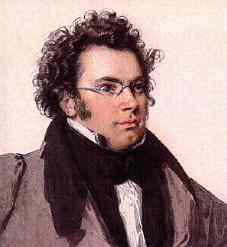
I was preparing Ave Maria for a church service and thought this info might be useful for other musicians. Franz Schubert’s “Ave Maria” was originally a prayer from a frightened girl and called “Ellen’s Song III” and not intended for liturgical services. However, the music was instantly inspirational to listeners, so Latin text was substituted in time to make it suitable for church services.
The original lyrics were in English, a poem called “Lady of the Lake” by Sir Walter Scott (1771-1832). The original English was translated into German by Adam Storck D 839 (Spring 1825) First Published in 1826 as Op. 52, No. 6. – It was the German words that Schubert used for his original. Later the Ellen’s Song III (Ave Maria as we know it today) had the latin text forced on it, which works ok in most parts, with a couple unnatural places. Like most of Schubert’s lieder (like Die Schonemullerin), this German lieder was originally scored for just piano and voice. ABOUT SCHUBERT’S AVE MARIA:
The Ave Maria was composed in about 1825 by Franz Schubert (1797-1828) when he was twenty-eight years old and filled with devotion to the Blessed Virgin Mary. It was written for voice and piano and first Published in 1826 as Op 52 no 6. The words most commonly used with Schubert’s music are not the words that the composer originally set to music. Franz Schubert actually wrote the music for an excerpt from the poem “The Lady of the Lake” by Sir Walter Scott (1771-1832), which was translated into German by Adam Storck. Schubert called his piece Ellens dritter Gesang (Ellen’s third song). In this particular excerpt from the poem the heroine, Ellen Douglas, is in hiding and prays to the Virgin Mary. A letter from Schubert to his father and step-mother refers to his music to Ave Maria:“My new songs from Scott’s Lady of the Lake especially had much success. They also wondered greatly at my piety, which I expressed in a hymn to the Holy Virgin and which, it appears, grips every soul and turns it to devotion.”
Ellens Gesang III (Ellen’s Song III [Ave Maria]) Sir Walter Scott (1771-1832)
Translated by Adam Storck D 839 (Spring 1825) First Published in 1826 as Op. 52, No. 6.
Storck’s translation as set by Schubert
&
Walter Scott’s Original from “The Lady of the Lake”
Ave Maria! Jungfrau mild,
Erhöre einer Jungfrau Flehen,
Aus diesem Felsen starr und wild
Soll mein Gebet zu dir hinwehen.
Wir schlafen sicher bis zum Morgen,
Ob Menschen noch so grausam sind.
O Jungfrau, sieh der Jungfrau Sorgen,
O Mutter, hör ein bittend Kind!
Ave Maria! Ave Maria! maiden mild!
Listen to a maiden’s prayer!
Thou canst hear though from the wild,
Thou canst save amid despair.
Safe may we sleep beneath thy care,
Though banish’d, outcast and reviled –
Maiden! hear a maiden’s prayer;
Mother, hear a suppliant child!
Ave Maria!
Ave Maria! Unbefleckt!
Wenn wir auf diesen Fels hinsinken
Zum Schlaf, und uns dein Schutz bedeckt
Wird weich der harte Fels uns dünken.
Du lächelst, Rosendüfte wehen
In dieser dumpfen Felsenkluft,
O Mutter, höre Kindes Flehen,
O Jungfrau, eine Jungfrau ruft!
Ave Maria! Ave Maria! undefiled!
The flinty couch we now must share
Shall seem this down of eider piled,
If thy protection hover there.
The murky cavern’s heavy air
Shall breathe of balm if thou hast smiled;
Then, Maiden! hear a maiden’s prayer;
Mother, list a suppliant child!
Ave Maria!
Ave Maria! Reine Magd!
Der Erde und der Luft Dämonen,
Von deines Auges Huld verjagt,
Sie können hier nicht bei uns wohnen,
Wir woll’n uns still dem Schicksal beugen,
Da uns dein heil’ger Trost anweht;
Der Jungfrau wolle hold dich neigen,
Dem Kind, das für den Vater fleht.
Ave Maria! Ave Maria! stainless styled!
Foul demons of the earth and air,
From this their wonted haunt exiled,
Shall flee before thy presence fair.
We bow us to our lot of care,
Beneath thy guidence reconciled;
Hear for a maid a maiden’s prayer,
And for a father hear a child!
Ave Maria!
The German text that Schubert set to music is not a perfect translation, but a fairly close one. The Lied may have first been performed at the home of Sophie Weissenwolff (1794-1847), who made it clear that she would like the dedication, and she received it. Countess Weissenwolff subsequently became known as “the lady of the lake.”
*****************
AVE MARIA LATIN TEXT
Ave Maria Prayer : The Latin text of the Ave Maria prayer
set to the music by Franz Schubert Ave Maria Gratia plena
LATIN TEXT FIRST VERSE:
Ave Maria, gratia plena, Dominus tecum;
benedicta tu in mulieribus,
et benedictus fructus ventris tui, Jesus [Christus].
Sancta Maria, Mater Dei,
ora pro nobis peccatoribus,
nunc et in hora mortis nostrae. Amen.
LATIN-ENGLISH TRANSLATION – 1st Verse
Ave Maria, gratia plena, Dominus tecum;
benedicta tu in mulieribus,
et benedictus fructus ventris tui, Jesus [Christus].
Sancta Maria, Mater Dei,
ora pro nobis peccatoribus,
nunc et in hora mortis nostrae. Amen.
***********************************
Hail Mary, full of grace, the Lord is with thee;
blessed art thou among women,
and blessed is the fruit of thy womb, Jesus [Christ].
Holy Mary, Mother of God,
pray for us sinners,
now and at the hour of our death. Amen.
Maria Gratia plena
Maria Gratia plena
Ave, ave dominus
Dominus tecum
Benedicta tu in mulieribus
Et benedictus
Et benedictus fructus ventris
Ventris tui Jesus
Ave Maria
Ave Maria Mater dei
Ora pro nobis pecatoribus
Ora, ora pro nobis
Ora ora pro nobis pecatoribus
Nunc et in hora mortis
In hora mortis, mortis nostrae
In hora mortis nostrae
Ave Maria!
*********************
Here is an introduction to the piece you might use in a church service:
In 1825 a young composer wrote a song called “Ellen’s Song Number Three”. The song was a prayer to Mary and so well received, the young composer wrote to his parents:
“My new songs…..especially had much success. They also wondered greatly at my piety, which I expressed in a hymn to the Holy Virgin and which, it appears, grips every soul and turns it to devotion.â€?
The composer died young at the age of 31. After his death Latin lyrics were replaced on the song for performance in a liturgical setting. The composer’s name was Franz Schubert, and “Ellen’s Song Number Three” is known to us today as “Ave Maria”.
The Latin translated reads as follows:
Hail Mary, full of grace, the Lord is with thee;
blessed art thou among women,
and blessed is the fruit of thy womb, Jesus [Christ].
Holy Mary, Mother of God,
pray for us sinners,
now and at the hour of our death. Amen.